Anyone using these? Good - Bad - Fair - Partly cloudy ??? Notably cyroCut - which seems to be their brand name for M2 steel tools.









A better test would be to have a handle that would allow me to swap in different steel for a truer comparison.
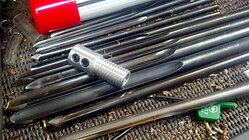
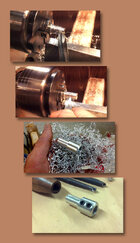
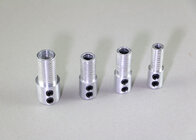
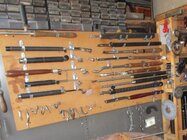
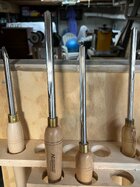
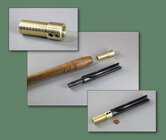
You may have seen this before but maybe some haven't. I have more tools without handles than with - make inserts like this, lets me store more tools in a smaller space than if they had handles. (Why so many identical tools? I can swap for a sharp one before stopping to set up the jig and sharpen the lot.)
View attachment 82890
Years ago I bought some inserts but I didn't like several things about them so I started making my own. (They are a LOT cheaper to make than to buy!)
These can be turned on the wood lathe with woodturning tools. For a club demo a few years ago I wrote a document on how to, brought some aluminum blanks. I know some who are still making them.
View attachment 82891
View attachment 82892
JKJ
Agreed, these tools go the heart of wood turning, daily use in a variety of wood and projects. OK they wont make you a better turner, but you will be less frustrated, no good battling technique, poor handles and lousy steel that wont hold an edge.I was going to start by saying there are no bad gouges but I rephrase to there are very few bad gouges (I reference that by a fellow woodturner who brought his Benjamin's Best gouges over because he couldn't get them to cut). The sparks didn't look right and when I ran a file across them it was taking metal off. I told him to send them back. But for me there is 3 categories good, better and best. and that is M2, M42 and 10V/15V. Now I use nothing but the best. When you go to buy your first or your next gouge check the prices between the three and I don't believe you will find a whole lot of difference between the prices of each category. My advice is spend a little extra and get better or best.
I like this idea although I dont have any at present , the insertion length always looks a bit short to me . I like atleast 75mm or 3". The double locking screws may make it a bit fiddly perhaps, but nothing comes loose with double screws.You may have seen this before but maybe some haven't. I have more tools without handles than with - make inserts like this, lets me store more tools in a smaller space than if they had handles. (Why so many identical tools? I can swap for a sharp one before stopping to set up the jig and sharpen the lot.)
View attachment 82890
Years ago I bought some inserts but I didn't like several things about them so I started making my own. (They are a LOT cheaper to make than to buy!)
These can be turned on the wood lathe with woodturning tools. For a club demo a few years ago I wrote a document on how to, brought some aluminum blanks. I know some who are still making them.
View attachment 82891
View attachment 82892
JKJ
I like this idea although I dont have any at present , the insertion length always looks a bit short to me . I like atleast 75mm or 3". The double locking screws may make it a bit fiddly perhaps, but nothing comes loose with double screws.
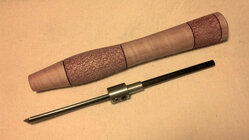
Lol, yes I turn a lot of hardwood and no doubt this effects my handles. But I take your point, its horses for courses. The idea of having handles with multiple tools is something I agree with and the only difference is my handles are foam covdered stainless tube. But yes I have and do the sameYou can easily make the insertion length anything you want. This length is just right for my use. Someone turning big wood with gusto might want something beefier.
I have also mentioned this before: I drill a deep smaller diameter hole down inside the handle for excess tool shaft. That way as the tool gets shorter from sharpening I can still keep the amount extended the same, to what I found works best for me. I dislike a LONG amount of the tool extended past the end of the handle.
View attachment 82909
For small diameter tools (eg. 1/4") I sometimes to make the inserts on the metal lathe from steel instead of aluminum. This lets me use smaller set screws with finer threads.
Large diameter tools (5/8" or so) get larger inserts. This one is from a brass rod I found at the scrap yard.
View attachment 82912
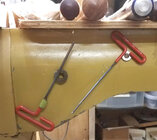
I keep T-handle hex keys stuck to my lathe with magnets so loosening/tightening the set screws is quick and easy.
View attachment 82911
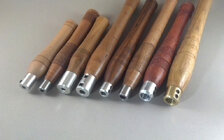
Some handles with inserts. (I didn't make but bought the third one from the left. I think the metal diameter is much too big for the 1/4" tool shaft. I made the other two on the left, the smaller one from steel lets me comfortably hold the handle close to the tool rest. I also think the fourth one from the left for a 3/8" tool is too big for comfort - both of those from the same person, they made them all from 1" round stock. It was after using these I decided to make my own.
View attachment 82913
Also, I'm a huge fan of short handles for detail work, especially on spindles.
BTW, I'm imagining securely tightening a keyless twist lock might depend somewhat on hand strength and fairly large diameter knurled parts. Set screws can be secured or removed with the T-handle-hex key held between thumb and forefinger. I do grind most set screws shorter to fit better in small inserts - hold them in a T-handle snd rotate against a grinding wheel.
Back on topic - many of my tools are Thompson and Hunter; these handles don't care what type or brand of tool they hold!
JKJ
and the only difference is my handles are foam covdered stainless tube.
on your wood lathe? You brave! I have a small metal lathe to make mine.You may have seen this before but maybe some haven't. I have more tools without handles than with - make inserts like this, lets me store more tools in a smaller space than if they had handles. (Why so many identical tools? I can swap for a sharp one before stopping to set up the jig and sharpen the lot.)
View attachment 82890
Years ago I bought some inserts but I didn't like several things about them so I started making my own. (They are a LOT cheaper to make than to buy!)
These can be turned on the wood lathe with woodturning tools. For a club demo a few years ago I wrote a document on how to, brought some aluminum blanks. I know some who are still making them.
View attachment 82891
View attachment 82892
JKJ
on your wood lathe? You brave! I have a small metal lathe to make mine.