• The forum upgrades have been completed. These were moderate security fixes from our software vendor and it looks like everything is working well. If you see any problems please post in the Forum Technical Support forum or email us at forum_moderator (at) aawforum.org. Thank you
  • February 2026 Turning Challenge: Cookie Jar! (click here for details)
  • Congratulations to Dean Center for "After Life" being selected as Turning of the Week for February 16, 2026 (click here for details)
  • AAW Symposium demonstrators announced - If the 2026 AAW International Woodturning Symposium is not on your calendar, now is the time to register. And there are discounts available if you sign up early, by Feb. 28. Early Bird pricing gives you the best rate for our 40th Anniversary Symposium in Raleigh, North Carolina, June 4–7, 2026. (There are discounts for AAW chapter members too) For more information vist the discussion thread here or the AAW registration page
  • Welcome new registering member. Your username must be your real First and Last name (for example: John Doe). "Screen names" and "handles" are not allowed and your registration will be deleted if you don't use your real name. Also, do not use all caps nor all lower case.

I know this will be controversial.....but, here goes....

Odie

Panning for Montana gold, with Betsy, the mule!
Joined
Dec 22, 2006
Messages
7,707
Likes
13,148
Location
Missoula, MT
I feel very lucky to have learned basic woodturning skills back in the early 1980's. Back then, there was no such thing as a swept back grind.....or, the Ellsworth grind, among other swept back grind shapes attributed to other turners. Back then, all new turners were taught the "traditional" gouge grind. The traditional gouge grind has probably been around for 100 years, and it's something you rarely see these days.....simply because the momentum of the woodturning herd has all but made it extinct.

In my opinion, the traditional grind (if shaped well) is a more versatile and can produce a finer cut in difficult places, than any of the swept back grinds.

For those who are unaware of the traditional gouge grind, it's produced using the "V-arm" of the Wolverine jig. The Wolverine makes it easy, but I suppose other turners have made their own simple jigs to produce this grind. It's not complicated, and because of that, it's also very easy to learn.

I suspect there will be a great pushback from the herd here, but this is because the traditional grind is seldom seen anymore.....virtually nobody is teaching it.....and very few turners are using it. Awareness of the traditional grind these days is practically non-existent, except for a few turners who have been turning for close to 40, or more years.

Just to be clear here, I first began using the swept back grind about 35 years ago, during a time when most turners were first learning this new approach to gouge grind shapes. I eventually was using the swept back grind exclusively. Back then, I transitioned from the traditional grind to the swept back grind......prior to transitioning back to the traditional grind about 20 years ago. When I transitioned back the traditional grind, it was after I had been turning for a couple decades.....so, at that time, I had some experience under my belt to evaluate the usefulness of the various grinds that were available and being taught.

Right now, I don't think I have a single gouge that still has a swept back shape.....and, that Vari-grind jig for the Wolverine is gathering dust! :)

=o=
 
Well, I guess it depends not only when but also where you started. I started turning in the early sixties in Sweden. All gouges were what the British call continental gouges i.e. forged from a flat steel and had a moderate swept back grind. There was no division in bowl gouges and spindle gouges. Looks very much like the spindle gouges I use today. For bowl gouges I today use the now common, milled from round HSS with a swept back grind.

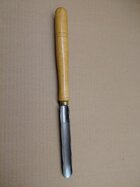
20260223_134024.jpg
 
I feel very lucky to have learned basic woodturning skills back in the early 1980's. Back then, there was no such thing as a swept back grind.....or, the Ellsworth grind, among other swept back grind shapes attributed to other turners. Back then, all new turners were taught the "traditional" gouge grind. The traditional gouge grind has probably been around for 100 years, and it's something you rarely see these days.....simply because the momentum of the woodturning herd has all but made it extinct.

In my opinion, the traditional grind (if shaped well) is a more versatile and can produce a finer cut in difficult places, than any of the swept back grinds.

For those who are unaware of the traditional gouge grind, it's produced using the "V-arm" of the Wolverine jig. The Wolverine makes it easy, but I suppose other turners have made their own simple jigs to produce this grind. It's not complicated, and because of that, it's also very easy to learn.

I suspect there will be a great pushback from the herd here, but this is because the traditional grind is seldom seen anymore.....virtually nobody is teaching it.....and very few turners are using it. Awareness of the traditional grind these days is practically non-existent, except for a few turners who have been turning for close to 40, or more years.

Just to be clear here, I first began using the swept back grind about 35 years ago, during a time when most turners were first learning this new approach to gouge grind shapes. I eventually was using the swept back grind exclusively. Back then, I transitioned from the traditional grind to the swept back grind......prior to transitioning back to the traditional grind about 20 years ago. When I transitioned back the traditional grind, it was after I had been turning for a couple decades.....so, at that time, I had some experience under my belt to evaluate the usefulness of the various grinds that were available and being taught.

Right now, I don't think I have a single gouge that still has a swept back shape.....and, that Vari-grind jig for the Wolverine is gathering dust! :)

=o=
Here's the thing I wonder... any really decent videos on actually doing and using that grind? Most every turner and YouTube video I've watched uses vari-grind jig for sharpening and swears by the swept back grind, but to my recollection I have yet to watch a decent youtube on that traditional grind and its use... so now I wonder if that might be "my" solution , since I'm basically self taught from watching turning videos on Youtube, I don't think I have ever even tried the traditional grind....
 
Here's the thing I wonder... any really decent videos on actually doing and using that grind? Most every turner and YouTube video I've watched uses vari-grind jig for sharpening and swears by the swept back grind, but to my recollection I have yet to watch a decent youtube on that traditional grind and its use... so now I wonder if that might be "my" solution , since I'm basically self taught from watching turning videos on Youtube, I don't think I have ever even tried the traditional grind....

I am not aware of any current instruction on the traditional grind. In my thinking, the transition from TG to SBG has been universal and complete. This transition occurred during a time in the early 90's when most turners didn't have computers yet, and I remember the furious transition, where most all woodturners considered the new swept back grind an industry wide innovation.....Including me! When I made the transition, I had been turning for 10 years, or so, and as I look back now, I consider myself not a particularly good turner back then.....even though I thought I was a better turner then, than I do now with my hindsight.

I remember sometime about 20 years ago, I had seen someone's compilation of all the different grinds with photos right here on the AAW forums. It was a well-done reference.......but the traditional grind was completely absent! I commented on this at the time, but the woodturning community was on a fast-track with the thinking that the only grinds that had any value to the woodturning community, are the swept back grinds.

Howdy Odie, Interesting thoughts on the type of grind. I am wondering if you could take a photo or three of the "traditional grind" to share with us?

I believe I have some photos comparing the two types of grinds.....I'll look, but I have many hundreds of woodturning photos that are not very well organized----->Unfortunately, it's one of those "round tuits" that I've never had! :(

=o=
 
Back
Top