I’m new - what’s a BOB tool?When some one mentions the "traditional" grind, I think of one where the bevel runs straight across the bottom of the gouge, pretty much no sweep to the bevel at all. Other than that, I don't know. I can't think of how that could be done with the Wolverine set up. As for swept back gouges, not sure how far back they go, but a long time. I haven't used one since I learned platform sharpening, and that may go back 15 years or so. The swept back design is kind of a jack of all trades, but also, a master of none. I use the 40/40 and a variety of BOB tools.
robo hippy

-
March 2026 Turning Challenge: Olla! (click here for details) -
Congratulations to David Wyke, People's Choice in the February 2026 Turning Challenge (click here for details) -
Congratulations to Michael Nathal for "Eroded Wheel" being selected as Turning of the Week for March 23, 2026 (click here for details) -
Welcome new registering member. Your username must be your real First and Last name (for example: John Doe). "Screen names" and "handles" are not allowed and your registration will be deleted if you don't use your real name. Also, do not use all caps nor all lower case.
You are using an out of date browser. It may not display this or other websites correctly.
You should upgrade or use an alternative browser.
You should upgrade or use an alternative browser.
I know this will be controversial.....but, here goes....
- Thread starter Odie
- Start date
BOB tools are specialized for "bottom of bowl". I may have coined the phrase. There are several "bottom feeders: which I thought was a signature tool, and BOB is easier to write out....
As for the 40/40 grind, I prefer it for my finish cuts. On the outside of the bowl, it is all I ever use. On the inside, I use a smaller gouge, but the same grind, and one of a number of BOB tool grinds, but my favorite is a spindle detail gouge which is excellent for rolling on its side for a very high shear angle which makes for a cleaner cut. I am not sure what is meant by "classic grind". I guess it is kind of like "fingernail" grind, and I have short stubby fingernails, and some have long fingernails..... Will we ever get "standardized"? Do we need to?
robo hippy
As for the 40/40 grind, I prefer it for my finish cuts. On the outside of the bowl, it is all I ever use. On the inside, I use a smaller gouge, but the same grind, and one of a number of BOB tool grinds, but my favorite is a spindle detail gouge which is excellent for rolling on its side for a very high shear angle which makes for a cleaner cut. I am not sure what is meant by "classic grind". I guess it is kind of like "fingernail" grind, and I have short stubby fingernails, and some have long fingernails..... Will we ever get "standardized"? Do we need to?
robo hippy
The "Bottom Feeder" is Mahoney's term, I think. I have his Carter & Son "Bottom Feeder" gouge that I use on the inside bottom of my bowls. I'd heard them called BBGs or just "Bottom Bowl Gouges" in the past too, but I like BOB!BOB tools are specialized for "bottom of bowl". I may have coined the phrase. There are several "bottom feeders: which I thought was a signature tool, and BOB is easier to write out....
As for the 40/40 grind, I prefer it for my finish cuts. On the outside of the bowl, it is all I ever use. On the inside, I use a smaller gouge, but the same grind, and one of a number of BOB tool grinds, but my favorite is a spindle detail gouge which is excellent for rolling on its side for a very high shear angle which makes for a cleaner cut. I am not sure what is meant by "classic grind". I guess it is kind of like "fingernail" grind, and I have short stubby fingernails, and some have long fingernails..... Will we ever get "standardized"? Do we need to?
robo hippy

- Joined
- Apr 27, 2004
- Messages
- 9,327
- Likes
- 6,141
- Location
- Lakeland, Florida
- Website
- www.hockenberywoodturning.com
what’s a BOB tool?
When hollowing a bowl with a bevel riding cut some grinds will be limited to a depth when the tool hits the rim.
On bowls much deeper than wide most bowl gouges regardless of grind will hit the rim before hollowing to the bottom ( Bob will hit tge rim on many of these bowls.
The bevel angle limits and bowl shape limit how far down the internal curve a gouge can go before hitting the rim with the tool.
An Ellsworth grind with the heel ground off can hollow rim to bottom center of most open bowls that are wider than deep.
I like using a 40/40 on platters. Here I want to do a push cut.
On bowls I prefer the Ellsworth. A pull cut on the outside gives a better surface than the 40/40. Hollowing the Ellsworth gives as nice a surf as the 40/40. On NE bowls the Ellsworth is a much better choice for me than the 40/40.
Mike Mahoney does have a "signature" line of tools that are made by Carter and Son tools.
robo hippy
robo hippy

Why don´t you use a ring tool or what I like to call an angled gouge? Shop made from a ball bearing ring. I have never understood the bottom feeder or bottom bowl gouge. Why make a particularly blunt tool, high cutting angle, when there is no need to?
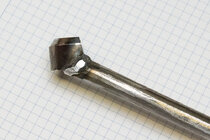
Why don´t you use a ring tool or what I like to call an angled gouge? Shop made from a ball bearing ring. I have never understood the bottom feeder or bottom bowl gouge. Why make a particularly blunt tool, high cutting angle, when there is no need to?
View attachment 86274
Have you used one? In my experience, using the bottom feeder is far easier and produces cleaner cuts on the bottom range of the inside of a bowl than any other gouge.
Yes, my standard in all deep bowls.Have you used one? In my experience, using the bottom feeder is far easier and produces cleaner cuts on the bottom range of the inside of a bowl than any other gouge.standard
The only common thing to the different BOB tools, for me, is that they all have a 65 degree bevel, and a ) shape nose. The advantage is that you can roll it up very steep so you get a nice high shear angle. I do bowls of all sizes and shapes, some deeper, and some shallower. For the shallow bowls/plates/platters, I go with the 40/40 grind. For deeper ones, one of my many BOB tools, but the favorite is a spindle detail gouge.
robo hippy
robo hippy
The only common thing to the different BOB tools, for me, is that they all have a 65 degree bevel, and a ) shape nose. The advantage is that you can roll it up very steep so you get a nice high shear angle. I do bowls of all sizes and shapes, some deeper, and some shallower. For the shallow bowls/plates/platters, I go with the 40/40 grind. For deeper ones, one of my many BOB tools, but the favorite is a spindle detail gouge.
robo hippy
Curious about the spindle detail gouge... It may just be because of how mine is designed (most of my tools are Carter & Son), but it is a very narrow, pointy tool, and I don't think I could use it on the bottom of a bowl.
When intended for spindle detail work, yes, it tends to be long and pointy. When used as a BOB tool, the nose profile, the nose is ) shaped and angle is 65 degrees. So, a pointy one never as a BOB tool. I converted an old Oneway detail gouge for mine. I have the Thompson fluteless gouges, and even an old Craft Supplies half round flute with the same profile. I go to the Oneway most of the time.
robo hippy
robo hippy
I see. So shallow u-shape, rounded...its mostly the angle your interested in.When intended for spindle detail work, yes, it tends to be long and pointy. When used as a BOB tool, the nose profile, the nose is ) shaped and angle is 65 degrees. So, a pointy one never as a BOB tool. I converted an old Oneway detail gouge for mine. I have the Thompson fluteless gouges, and even an old Craft Supplies half round flute with the same profile. I go to the Oneway most of the time.
robo hippy

Odie
Panning for Montana gold, with Betsy, the mule!
That would be an interesting one to see in action!Why don´t you use a ring tool or what I like to call an angled gouge? Shop made from a ball bearing ring. I have never understood the bottom feeder or bottom bowl gouge. Why make a particularly blunt tool, high cutting angle, when there is no need to?
View attachment 86274

=o=
Odie
Panning for Montana gold, with Betsy, the mule!
Of course, Bill.......
That's why I put this thread in the "getting started" forum.
I know very well that seasoned turners like you are already set in their ways, and difficult to influence.
The newbies are much more open minded about things that are not a part of "herd think", and so firmly established.
Even so, I think there might be a few seasoned turners who will consider trying the traditional grind.
=o=
Just wondering if anyone at all has at least tried the traditional grind...???
I can tell you this......the original traditional grind is the easiest, most simple method of producing a useful gouge shape for bowl turning.
Woodturning doesn't have to be complicated.....it just has to be practiced until competence is achieved. Evaluation of the immense amount of gouge shapes and the equipment necessary to produce them, is a very confusing aspect for a newbie. I'll have to admit that when I began bowl turning in 1982, I didn't have to deal with the plethora of methods phenomena we are currently experiencing within the woodturning community.
I have a feeling that some of you newbies are overwhelmed by all the different gouge grind shapes and uses. I suspect that some of the seasoned turners who are using gouge grinds that are produced by either a platform, or any of the Ellsworth inspired methods that are so popular....that they have not yet experienced this very simple method of producing a very useful gouge grind.
=o=
Last edited:
I use mine every time I turn a bowl. Mine has a 40 degree bevel. Only thing I do different than you is I use the oneway wolverine jig to do mine and I round the heel off. I might try sharpening it with the jig you have to see how that works.
Odie, I am newer (started turning in 2020), and I use a 40/40 grind most of the time for the outside and upper inside of my bowls. That said, I learned that from Stuart Batty, and I am not sure if it is the same as the "original traditional" grind. I asked earlier in the thread if there was a difference. I would love to try out the traditional grind if it is different than the 40/40, which involves a specific grinding technique on a flat grinding platform. How do you grind the traditional grind? What are the angles? Nose profile? You picture your gouge just sitting in the pocket there...is that how you actually grind?Just wondering if anyone at all has at least tried the traditional grind...???
I can tell you this......the original traditional grind is the easiest, most simple method of producing a useful gouge shape for bowl turning.
Woodturning doesn't have to be complicated.....it just has to be practiced until competence is achieved. Evaluation of the immense amount of gouge shapes and the equipment necessary to produce them, is a very confusing aspect for a newbie. I'll have to admit that when I began bowl turning in 1982, I didn't have to deal with the plethora of methods phenomena we are currently experiencing within the woodturning community.
I have a feeling that some of you newbies are overwhelmed by all the different gouge grind shapes and uses. I suspect that some of the seasoned turners who are using gouge grinds that are produced by either a platform, or any of the Ellsworth inspired methods that are so popular....that they have not yet experienced this very simple method of producing a very useful gouge grind.
=o=
View attachment 86572
Nose profile is something I've been noticing lately, that I seem to be allowing to drift across grind sessions. My most used gouges originally had rounder nose profiles, and over time I think I ended up making them pointier. This was the case for both my standard spindle gouges and a couple of my bowl gouges. I've been working on restoring a more rounded profile. I think there is also a matter of "depth"...not sure if there is an official term for this, but I'm referring to the distance between the upper part of the wings, and the tip of the cutting edge. I also seemed to be allowing that distance to grow over time. So I've been trying to reign these things in. I am not sure if it is just the angles I'm grinding at (I have almost all Carter & Son tools, and I use their pamphlet as well as the angle setting jigs they recommend, to set the exact angles they recommend), or if it is a matter of skill and technique with grinding. I think it is mostly the latter in my case, so I'm trying to work on that.
I don't necessarily want a complicated grind...and grinding the 40/40 is more complicated as it only relies on a platform, and there is a specific technique to grinding the wings vs. the nose, there has to be a specific transition from nose to wing profile, wings have to be strait, etc. Now, I do this because the 40/40 grind helped me nearly eliminate tearout entirely, and if it occurs, its rare and light. I've never been able to get an "irish" grind (ellseworth or any other) to work as well. It also seems like the 40/40 moves rather effortlessly through the wood, which again is not something I've ever experienced with the irish grinds. It may just be technique, and mine may just suck.
 But I've tried, for years, and when I went back to the 40/40 (last year I think, about this time last year) the difference was so huge...it made turning bowls so much easier.
I'd love to give traditional grind a try. I just don't know exactly what that means, or how its ground.
Odie
Panning for Montana gold, with Betsy, the mule!
Odie, I am newer (started turning in 2020), and I use a 40/40 grind most of the time for the outside and upper inside of my bowls. That said, I learned that from Stuart Batty, and I am not sure if it is the same as the "original traditional" grind. I asked earlier in the thread if there was a difference. I would love to try out the traditional grind if it is different than the 40/40, which involves a specific grinding technique on a flat grinding platform. How do you grind the traditional grind? What are the angles? Nose profile? You picture your gouge just sitting in the pocket there...is that how you actually grind?
Nose profile is something I've been noticing lately, that I seem to be allowing to drift across grind sessions. My most used gouges originally had rounder nose profiles, and over time I think I ended up making them pointier. This was the case for both my standard spindle gouges and a couple of my bowl gouges. I've been working on restoring a more rounded profile. I think there is also a matter of "depth"...not sure if there is an official term for this, but I'm referring to the distance between the upper part of the wings, and the tip of the cutting edge. I also seemed to be allowing that distance to grow over time. So I've been trying to reign these things in. I am not sure if it is just the angles I'm grinding at (I have almost all Carter & Son tools, and I use their pamphlet as well as the angle setting jigs they recommend, to set the exact angles they recommend), or if it is a matter of skill and technique with grinding. I think it is mostly the latter in my case, so I'm trying to work on that.
I don't necessarily want a complicated grind...and grinding the 40/40 is more complicated as it only relies on a platform, and there is a specific technique to grinding the wings vs. the nose, there has to be a specific transition from nose to wing profile, wings have to be strait, etc. Now, I do this because the 40/40 grind helped me nearly eliminate tearout entirely, and if it occurs, its rare and light. I've never been able to get an "irish" grind (ellseworth or any other) to work as well. It also seems like the 40/40 moves rather effortlessly through the wood, which again is not something I've ever experienced with the irish grinds. It may just be technique, and mine may just suck.
I'd love to give traditional grind a try. I just don't know exactly what that means, or how its ground.
Howdy Jon......so glad you posted!
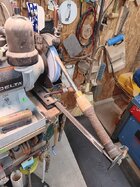
The traditional grind is very different than the 40/40 grind, in that it doesn't have two distinctly different ground surfaces. You could easily put a second bevel on the traditional grind, but I've never felt a need for it. The main purpose of the second bevel is for clearance. When "turning the corner" is about halfway through the arc, I have come to use standard scrapers and then graduate to negative rake NR scrapers when I'm getting close to the final sand-able surface.
On a standard grind (SG), it's easy to lengthen or shorten the bevel slightly, and the tip can be made more round or pointy.....this is all up to your individual preferences and acquired skill level......but, I feel anyone can do it with a minimum of practice. Just like with the platform, the SG does take some practice to form your wings and tip to your liking. Once you get the grind you want, it's very easy to maintain it for as long as you want.
OK, you've seen the photo in post #54. All you do is rotate the tool on its longitudinal axis. For the initial grind, it might take a while to get exactly what you want, but it's very easy to touch it up quickly after that.
It shall be noted here that I use a diamond hone to touch up the edge frequently, and this is done about 5 times +/- before I need to return to the grinder.
Thanks for responding....
=o=