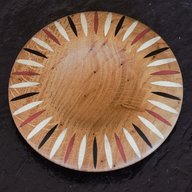
• December 2025 Turning Challenge: Single Tree! (click here for details)
  • Congratulations to Bob Henrickson, People's Choice in the November 2025 Turning Challenge (click here for details)
  • Congratulations to John Dillon for "Chinquapin Oak" being selected as Turning of the Week for December 22, 2025 (click here for details)
  • Welcome new registering member. Your username must be your real First and Last name (for example: John Doe). "Screen names" and "handles" are not allowed and your registration will be deleted if you don't use your real name. Also, do not use all caps nor all lower case.

I need some education on sanding and finishing

Joined
Jan 20, 2011
Messages
934
Likes
1,119
Location
Traverse City, MI
I'm hoping to generate some useful discussion here. After 20+ years, I've improved somewhat at the turning part, but I'll admit, I'm still learning. There's lots of info on turning, but the sanding and finishing of pieces doesn't seem to get as much attention. I feel like I'm still experimenting a lot more than I should be. You'd think I would've nailed down more of it by now.

I can usually do well with dry pieces. The sanding and finishing is a bit more straightforward. My biggest issues come with pieces from fresh wood. I know trying to sand soggy wet wood doesn't work well. It clogs the paper (Abranet works much better) and smears/blends the colors. I try to at least wait for the surface to "dry" before trying to sand, but I still have issues with heavy contrast wood like walnut that has both sap and heart woods, or bark on sapwood. Spalted woods like maple or beech also give me problems. Even dry, the black spalt lines can smear into the surrounding wood and give a muddy appearance. Is sanding sealer the solution for these situations? I have tried wet sanding under running water, but that's not much fun and feels slow going, but was sort of successful.

I know sanding sealer can make endgrain less dark by limiting the penetration of finish, but are there downsides to using it? From my limited use/experience, it seems like it can make the final finish less rich looking. I'm lost on when to use, or not use sanding sealer.

Is it normal that the time spent on finishing is multiples of the actual turning time?

Are there some useful books, videos, etc. that you could suggest for improving my finishing process?
 
Book- Understanding Wood Finishing, by Bob Flexner. It's out as a third edition, available just about everywhere. Flexner passed away not long ago...

Generally, wet wood needs to be dry to accept finishes, and even for successful sanding. The book above probably won't address wet wood, not that I recall. (Drying wet wood is a subject all to itself, with plenty of past discussions on the topic.) Putting finishes on wet wood will stunt the drying process of the wood, and prevent proper finish curing. For turners, this is the main rationale with rough turning wet wood, and then finish turning some period of time later- weeks, months, even years depending on thickness.

I hope this helps shed some light. Buy that book, it really is the science and how-to of finishing.

(Edit, Flexner also wrote articles for Popular Woodworking magazine. You can see his articles if you register at their website. But still buy the book.)
 
Last edited:
Book- Understanding Wood Finishing, by Bob Flexner. It's out as a third edition, available just about everywhere. Flexner passed away not long ago...

Generally, wet wood needs to be dry to accept finishes, and even for successful sanding.

I second that recommendation. I see I bought that book 10 years ago, 2015.
I can't imagine me sanding or applying finish to wet wood.

JKJ
 
I spent an afternoon with Mike Mahoney a few years ago. He was turning his natural edge nested bowl sets. They were finished green. He was power sanding them with velcro sanding pads. The wet wood kept clogging his sandpaper, so he had a piece of rubber looking stuff hot glued to the headstock of his lathe. He said it was a cleaning stick that is sold for cleaning belt and disc sander paper. I asked him how well it works. He said it works alright, but a brass brush works even better.
 
For some pieces, the end result is better if the sanding is done while the wood is still somewhat wet. As it shrinks and dries, the structure of the wood becomes a wonderful natural texture. Crotch wood gets an almost ripped muscular look and feel, while burl figure gets a sort of antique leather appearance.
 
Book- Understanding Wood Finishing, by Bob Flexner. It's out as a third edition, available just about everywhere. Flexner passed away not long ago...

Generally, wet wood needs to be dry to accept finishes, and even for successful sanding. The book above probably won't address wet wood, not that I recall. (Drying wet wood is a subject all to itself, with plenty of past discussions on the topic.) Putting finishes on wet wood will stunt the drying process, and prevent proper finish curing. For turners, this is the main rationale with rough turning wet wood, and then finish turning some period of time later- weeks, months, even years depending on thickness.

I hope this helps shed some light. Buy that book, it really is the science and how-to of finishing.

(Edit, Flexner also wrote articles for Popular Woodworking magazine. You can see his articles if you register at their website. But still buy the book.)

I don't know about the book, but some of Steve's commentary here is some of the best information to be found in this thread....

=o=
 
I second that recommendation. I see I bought that book 10 years ago, 2015.
I can't imagine me sanding or applying finish to wet wood.

JKJ
I third that recommendation. But also to answer your question of "Is it normal that the time spent on finishing is multiples of the actual turning time?" not necessarily "normal" but certainly not uncommon. Some woods finish beautifully and easily (mesquite), others (walnut) are difficult.
 
I spent an afternoon with Mike Mahoney a few years ago. He was turning his natural edge nested bowl sets. They were finished green. He was power sanding them with velcro sanding pads. The wet wood kept clogging his sandpaper, so he had a piece of rubber looking stuff hot glued to the headstock of his lathe. He said it was a cleaning stick that is sold for cleaning belt and disc sander paper. I asked him how well it works. He said it works alright, but a brass brush works even better.
yes I have a brass wire brush
 
For some pieces, the end result is better if the sanding is done while the wood is still somewhat wet. As it shrinks and dries, the structure of the wood becomes a wonderful natural texture. Crotch wood gets an almost ripped muscular look and feel, while burl figure gets a sort of antique leather appearance.
Yes, I do that often because I only turn green wood. The trick is timing. You have to sand it when the outer surface has dried enough to sand without sandpaper clogging up. The center of the wood wall thickness is still pretty wet. At this stage the vessel is not too much out of shape, running pretty true. Wait any longer and the vessel will have considerable movement, distortion and not run true round on the lathe. Sanding after it dries will have a nice smooth surface. Sanding when partly wet will result in the surface you describe with ripples in the surface from the shrinkage of drying. Crotches or burl woods can have a fantastic surface texture from drying. The magic of mother nature showing off her beauty. The timing from finish turning to sandability is short and variable depending on the wood variety and wall thickness. Thin walls will get there in a matter an hour or to thicker vessels can take overnight. This is another reason to have uniform wall thicknesses. The entire vessel dries out at the same pace that way.
 
Make that a fourth recommendation for Flexner’s book.

I bought the first edition decades ago and read it cover to cover twice as I recall. After giving this away to someone I bought the third edition and read it cover to cover again. BEST finishing book of several I’ve owned, and the only one I’ve read several times. Easy to read, well organized, and very informative.
 
You've had a lot of great responses on your post. I will add/agree with several; yes, I can spend 2-3 times longer in the sanding/finishing process compared to the time spent turning. Regardless of whether I am twice turning or turning once to final thinness.

When I'm turning and sanding bowls, 90% of them will be twice turned, because they are intended for functional use. Warped or tippy bowls are not popular for holding salads, fruit, popcorn, etc. My finish turning will take roughly 20-30 minutes. My sanding will take roughly 45-90 minutes, depending on the wood species. Once turned bowls or vessels, I use compressed air to blow as much moisture out of the piece, then bag it in paper for a few days. Within a week, it's ready to sand.

I can usually begin sanding at 180. I try to get as smooth a cut off the tool as possible. Shear cutting with a freshly sharpened bowl gouge on the exterior, and a negative rake scraper on the interior. My sanding always begins with the interior first. The 180 is done with a corded drill and hook and loop abrasives. I always used compressed air to blow away debris after each grit. After the 180 corded drill, I switch to a pneumatic random orbit air sander (I use Grex) and repeat 180 with a fresh abrasive.

This is where it becomes time consuming. If you are using a pneumatic random orbital sander, you can't use the lathe under power to 'assist'. That's because the orbit will begin the match the rotation of the lathe's speed. And as you get closer to the bottom of your bow, you will begin to see a familiar pattern if you were a child in the 1960's and 70's and had a Spirograph. So, I move the piece by hand, back and forth as I sand. I will go through the grits up to 600 and always raise the grain at least twice - most often when switching the 180 corded to pneumatic, and at 320 or 400.

I reverse chuck using a vacuum chuck, clean up or turn away the tenon, and sand the exterior, using the same process as above. I will often use fresh abrasives on the exterior, applying the principle "use sandpaper like someone else is paying for it." Sometimes, I will use mineral spirits after 220 (on both interior and exterior) to simulate a finish. I will unthread the chuck from the spindle and step to a window, or outside and examine the surface in sunlight. This step will help me determine whether I have successfully removed the deep scratches from the lower grits. The mineral spirits will dissipate within 10 minutes or less, and this saves me the headache that turners have when they see scratches ONLY after the finish goes on.

Speaking of finishes, note, that I did not apply any finishes on my bowl while still on the lathe. My finish is home-made, based on the finish recommended and used by Alan Lacer: 1/3 boiled linseed oil, 1/3 high quality varnish; 1/3 mineral spirits to thin those other two -- which have the viscosity of Karo syrup. After using a woodburner and handpiece to sign the bottom of the bowl, it goes into my finish room. I liberally apply a coat of that pre-mixed concoction and place it on a used bandsaw blade that is cut about 8" in length and bent at a 45-degree angle. That lifts the bowl off the surface and has only 2 or 3 'points' of the blade that contacts the bowl. I leave that bowl alone for an hour, allowing it to soak in - and with the first coat, it will soak in. After an hour, I recoat and then wipe it 'dry' with several paper towels. I leave it alone for at least 24 hours. In higher humidity months, it's sometimes 36 hours. Then I scuff the bowl with 4/0 steel wool (not the stuff in plastic bags from the big box store). I use Behlen's, or Liberon, carried at Rockler or Woodcraft. This step will remove any dust or debris that might have been in the air and settled on the bowl while drying. Use compressed air to blow away the 'dust', and repeat that liberal application, etc. I do this for 5-7 days. Then let the finish cure for 30 days. Use the Beale Buffing system (tripoli, white diamond - but never on walnut - and finish with carnauba wax.

Lot of work.... Why go to that much trouble?...you might ask. First, was my experience in using the film finishes - these are the finishes that are marketed as woodturner's finishes. These sit on the surface. Again, my experience, was that anything that was quick and easy to apply lasted only that long. In the early stages, I used the salad bowl finishes, minwax poly blends, and discovered that they lasted only through 3-4 washings.

My market in NH is selling through a venue (The League of NH Craftsmen) that customers are not expected to maintain or re-apply the finish after a few uses. In 2005, I pulled two 9" bowls from my inventory at the end of the selling season and brought them into the house for regular use. I wanted to know how well that finish held up. Dave and I used them with salad dressing, metal utensils, popcorn, chips, grapes, anything. That finish held up for at least 12 years. And one of those bowls was always in my booth to show a potential customer what 'their bowl' could look like after a decade of use. It always closed the sale.

Now I understand that most turners won't go through all that I do in making a utilitarian bowl. And that's fine. But it's important to me, because my name is on that. And I have customers, who when my work is delivered to the gallery, are notified by staff, and they sell. And No, I do not undercut or bypass the gallery. I don't have a gallery in my studio. If they want my work, buy it directly from me at a show, or buy it from the gallery.
 
One trick when turning wet when it is time to sand:

Use friction to try out the top few fractions of an inch of wood. Use the back of sandpaper, or pieces of brown paper bag, propane torch from a distance... Get the piece HUMMING on the lathe and use whatever smooth material you can to build up heat on the piece, without burnishing.

Heat/friction are your friends! Sand down. If the wood starts getting wet, repeat.

--Scott
 
Back
Top