Does anyone know where the lak sticks that are different colors that india woodturners apply to there turned work and then smooth out and get a high gloss finish can be purchased. I believe they call the lak sticks battis and the palm stick is called rangatha and then they use ground nut oil to complete the piece. I have looked every where for those color sticks and cant seem to find any. Any help to locate or get me on right path will be much appreciated listed.

-
April 2026 Turning Challenge: Salad Bowl! (click here for details) -
Congratulations to David Bartell, People's Choice in the March 2026 Turning Challenge (click here for details) -
Congratulations to Ted Pelfrey for "Cherry Blossoms on Cherry" being selected as Turning of the Week for April 27, 2026 (click here for details) -
Welcome new registering member. Your username must be your real First and Last name (for example: John Doe). "Screen names" and "handles" are not allowed and your registration will be deleted if you don't use your real name. Also, do not use all caps nor all lower case.
You are using an out of date browser. It may not display this or other websites correctly.
You should upgrade or use an alternative browser.
You should upgrade or use an alternative browser.
India and Pakistan finish
- Thread starter Lancer Gooding
- Start date

- Joined
- Feb 28, 2021
- Messages
- 1,822
- Likes
- 1,634
- Location
- Roulette, PA
- Website
- www.reallyruralwoodworks.com
Lac sticks? I'd wonder if it is not simply Shellac, in which case, might be as simple as getting yourself some shellac flakes , mix em in alcohol just enough to dampen them and mold them into your sticks, problem solved? Shellac can come in various colors naturally, as well as I believe you can mix in colored dyes to give them a particular tint...

They do sell shellac sticks, might be what you are looking for.

- Joined
- Feb 6, 2010
- Messages
- 3,532
- Likes
- 2,606
- Location
- Brandon, MS
- Website
- threeringswoodshop.square.site
I think that lacquer sticks are what they use to repair furniture finishes.
Lacquer Sticks
Lacquer Sticks

Shellac.net sells button lac, get yourself some bulk turmeric on Amazon and you are good to go. Doubt what you see them making in the video, for their own use, is available for purchase.
Lots of different colored spices for different colors, (flavors ).
).
Lots of different colored spices for different colors, (flavors
).
Last edited:

- Joined
- Jan 27, 2005
- Messages
- 13,244
- Likes
- 5,883
- Location
- Dalworthington Gardens, TX
- Website
- pbase.com
You can use Chestnut dyes. I apply the dye to bare wood for best chatoyance and topcoat with spray lacquer.

I have been interested, too. Here is some good info: https://blog.indicinspirations.com/channapatna-wooden-toys-for-kids/Does anyone know where the lak sticks that are different colors that india woodturners apply to there turned work and then smooth out and get a high gloss finish can be purchased. I believe they call the lak sticks battis and the palm stick is called rangatha and then they use ground nut oil to complete the piece. I have looked every where for those color sticks and cant seem to find any. Any help to locate or get me on right path will be much appreciated listed.
- Joined
- Feb 6, 2010
- Messages
- 3,532
- Likes
- 2,606
- Location
- Brandon, MS
- Website
- threeringswoodshop.square.site
Found this online a pretty easy Google search
Lacquer Sticks
Lacquer Sticks
Interesting. Because of the last statement's indication of a short product usability life (quoted below), I doubt we'd ever see lac sticks (a shellac product, not lacquer) available to purchase on the international market. But Lancer's video above shows the manufacturing process. Looks simple enough.I have been interested, too. Here is some good info: https://blog.indicinspirations.com/channapatna-wooden-toys-for-kids/
"Preparation of lac-sticks -Lac sticks are created by mixing lac (Shellac) -a non-toxic 100% natural resin and natural dyes/ colours. Shelac is the secretion of a tiny insect which is found on certain trees. It has been used in India since ancient time. Lac is heated directly on charcoal fire. Once it melts dye (extracted from naturally available sources like plants, trees or minerals) is added. It is then thoroughly mixed. kneaded and made into long rods and made into small lac sticks. Red colour sticks are made mixing kumkum powder with lac. Yellow colour sticks are made mixing turmeric with lac. Green colour sticks are made indigo and tumeric.
These sticks cannot be preserved long and must be used within a month. Thereafter the lac becomes hard and is rendered unfit."
Last edited:
These sticks cannot be preserved long and must be used within a month. Thereafter the lac becomes hard and is rendered unfit."
Speculation:
Since the lac sticks appear to be colored shellac, and ethanol alcohol is the preferred solvent, perhaps the lifetime limit is due to the stick becoming hard as the alcohol slowly evaporates. The video shows a metal bowl with a clear liquid the person adds to the mixture; perhaps that’s the alcohol. Perhaps the life of the sticks could be extended by storing them in a tight glass container with a bit of alcohol in the bottom.
Since rubbing the lac sticks on the wood appears to be a method of applying friction polish. This was documented in an article by an English explorer in India in the 1600’s who watched a craftsman turn “household items” then apply lac bug secretions to the spinning wood with friction. I suspect color in some form (dye? pigment?) could be added to today’s off-the-shelf friction polish such as the shellac-based Mylands. However, that stuff goes on pretty thin and requires multiple coats to get the “high build” advertised on the can’s label.
I’ve applied Mylands friction polish over color on the wood but I don’t remember what I eventually did to prevent color bleeding from the heat and the alcohol - I might have used pigment-based colored india ink, wonderful stuff.
JKJ
I think I need to clarify- it's their claim, not mine. I just added the bold font as part of the quote.Speculation:
Since the lac sticks appear to be colored shellac, and ethanol alcohol is the preferred solvent, perhaps the lifetime limit is due to the stick becoming hard as the alcohol slowly evaporates. The video shows a metal bowl with a clear liquid the person adds to the mixture; perhaps that’s the alcohol. Perhaps the life of the sticks could be extended by storing them in a tight glass container with a bit of alcohol in the bottom.
Since rubbing the lac sticks on the wood appears to be a method of applying friction polish. This was documented in an article by an English explorer in India in the 1600’s who watched a craftsman turn “household items” then apply lac bug secretions to the spinning wood with friction. I suspect color in some form (dye? pigment?) could be added to today’s off-the-shelf friction polish such as the shellac-based Mylands. However, that stuff goes on pretty thin and requires multiple coats to get the “high build” advertised on the can’s label.
I’ve applied Mylands friction polish over color on the wood but I don’t remember what I eventually did to prevent color bleeding from the heat and the alcohol - I might have used pigment-based colored india ink, wonderful stuff.
JKJ
I have tried this and I must not be doing something right cause it never comes out right. But I'll keep trying and if and when I get it solved I will let everyone know. And if someone else figures it out before I do please post on how you did it. Thanks.Interesting. Because of the last statement's indication of a short product usability life (quoted below), I doubt we'd ever see lac sticks (a shellac product, not lacquer) available to purchase on the international market. But Lancer's video above shows the manufacturing process. Looks simple enough.
"Preparation of lac-sticks -Lac sticks are created by mixing lac (Shellac) -a non-toxic 100% natural resin and natural dyes/ colours. Shelac is the secretion of a tiny insect which is found on certain trees. It has been used in India since ancient time. Lac is heated directly on charcoal fire. Once it melts dye (extracted from naturally available sources like plants, trees or minerals) is added. It is then thoroughly mixed. kneaded and made into long rods and made into small lac sticks. Red colour sticks are made mixing kumkum powder with lac. Yellow colour sticks are made mixing turmeric with lac. Green colour sticks are made indigo and tumeric.
These sticks cannot be preserved long and must be used within a month. Thereafter the lac becomes hard and is rendered unfit."

I have seen a_woodworkers_son_ on Instagram mixing mica powders with shellac and making colored sticks to finish a few turnings. He seems to be trying to figure this out as well.
Do you remember who it was and how I can find this info. ThanksI have seen a_woodworkers_son_ on Instagram mixing mica powders with shellac and making colored sticks to finish a few turnings. He seems to be trying to figure this out as well.
I watched this not too long ago. I think it was linked by someone here in another thread here on these forums. It was pretty interesting, and the sheer number of pepermills he makes was astonishing (I think he said he's made around 9000!?):
View: https://www.youtube.com/watch?v=JMItJDn-9lA&t=1672s
He shows how he uses them, and says he gets pretty much a perfect finish with them. He uses palm leaf (which he says is what they use in India) to spread the shellac out and polish it up to a shine. He shared that the palm leaf was the only material he could find to spread the shellac out like he wanted. Thought that was interesting.
I've never used these before, but I think he mentions the brand he uses, so I bookmarked this video for future reference (my only use case would probably be tops, although I recently found some really amazingly done spinning tops made from a variety of quality woods, and they look very rich and natural, which I think is more up my alley than tops as demonstrated in this video.)
He shows how he uses them, and says he gets pretty much a perfect finish with them. He uses palm leaf (which he says is what they use in India) to spread the shellac out and polish it up to a shine. He shared that the palm leaf was the only material he could find to spread the shellac out like he wanted. Thought that was interesting.
I've never used these before, but I think he mentions the brand he uses, so I bookmarked this video for future reference (my only use case would probably be tops, although I recently found some really amazingly done spinning tops made from a variety of quality woods, and they look very rich and natural, which I think is more up my alley than tops as demonstrated in this video.)
Wow I've been in touch with this guy and he said he was going to make a video of how he makes those color sticks he uses. So just waiting for that video to drop. Thanks for the info though. I have recieved lot of pointers/ideas from this forum.
Thanks Jon
Lancer
Thanks Jon
Lancer
Hi, this is Tyler David, I am the demonstrator for the video linked above. I will be demonstrating everything I know about lac color sticks at the AAW Symposium in 2026. I apologize for not getting a video out on how I make them yet. I may be able to make that video this winter before the symposium.
Looking forward to that video - I am very curious about this method. Even a short write up so I could start playing with the process myself would be great 
Pulling up this thread to add this link for uncolored shellac wax blocks (4oz), and down below beeswax/shellac wax block blends (4oz).
https://donsbarn.com/finishing-supplies/ Other finishing supplies are listed at this site, too.

 donsbarn.com
Reading the descriptions, I'm not sure if the shellac wax block would be appropriate for holding in direct contact with the spinning wood (it probably works similarly to the two videos shown earlier in this thread), but the beeswax/shellac wax blend block should work well as a normal friction wax topcoat rubbed directly against the spinning wood. And it shouldn't take more than a small amount of contact on the wood to cover a surface by spreading with a small square of cotton rag. Normal wax application results in 99% of it being buffed off, very little stays on the surface (unless that is the point like the colored shellac waxes shown in the earlier videos). In time, a small rag used repeatedly becomes loaded with the wax, and it turns into its own wax applicator. The 4oz blocks probably offer a long life with judicious use.
(Edit- why not... I just ordered a block of the beeswax/shellac wax blend for myself.)
https://donsbarn.com/finishing-supplies/ Other finishing supplies are listed at this site, too.
Finishing Supplies
All prices include domestic shipping.* Shellac wax 1/4 pound – $21 Shellac wax, extracted from raw stick lac, is the second hardest of the naturally occurring waxes. It is generally used as a…
donsbarn.com
Reading the descriptions, I'm not sure if the shellac wax block would be appropriate for holding in direct contact with the spinning wood (it probably works similarly to the two videos shown earlier in this thread), but the beeswax/shellac wax blend block should work well as a normal friction wax topcoat rubbed directly against the spinning wood. And it shouldn't take more than a small amount of contact on the wood to cover a surface by spreading with a small square of cotton rag. Normal wax application results in 99% of it being buffed off, very little stays on the surface (unless that is the point like the colored shellac waxes shown in the earlier videos). In time, a small rag used repeatedly becomes loaded with the wax, and it turns into its own wax applicator. The 4oz blocks probably offer a long life with judicious use.
(Edit- why not... I just ordered a block of the beeswax/shellac wax blend for myself.)
Last edited:
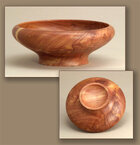
BEESWAX FINISH. I often use straight beeswax on wood, mostly Eastern Red Cedar since I like the look. Either rub it in using no solvent or apply rub then use a heat gun to melt so the wax seeps into the fiber. Gives an entirely different look.
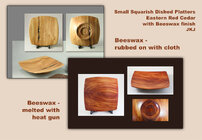
Beeswax applied with cloth with lathe spinning, generating some heat.
Early bowl from about 20 years ago.
Lid for salt bowl we keep near the stove. Beeswax melted with heat gun.
Glass and silicone seal from Ikea.
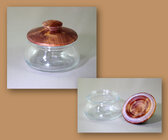
Beeswax doesn't hold up well to water but is great for things that don't get wet. I usually apply Reniassance wax on top.
All my beeswax is yellow, natural from my hives - the clean capping comb melted and filtered.
I use thick paper filters I bought for filtering goat's milk.
White beeswax is likely chemically bleached to remove the yellow color.
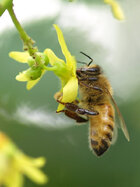
One of my bees foraging for nectar, pollen, and resins. The newly hatched house bees, not yet foragers, make the wax from special glands.
(BTW, it's tricky to take a macro photo like this - I got 6 good photos from several hundred shots.)
JKJ
Beeswax applied with cloth with lathe spinning, generating some heat.
Early bowl from about 20 years ago.
Lid for salt bowl we keep near the stove. Beeswax melted with heat gun.
Glass and silicone seal from Ikea.
Beeswax doesn't hold up well to water but is great for things that don't get wet. I usually apply Reniassance wax on top.
All my beeswax is yellow, natural from my hives - the clean capping comb melted and filtered.
I use thick paper filters I bought for filtering goat's milk.
White beeswax is likely chemically bleached to remove the yellow color.
One of my bees foraging for nectar, pollen, and resins. The newly hatched house bees, not yet foragers, make the wax from special glands.
(BTW, it's tricky to take a macro photo like this - I got 6 good photos from several hundred shots.)
JKJ
Really interesting stuff Tyler , thanks for sharing, have you tried just make the sticks without color and the applying the shellac sticks to your work as a clear finish ? Seems like it might work and be a nice finish that way as well. I'm looking forward to more info from you in the futureHi, this is Tyler David, I am the demonstrator for the video linked above. I will be demonstrating everything I know about lac color sticks at the AAW Symposium in 2026. I apologize for not getting a video out on how I make them yet. I may be able to make that video this winter before the symposium.