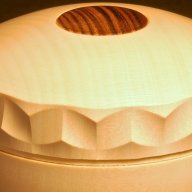
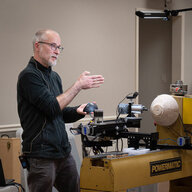
In ornamental turning it is all about three things:
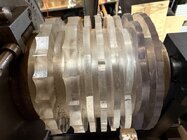
– The motion of the headstock / spindle, often "rocking" with the input from a rosette on a rose engine type lathe, but also partial rotations, as well as sliding or traversing (pumping), or linked to a sliderest motion to produce patterns like helices and reciprocation,
– The presentation and shape of the cutter, meaning how you bring a cutter up to the workpiece (angle, above or below center, etc.), and what (if any) profile the cutter has,
– ...and thirdly, how the workpiece is positioned / oriented for a given cut.
Because ornamental turning is generally done at very slow speeds, think 3 RPM or often as slow as 3 minutes per revolution for a perfect finish, a workpiece can be wildly off-center or out of balance, when being cut slowly with a fly cutter taking off whisker thin shavings.
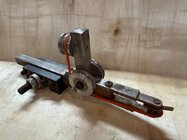
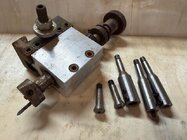
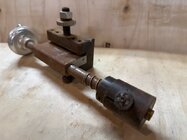
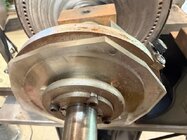
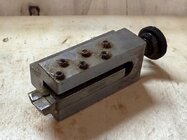
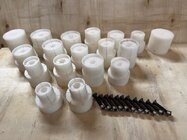
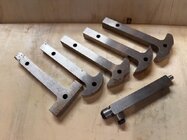
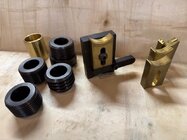
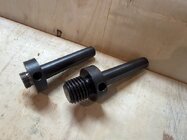
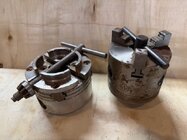
To complete the ornamental tuning aresenal, a well equipped lathe will have an array of work-positioning accessories. Here are the parts, often reassembled in various permutations to accomplish an amazing range of patterns, on various surfaces of a workpiece.
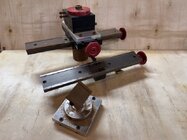
The
double eccentric chuck allows offsetting a workpiece in two directions, but its components can also be reconfigured to make a "
dome chuck", an "
oblique chuck" and other permutations.
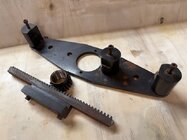
The
straightline chuck attaches to the front of the headstock, and using the spine nose, allows a workpiece to (typically) drop, while the headstock is "rocking", translating round patterns from the rosette into linear patterns as the workpiece passes vertically by the cutter.
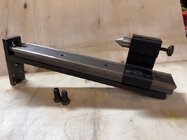
The
rocking tailstock can be attached to the headstock, and allows cutting rosette / rocking patterns, while supporting the outboard end of the workpiece.