• December 2025 Turning Challenge: Single Tree! (click here for details)
  • Congratulations to Bob Henrickson, People's Choice in the November 2025 Turning Challenge (click here for details)
  • Congratulations to Steven Gordon for "Dropped Ice Cream Cone" being selected as Turning of the Week for December 9, 2025 (click here for details)
  • Welcome new registering member. Your username must be your real First and Last name (for example: John Doe). "Screen names" and "handles" are not allowed and your registration will be deleted if you don't use your real name. Also, do not use all caps nor all lower case.

Live edge vs. natural edge

Joined
Dec 3, 2025
Messages
42
Likes
9
Location
Colebrook NH
Website
ebay.com
As I understand it, live edge has bark and natural edge does not. Assuming that to be correct, do buyers prefer one over the other? Or do they prefer a turned edge. The one piece that I've sold had half bark and half no bark. The customer loved it like that.
 
I think the terms mean the same thing. I have never seen anything that differentiates between bark on or off.
 
I usually refer to it as "bark on, natural edge" to make it clear. As for peoples preference I think the bark on makes a piece very distinctive and gets more attention. However one of our club members who has a gallary and has his stuff in many art galleries always takes the bark off because when it comes off he doesn't want his customers coming back to him.
 
I usually refer to it as "bark on, natural edge" to make it clear. As for peoples preference I think the bark on makes a piece very distinctive and gets more attention. However one of our club members who has a gallary and has his stuff in many art galleries always takes the bark off because when it comes off he doesn't want his customers coming back to him.
Thanks for the input.
 
Based on the number of buyers in the United States, no blanket statement can be made to what “they” prefer. I’ve sold all shapes and rim styles. If you want the bark to remain, the wood should be cut when the tree is dormant. Keeping the bark on in a spring or early summer cut log is nearly impossible. The cambium layer is too soft and will shrink dramatically, loosening the bark. Are you going to an AAW chapter meetings? Finding a good mentor will answer all your questions in a couple weeks with hands on experience. It’s incredibly hard to become an accomplished turner asking one question at a time on the internet!
 
Based on the number of buyers in the United States, no blanket statement can be made to what “they” prefer. I’ve sold all shapes and rim styles. If you want the bark to remain, the wood should be cut when the tree is dormant. Keeping the bark on in a spring or early summer cut log is nearly impossible. The cambium layer is too soft and will shrink dramatically, loosening the bark. Are you going to an AAW chapter meetings? Finding a good mentor will answer all your questions in a couple weeks with hands on experience. It’s incredibly hard to become an accomplished turner asking one question at a time on the internet!
Not yet. I've only been turning for a month or so and this is the first place I've joined.
 
Not yet. I've only been turning for a month or so and this is the first place I've joined.
Go here: https://www.woodturner.org/Woodturner/Woodturner/AAWConnects/AAW-Connects.aspx
Put in your state and maybe a couple neighboring states (leave everything else blank) and hit the Find button.
Hopefully one of those is not too far*. Go to a couple meetings, meet some folks face-to-face. Most clubs have mentor programs or beginner sessions or something similar. All clubs have folks willing to help get you on the right track.

* Re "too far": Several folks un my club (myself included) drive an hour or more each way to get to a meeting and find it worth the effort.
 
Hopefully one of those is not too far*.
* Re "too far": Several folks un my club (myself included) drive an hour or more each way to get to a meeting and find it worth the effort.

There used to be a local club, but it died several years ago. My two alternatives are 70 and 90 miles away -- 'luckily' almost entirely by interstate. I try to make every meeting of the more distant -- well worth the effort. Attending the other depends much more on weather and the scheduled demo.
 
As I understand it, live edge has bark and natural edge does not. Assuming that to be correct, do buyers prefer one over the other? Or do they prefer a turned edge. The one piece that I've sold had half bark and half no bark. The customer loved it like that.
I first joined the MWA in 1989 and some time in the 1990's the term natural edge became a thing which applied to either bark on or off but mostly off. The term live edge appeared I believe less then 10 years ago with the slab table fad. I personally don't like it because once you make something out of the wood it becomes dead, therefore "natural edge is more accurate and it is what I like.
 
I first joined the MWA in 1989 and some time in the 1990's the term natural edge became a thing which applied to either bark on or off but mostly off. The term live edge appeared I believe less then 10 years ago with the slab table fad. I personally don't like it because once you make something out of the wood it becomes dead, therefore "natural edge is more accurate and it is what I like.
What’s it called if you make something from a standing dead tree?
 
What’s it called if you make something from a standing dead tree?
Landscaping.

@David A Morris, welcome to the forum, and welcome to the craft. You'll find no shortage of solid information and interesting opinions here. Hopefully they mesh with each other and lead you in the right direction, but never be afraid to ask, both to learn and to verify.

My take- if that piece of wood is in my workshop, it ain't live no more. Live edge, that is just the silliest term I've heard applied to woodworking since snake oil wood finish manufacturers printed, "it feeds and nourishes the wood" on the side of their can.

And what if the edge of a board or log had the bark and sapwood removed, do we then call it a dead edge? Of course not. But to balance "live edge", maybe we should.

I can live with either bark edge or natural edge, but the woodworking world needs to stop with live edge. It is insulting to the intelligence of all parties involved.

(See? Lots of opinions here. Except mine, my thoughts are always purely objective and factual. :cool:)
 
Last edited:
Based on the number of buyers in the United States, no blanket statement can be made to what “they” prefer. I’ve sold all shapes and rim styles. If you want the bark to remain, the wood should be cut when the tree is dormant. Keeping the bark on in a spring or early summer cut log is nearly impossible. The cambium layer is too soft and will shrink dramatically, loosening the bark. Are you going to an AAW chapter meetings? Finding a good mentor will answer all your questions in a couple weeks with hands on experience. It’s incredibly hard to become an accomplished turner asking one question at a time on the internet!
I personally find these forums extremely useful for random questions - more so than the three clubs I have belonged to, as there is usually so much going on at the club meetings and time is always short. The hands-on demos and live teaching experiences are invaluable as is club association in general, but for a couple of years before I even knew there was a club in my former city I got most of my information from trusted online forums. I still ask a lot of ignorant questions on here and am always grateful for patient responses and am always happy to share my knowledge/experiences with others. That’s what makes this forum so helpful and enjoyable.

That being said, in answer to the poster’s original question, I have also heard “live edge” specifically referred to as a natural edge bowl with the bark still on, but overall, it seems most turners use the terms interchangeably. In my experience, keeping the bark intact is more desirable, though people in general seem to still love the bark-less natural edge bowls too. I charged more for natural edge bowls compared to regular bowls and even more for live edged bowls in the limited selling that I’ve done.

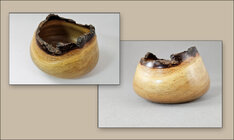
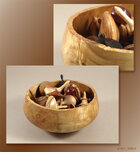
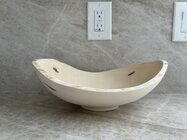
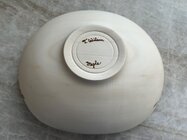
If I’m making a live edge bowl and a chunk of bark comes off I will try to glue it back on as I’m turning to make it appear natural. If I can’t find the piece or if it doesn’t quite look right then I will tear the rest of the bark off, but that’s just my personal preference. Here is a 13x6” maple bowl without finish that I turned this week for a neighbor who had a tree come down last month. I got to the very end and a chunk of bark came off so I stripped the whole thing, but they didn’t know that and still loved it. (It was finished with a food-safe paste wax after the photo).

IMG_1554.jpeg IMG_1555.jpeg


Good luck and keep the questions coming!

Tom
 
I haven't done bark on types for years. Main reason is that when I did turn them, most were not practical for daily use, which is what I want mine to be. Also, when selling them at the local Saturday Market, people always seemed to pick them up by the bark rather than the bottom of the bowl, and the bark always seemed to break. Best thing I hear at the only show I do any more is "we have a bunch of your bowls and plates and use them every day". Natural edge bowls are not used that way, at least most of the time. Finding a log with flat spots, which would make them more useable just are not common.

robo hippy
 
I haven't done bark on types for years. Main reason is that when I did turn them, most were not practical for daily use, which is what I want mine to be. Also, when selling them at the local Saturday Market, people always seemed to pick them up by the bark rather than the bottom of the bowl, and the bark always seemed to break. Best thing I hear at the only show I do any more is "we have a bunch of your bowls and plates and use them every day". Natural edge bowls are not used that way, at least most of the time. Finding a log with flat spots, which would make them more useable just are not common.

robo hippy
I can see that.
 
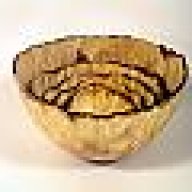
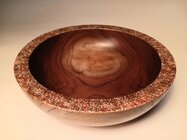
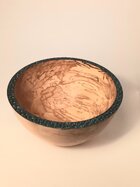
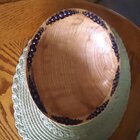
I don't do many bark edge bowls anymore. Ive had the bark come loose years later on some species and my memory isn't goid enough to remember which species. I carve away all the bark and then paint the edge using sponge painting techniques to resemble lichen. Although lately I've been adding other colors. Sometimes I carve or add pyrogrophy textures before I paint.
 

Attachments

  • 20240323_181441.jpg
    20240323_181441.jpg
    264.3 KB · Views: 1
  • 20240412_083514.jpg
    20240412_083514.jpg
    137.5 KB · Views: 1
  • 20230303_074920.jpg
    20230303_074920.jpg
    460.9 KB · Views: 1
I don't do many bark edge bowls anymore. Ive had the bark come loose years later on some species and my memory isn't goid enough to remember which species. I carve away all the bark and then paint the edge using sponge painting techniques to resemble lichen. Although lately I've been adding other colors. Sometimes I carve or add pyrogrophy textures before I paint.
Appreciate the input.
 
Back
Top