• January 2026 Turning Challenge: Turned and Bent! (click here for details)
  • Congratulations to Phil Hamel, People's Choice in the December 2025 Turning Challenge (click here for details)
  • Congratulations to Clayton Thigpen for "Armillary Sphere" being selected as Turning of the Week for January 19, 2026 (click here for details)
  • Welcome new registering member. Your username must be your real First and Last name (for example: John Doe). "Screen names" and "handles" are not allowed and your registration will be deleted if you don't use your real name. Also, do not use all caps nor all lower case.

Looking for input from those mechanical/engineering minds

Joined
May 25, 2021
Messages
119
Likes
297
Location
Glendale, AZ
Sorry about the title but I could not find the words for the following lol

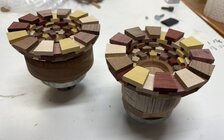
I make mostly open segmented vessels. After each row of pieces I glue on, I like to put it on the lathe for a quick and light sanding. I usually use a speed of around 250 rpms.

Currently my gluing station is not in the same location as my lathe. Opposite ends of my yard.

I am wondering if there is a way to build something that would replace the lathe for this specific type of sanding. I thought maybe converting a benchtop disc sander however I would need to mount some sort of 1.25" threaded spindle to attach the faceplate. (I always use faceplates). I would also need to control the rpms.

Anyone have any ideas?

I also need this to be mobile

I DO NOT WANT ANOTHER LATHE!

Thank you
 
Last edited:
I am wondering if there is a way to build something that would replace the lathe for this specific type of sanding.

I'm thinking you don't need much torque right? Are you sanding by hand or with spinning disks on a drill?

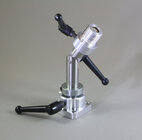
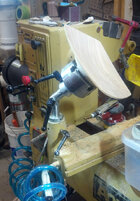
Could even be turned by hand - I do that a lot using a carving/finishing stand from Best Wood Tools. This normally fits into the banjo at the lathe but comes with a bench mount. I to the sanding by hand, or on occasion with a pneumatic sander with fine grit turning at a very low speed. But could be power sanded with coarse grit while turning by hand. Chuck, faceplate, etc will fit.

1768925278300.jpeg 1768925622766.jpeg

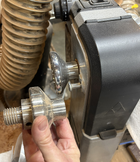
Best Wood Tools and others also carry various spindle adapters threaded for 1.25x8. Another possibility is an adapter that fits a Oneway or clone type rotating tailstock center. Could hold the body of the center (the wide part with the bearings) in a vise, mount the work on the adapter, then even rotate it using power from an electric drill clamped to the bench or something, using a big o-ring around a disk in the drill and and around the adapter.

Could devise something simpler with a straight shaft adapter (also available from BWT) but slipped into a loose hole in a wood block or something machined (such as the bench adapter in the photo above.) Maybe even grip a large bearing in a bench vise and devise a shaft with a threaded adapter on the end.

(You might guess I like Best Wood Tools! I've bought a lot from them over the years and never got something that wasn't well thought out and well made.) One guy makes everything. Call their number for info on products. (Their web site is not always the best.)

Know anyone near you with a small machine shop? They could prob make something quickly. Jump in the car and come visit - could probably make something here!

JKJ
 
Get a used treadmill. Salvage the motor and controller. You can buy an adaptor from bestwoodtools.com to fit the motor shaft and your faceplate threads. Mount that on a box and your set to go.

Oh, great idea! I actually did that once - pulled out the motor and control board from an old treadmill. Hooked them up and tested - worked fine! Never did anything with it. :(
I wonder if I still have the pieces in a shed.
 
I'm thinking you don't need much torque right? Are you sanding by hand or with spinning disks on a drill?

Could even be turned by hand - I do that a lot using a carving/finishing stand from Best Wood Tools. This normally fits into the banjo at the lathe but comes with a bench mount. I to the sanding by hand, or on occasion with a pneumatic sander with fine grit turning at a very low speed. But could be power sanded with coarse grit while turning by hand. Chuck, faceplate, etc will fit.

View attachment 84338 View attachment 84339

Best Wood Tools and others also carry various spindle adapters threaded for 1.25x8. Another possibility is an adapter that fits a Oneway or clone type rotating tailstock center. Could hold the body of the center (the wide part with the bearings) in a vise, mount the work on the adapter, then even rotate it using power from an electric drill clamped to the bench or something, using a big o-ring around a disk in the drill and and around the adapter.

Could devise something simpler with a straight shaft adapter (also available from BWT) but slipped into a loose hole in a wood block or something machined (such as the bench adapter in the photo above.) Maybe even grip a large bearing in a bench vise and devise a shaft with a threaded adapter on the end.

(You might guess I like Best Wood Tools! I've bought a lot from them over the years and never got something that wasn't well thought out and well made.) One guy makes everything. Call their number for info on products. (Their web site is not always the best.)

Know anyone near you with a small machine shop? They could prob make something quickly. Jump in the car and come visit - could probably make something here!

JKJ
Hi John!

I knew you would reply lol

I mount the vessel to headstock, speed at 250, I have a round board with sandpaper on it and just press against the vessel. Occasionally I might attach that sanding disk to the tailstock and slowly move it and sand. That is only if the vessel has a wobble.

I tried hand sanding by placing the sanding disk on a table and turn the vessel upside down and slowly moving the vessel. That takes a lot longer and because it is moving so slow, occasionally catches.
 
So, I am guessing you mill the wood first so it is pretty much exact same thickness, and then glue it up, and then use a board with abrasives on it to make sure it is dead flat, correct? Or some thing like that. While I don't do segmented bowls, I would run my rings through my drum sander, which is a luxury for some. They can be handy!

robo hippy
 
So, I am guessing you mill the wood first so it is pretty much exact same thickness, and then glue it up, and then use a board with abrasives on it to make sure it is dead flat, correct? Or some thing like that. While I don't do segmented bowls, I would run my rings through my drum sander, which is a luxury for some. They can be handy!

robo hippy
Yes I do that with a drum sander. The slightest imperfection in the drum sanding can make a big difference when I am gluing pieces that are only ~.165". Plus, after cleaning any glue with a damp pipe cleaner and/or some woods swell with gluing, it can create unevenness. This can make some of the pieces for the next row uneven/ crooked.
 
I agree with Richard. I would get a dedicated lathe to place near the gluing station. It can be acquired very economically because it can be a very basic, old/used machine: all it needs to do is spin your bowl-in-progress so that you can use your sanding plate, and it will be the only practical way to align your sanding plate (on the tailstock) when you want certainty of alignment. And all you need to do is get the lathe, no re-engineering of parts from machines that, unlike the lathe, were not designed to do the very thing you want to do.
 
For larger rings. I only put one side in the drum sander and rotate it by hand as the belt pulls the ring through which gives me a smooth surface on the entire ring.

It’s a continuous feed of the ring as it turns. I slowly lower the drum till the ring is smooth. When time to remove, I raise the drum.
 
For larger rings. I only put one side in the drum sander and rotate it by hand as the belt pulls the ring through which gives me a smooth surface on the entire ring.

It’s a continuous feed of the ring as it turns. I slowly lower the drum till the ring is smooth. When time to remove, I raise the drum.
Not sure what this has to do with my question but thanks.
 
I agree with Richard. I would get a dedicated lathe to place near the gluing station. It can be acquired very economically because it can be a very basic, old/used machine: all it needs to do is spin your bowl-in-progress so that you can use your sanding plate, and it will be the only practical way to align your sanding plate (on the tailstock) when you want certainty of alignment. And all you need to do is get the lathe, no re-engineering of parts from machines that, unlike the lathe, were not designed to do the very thing you want to do.
Thanks but if I wanted another lathe I wouldn't have asked this question.
 
Get a used treadmill. Salvage the motor and controller. You can buy an adaptor from bestwoodtools.com to fit the motor shaft and your faceplate threads. Mount that on a box and your set to go.
Sorry...but what's preferential about this set-up as opposed to OP getting a small variable speed lathe?
 
Another option is to do your assembly on the lathe. Saves having to move anything..... just not quite as ergonomic for assembly, but could be made better by setting a stool at the right height for your lathe etc.
 
Because I do not want, need or have room for another lathe! If I did, I would not have asked the question.
Do you have the equipment to build something that kinda looks like a lathe? By the time you build something, it could be nearly the size of another lathe, and it would have helped you make several items. BUT I CAN NOW SEE YOU REALLY DON'T WANT A LATHE!
 
Jim, I think that, in the spirit of respect for people who have taken the time to try to help you with this question, you should see the "get another lathe" responses to be saying something like this: The operation you want to perform is performed very well by a compact, inexpensive lathe, whereas fashioning another device to do this job would be challenging and the device would only perform the job well if you managed to make it behave very much like a lathe. You asked for "any ideas", and sometimes the input you get when you ask a question like that is a bit lateral; sometimes that is the best kind of advice.

A small lathe is remarkably compact, but if for some reason you don't have room for one, then that is that. But you should not be impatient with people for suggesting that a second lathe is an efficient solution: many of us have one for threading or buffing or other operations that are not "turning" per se, and so we have offered this insight for your consideration.
 
Sorry about the title but I could not find the words for the following lol

I make mostly open segmented vessels. After each row of pieces I glue on, I like to put it on the lathe for a quick and light sanding. I usually use a speed of around 250 rpms.

Currently my gluing station is not in the same location as my lathe. Opposite ends of my yard.

I am wondering if there is a way to build something that would replace the lathe for this specific type of sanding. I thought maybe converting a benchtop disc sander however I would need to mount some sort of 1.25" threaded spindle to attach the faceplate. (I always use faceplates). I would also need to control the rpms.

Anyone have any ideas?

I DO NOT WANT ANOTHER LATHE!

Thank you
Got a drill press? This works really well https://www.stewmac.com/luthier-tools-and-supplies/types-of-tools/planes/stewmac-safe-t-planer/ I just used it to surface a small box lid that I had filled with inlay segments , if you have the drill press and some MDF and materials to build a fence, you should be good to go with one of those, I imagine...
 
I am wondering if there is a way to build something that would replace the lathe for this specific type of sanding. I thought maybe converting a benchtop disc sander however I would need to mount some sort of 1.25" threaded spindle to attach the faceplate. (I always use faceplates). I would also need to control the rpms.
Does the outboard end of your spindle have threads that can accommodate a faceplate? You could build a dedicated disc sander and swing-up table right onto that end of the lathe. If it’s got a handwheel, I imagine you could even drill it to be able to screw a plywood disc to be the base of a sanding disc. That would give you the rpm control you want without an extra machine. Just a thought.
 
Does the outboard end of your spindle have threads that can accommodate a faceplate? You could build a dedicated disc sander and swing-up table right onto that end of the lathe. If it’s got a handwheel, I imagine you could even drill it to be able to screw a plywood disc to be the base of a sanding disc. That would give you the rpm control you want without an extra machine. Just a thought.
I like this idea! I had a special handwheel made for my mini lathe that had a thread on it so I could turn outboard. It would do just what Jim is looking for.

1769001898297.png
 
Jim, I think that, in the spirit of respect for people who have taken the time to try to help you with this question, you should see the "get another lathe" responses to be saying something like this: The operation you want to perform is performed very well by a compact, inexpensive lathe, whereas fashioning another device to do this job would be challenging and the device would only perform the job well if you managed to make it behave very much like a lathe. You asked for "any ideas", and sometimes the input you get when you ask a question like that is a bit lateral; sometimes that is the best kind of advice.

A small lathe is remarkably compact, but if for some reason you don't have room for one, then that is that. But you should not be impatient with people for suggesting that a second lathe is an efficient solution: many of us have one for threading or buffing or other operations that are not "turning" per se, and so we have offered this insight for your consideration.
Gord, I appreciate your feedback. However, I asked a simple question for what I NEEDED and getting suggestions that do not relate to my specific question is frustrating. I have reasons for my question that I do not need to share here.
This is the main reason I usually keep my questions to myself.

Thanks
 
Got a drill press? This works really well https://www.stewmac.com/luthier-tools-and-supplies/types-of-tools/planes/stewmac-safe-t-planer/ I just used it to surface a small box lid that I had filled with inlay segments , if you have the drill press and some MDF and materials to build a fence, you should be good to go with one of those, I imagine...
That is an interesting road to take. Unfortunately, Some of my vessels are over 12" id diameter at it's widest. I do not think the sanding disk would fit.

Thanks
 
Does the outboard end of your spindle have threads that can accommodate a faceplate? You could build a dedicated disc sander and swing-up table right onto that end of the lathe. If it’s got a handwheel, I imagine you could even drill it to be able to screw a plywood disc to be the base of a sanding disc. That would give you the rpm control you want without an extra machine. Just a thought.
I am not near my lathe when gluing and that will not change.

Thanks
 
Do you have the equipment to build something that kinda looks like a lathe? By the time you build something, it could be nearly the size of another lathe, and it would have helped you make several items. BUT I CAN NOW SEE YOU REALLY DON'T WANT A LATHE!
I do not need the lathe bed. All I want is to replicate the headstock so I can sand. This is why a treadmill motor might work. As long as the weight is balanced once the vessel is on. I only need it to turn 250rpms tops.

Thanks
 
If your index setup has a stepper motor, can you program it to spin at 100rpm for sanding right on the jig. I know - you don't use a stepper motor.
Just trying to get my head at the right end of your yard.
 
Last edited:
You asked John Lucas:

John, I could not find anything that resembled a thread stock to mount on the motor on that website. Do you have a name for that part?

The other John (me) wrote earlier "Call their number for info on products. (Their web site is not always the best.)"
Explain what you want to do. The number is: (931) 456-6155

If he doesn't have exactly what you want he could make it. They mention this somewhere on the web site.

JKJ
 
You asked John Lucas:


The other John (me) wrote earlier "Call their number for info on products. (Their web site is not always the best.)"
Explain what you want to do. The number is: (931) 456-6155

If he doesn't have exactly what you want he could make it. They mention this somewhere on the web site.

JKJ
Thanks John!

BTW: I wished I lived closer, I could learn a lot from your mind :)
 
Back
Top