• January 2026 Turning Challenge: Turned and Bent! (click here for details)
  • Congratulations to Phil Hamel, People's Choice in the December 2025 Turning Challenge (click here for details)
  • Congratulations to Clayton Thigpen for "Armillary Sphere" being selected as Turning of the Week for January 19, 2026 (click here for details)
  • Welcome new registering member. Your username must be your real First and Last name (for example: John Doe). "Screen names" and "handles" are not allowed and your registration will be deleted if you don't use your real name. Also, do not use all caps nor all lower case.

Making your Segments?

Joined
Jun 4, 2021
Messages
24
Likes
311
Location
Hudson, MA
Website
www.instagram.com
I've done one segmented piece in 8 years of turning. I cut those segments on a Delta cabinet saw with a home made Crosscut sled. For a first project it was fine.

Now I'm thinking of doing some more segmented turning but the cabinet saw is gone. So how does everyone make their segments? What saw do you use? Since my new shop is small, could I be successful with a folding contractor saw?

I recall seeing a video (from our club's library) where the turner used a miter saw to cut his segments. If that's a common approach that results in repeatable segments, I'd consider it too (with a new miter saw, because my old one is used up).

In other words, what equipment do you use to make your segments.

(And I hope this isn't like asking which religion is best, because I don't want to start a religious war :) )

Thanks,
Mark
 
If you have a miter saw and a way to set it accurately you can probably use it. I watched a video recently and the fellow did exactly that. I chose to use my table saw but he (the video guy) seemed to get good results with his miter saw.
 
I use my cabinet saw and a wedgie sled. I made my own sled and purchased a few wedgies from Jerry Bennet (segeasy.com). Plans for the sled are on Jerry’s site and there are some great videos on YouTube (Segmentology). I’ve heard great things about the Pete Marken sled as well and you don’t need the wedgies. Either create perfect rings.
 
I designed and built my own sine-based double-fence sled. The benefit is the ability to set any angle without additional specialty pieces. The concept is just like a sine plate used for machine work - incredibly accurate.

Tim
 
I purchased a wedgie sled from Pete Marken and have been very happy with it.


Jerry Bennett has a great series called Segmemtology which I found to be very helpful.

View: https://youtu.be/hpFNE1CHsc4?si=CSYpAu34wcmvOoga


Bob
☝️☝️
Pete's sleds are very well made. I'm very happy with mine.
The fences index perfectly for 8 different common segment angles, so theres no need for wedgies unless you go with a different segment count.
 
I use a Marken wedgieless sled too. With a wedgie sled, the type of table saw doesn’t matter too much. There are a couple of things to check on your saw that matter.
- blade is parallel to miter slot
- sled is a tight fit in miter slot
- blade runout
…….
The segmented Woodturners chapter of AAW is another good resource for all this info.

Malcolm tibbetts is a well known user of a miter saw. He has a you tube channel where he shows his setup. You can still buy his book too which is an excellent resource.
 
I’m also a big fan of Pete Marken’s sleds. They allow me to use segment counts from 8 to 288. I also echo Steve’s recommendation of this site:


Jerry Bennett’s Segmentology is where I would start too. You can cut segments with a chop saw but once the saw is set perfectly for a certain segment count, that process starts all over again for another segment count (or for a square cut). Sleds, with wedgies or not, are far superior regarding changes (although Malcolm might argue otherwise, lol). If you want to learn segmenting, ask a segmenter…they love to share more often than not! Keep in mind, we all started right where you find yourself!
 
I agree with Russ' comments on table saw vs miter saw. I've found the table saw wedgie sled combination much more accurate and repeatable than a miter saw. I think the miter saw is faster, which is maybe why Malcolm prefers it. He turns out amazing stuff at an incredible rate. I started with Malcolm's book and used a miter saw for many years, resisting the change to wedgie sleds. But once you try one, there is no going back (unless you segment at Malcolm's pace maybe)!
 
I would highly recommend Tim Hunter's sine-based sleds, as i said earlier i do use Jerry Bennett's wedgies and they work great for common segment counts, i did make one of the Tim Hunter designed sleds it allows you to make a ring with any number of segments and is very accurate, the link he provided above takes you to a very detailed explanation of how to fabricate on of his sleds. thanks Tim Hunter for putting this out
 
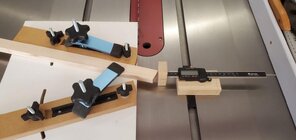
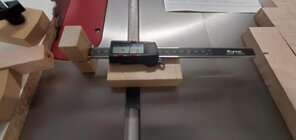
Note the way you have your caliper set up it’s not actually measuring seg edge length.
The image posted shows a piece of wood that had not yet had the initial sacrificial angle cut off done to it .... probably confusing/lazy on my part.
The caliper will always show a negative number. With that fact ignored, the number displayed has always been quite accurate in cutting the desired length of segments.

Please let me know if this addresses the point of your comment .... or if I misinterpreted what you were trying to say 🤔.
 
The image posted shows a piece of wood that had not yet had the initial sacrificial angle cut off done to it .... probably confusing/lazy on my part.
The caliper will always show a negative number. With that fact ignored, the number displayed has always been quite accurate in cutting the desired length of segments.

Please let me know if this addresses the point of your comment .... or if I misinterpreted what you were trying to say 🤔.
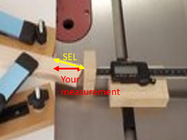
This may show what I meant more clearly. I assume you zero your gauge on the blade? For it to measure SEL you need to have the gage at the same angle as the fence.
What you are measuring has a cosine error as it is at the wrong angle (the red arrow is shorter than the yellow). Your segments would always be slightly oversized. The error get worse at low segment counts and becomes insignificant at high counts. Hope that makes sense. Maybe I'm not understanding how you use the gauge.

1769014393194.png
 
I've found the table saw wedgie sled combination much more accurate and repeatable than a miter saw.
I completely agree with Steve. I'm sure everyone has tried it and seen it for themselves. :) Precision is everything.
I made a few very simple sleds for the number of segments I most often work with (9, 12, 18).
IMG_20260120_161232_2.jpg
I made the sleds with two T-guides, which makes them more stable (in my feelings). I ruined a few slats, but I got the sleds set up perfectly. Now I don't waste time adjusting them; I just grab the right sleds from the shelf.

Here’s a link to my sine-based sled build
Tim, thanks a lot. I'm very impressed with the idea. I'll try implementing it soon, as I want to try it with 36 segments.
 
Question. If the wedges are cut on a miter saw and the board is marked, the board flipped with each cut, and the wedges assembled using the mark so you get the same alternating cut pattern, wouldn’t the glue joints be precise?
 
Only if the miter saw angle is precise.
My reason for asking is if you cut a board in half and flip one side over, the cut matches up for a straight board when you connect the two ends. Wouldn’t a segmented joint be the same if the pieces were alternated? Just asking because it seems logical.

I think I’m going to try cutting a 12 piece ring from scrape with both miter and bevel off by a few degrees. I’m curious what I find and will report back.
 
Question. If the wedges are cut on a miter saw and the board is marked, the board flipped with each cut, and the wedges assembled using the mark so you get the same alternating cut pattern, wouldn’t the glue joints be precise?
The two most important details in my nsho opinion that no one is mentioning is #1 tuning the saws and surfacing machines to get exact cuts such that all edges are at 90 degrees to each other #2 the wood strips must be parallel edge to edge.
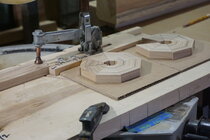
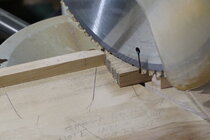
The method I prefer is the miter saw with an auxiliary table and fence that is also equipped with a positive stop and a Destaco clamp the hold the cut piece in place while you lift and stop the blade. The procedure I use is to first make a cut in a wide piece of hardwood, set the angle close make a cut and check with a digital protractor then make adjustment to the angle and try another cut until it is as close to accurate as you can get. The next step is to cut a scrap stick to the angle and mount the auxiliary table and position the stop ( the stop is inverted such that the angle is opposite to the blade angle) and clamp. The cutting method is start by making a cut on the end of a strip flip the strip move it against the stop clamp and cut, remove the cut piece flip , clamp ,cut etc. note that after each make sure that there is no saw dust between the table , fence or stop. The final step before cutting usable segments is a trial run with scrap to check for fit - dry fit the entire set of segments and if the fit is not tight on the outside diameter partially loosen the angle clamp and gently tap to increase the angle or if the inside diameter is not tight move the other way. Once you get an acceptable test ring continue with the good stuff and when gluing up a segment ring you don't have to fiddle with little pieces of dowel.
DSC00304.JPGDSC00306.JPG

These pictures should illustrate the advantage of the auxiliary table and the clamp because the cut piece is supported right to the edge of the saw cut. The clamp could be eliminated but then you would have to stop the saw in the down position before removing the cut segment because the cut piece will giggle and be damaged when the moving blade is lifted.
 
Back
Top