• The forum upgrades have been completed. These were moderate security fixes from our software vendor and it looks like everything is working well. If you see any problems please post in the Forum Technical Support forum or email us at forum_moderator (at) aawforum.org. Thank you
  • April 2026 Turning Challenge: Salad Bowl! (click here for details)
  • Congratulations to David Bartell, People's Choice in the March 2026 Turning Challenge (click here for details)
  • Congratulations to Ethan Hoff for "Basket Illusion Platter" being selected as Turning of the Week for April 13, 2026 (click here for details)
  • Welcome new registering member. Your username must be your real First and Last name (for example: John Doe). "Screen names" and "handles" are not allowed and your registration will be deleted if you don't use your real name. Also, do not use all caps nor all lower case.

Microwave drying

Joined
Oct 20, 2025
Messages
35
Likes
458
Location
Frankfort, KY
I know that there have been many threads on Microwave drying of wood, but I tried something earlier in the week that might be helpful.

Started with a rough turned maple bowl, around 13" in dia, left it 1"+ in thickness. it weighted 4lbs 14 oz. Ended up drying it 14 times, it came out 4 lbs. I did let the piece cool to below 80 degrees before the next cycle.

The first cycle was for 5 minutes, I took an infrared thermometer and checked inside and outside of the piece after it finished. 120 degrees F was the highest spot. Microwaving basically boils the moisture out of the wood, so I bumped up the next four runs to 6 minutes. The next three cycles topped out at 180 degrees, the fourth came out at 200 degrees. The next four cycles were at 5 minutes, max temperature went from 180 to 190 on the last cycle. Each cycle, the piece lost an ounce and a half of weight. I did one more 5 minute cycle, and found the bottom of the piece was at 265 degrees.
It had only lost 1/2 ounce.

I did a 3 minute cycle, 180 degrees max and lost .5 oz. 2 more runs at three minutes showed the temperature the same, and .5 oz loss. The final cycle showed the temperature about half way up the piece at 240 degrees, it only lost .2 oz.

I am thinking that there is merit to checking temperature while drying and that 180-190 degrees would be a good point to judge the time of cycle.

WH

 
Is the cycle a defrost cycle What setting did you use? Thanks. Found I can get a MWO much cheaper than a dehydrator.
 
Is the cycle a defrost cycle What setting did you use? Thanks. Found I can get a MWO much cheaper than a dehydrator.
I am calling a cycle, one session in the Microwave. I use the high setting for temperature, the time in the oven is kind of a guess, using the infrared thermometer seems to me, to be a way to see what is happening to the wood to optimize the time.

When I first started drying wood in the Microwave, I left a piece of walnut in too long and set it on fire internally, no flame, but a lot of smoke. Took it outside and it would not quit smoking. I had to dunk it in water.

If you try using this method, read everything you can, go slow, and keep a log of the time and temperature.
 
I've done the same with good success ... 5 minutes on high for a medium to large bowl blank, weighing before and after microwaving, and checking with a moisture meter once it gets fairly dry. I've done five minutes at a time until the piece comes out without a lot of steam, and then start backing off the time. I've never had a piece burn at all. I hadn't thought of the infrared thermometer. I think that's a great idea, because it takes out a lot of the guesswork.
I've read about people using low heat for a minute at a time, and that just seemed way to slow and probably completely ineffective. I think your post proves that.
Again, the thermometer seems to be a great idea.
 
I've read about people using low heat for a minute at a time, and that just seemed way to slow and probably completely ineffective. I think your post proves that.
Again, the thermometer seems to be a great idea.
I did quite a bit of experimenting quite a while back and I found the best way to maintain a constant internal and external is to do an initial longer cycle (4 to 6 minutes depending on mass and moisture content) followed by a roughly 10% duty cycle, usually 1 minute on, 10 minutes off (with fan going). Of course, this would be a pain to do manually so I added a Esp-32 microcontroller to run the microwave keypad, letting me set cycle parameters via wifi. Works great, but I almost never use it, so if anyone wants it....
 
I did quite a bit of experimenting quite a while back and I found the best way to maintain a constant internal and external is to do an initial longer cycle (4 to 6 minutes depending on mass and moisture content) followed by a roughly 10% duty cycle, usually 1 minute on, 10 minutes off (with fan going). Of course, this would be a pain to do manually so I added a Esp-32 microcontroller to run the microwave keypad, letting me set cycle parameters via wifi. Works great, but I almost never use it, so if anyone wants it....
I guess I'm not techie enough know what an esp-32 is, but being able to control by wifi would be great.
 
For what it is worth, note that the IR thermometer will report the surface temperature of the piece, not the internal temperature.

I understand we are talking surface temp. If we took a pan of boiling water and checked it with an IR thermometer, it should read 212 degrees, when the water boils off, the temp will rise.
 
Is the cycle a defrost cycle What setting did you use? Thanks. Found I can get a MWO much cheaper than a dehydrator.

I got one for free off Facebook Marketplace.

This is very interesting. I also have the impatience bug, but haven't tried any extended times, just 30 second blasts. I haven't checked temps other than by feel. I don't always let it cool completely before the next round, either. If only I took notes... I've also been experimenting with a soaking roughed blanks in denatured alcohol first.
 
I got one for free off Facebook Marketplace.

This is very interesting. I also have the impatience bug, but haven't tried any extended times, just 30 second blasts. I haven't checked temps other than by feel. I don't always let it cool completely before the next round, either. If only I took notes... I've also been experimenting with a soaking roughed blanks in denatured alcohol first.
Many times a MWO at the curb only needs a fuse. Remove the back and replace for a couple of bucks.
 
One thing I wold like to be educated on about the process of drying by microwave or even with gentle heat in a light bulb refrigerator kiln.

I've done microwave drying on small pieces and one thing I don't like about it - when to decide it's dry how do you know if is actually at at EMC? (equilibrium moisture content) for the specific environment? Since many pieces are kept indoors when finished, turning the piece when at EMC will prevent it from gaining or loosing moisture and warping when moved to a conditioned indoor envronment. Of course, if you turn green and let it warp when drying, none this matters unless you want the final piece to sit flat on the table wittout rocking.

If it comes out of the microwave (or makeshift kiln) with greater moisture than EMC, it will lose mositure when moved into a conditioned house. If it comes out COMPLETELY dry with a lower moisture than EMC (something I definitely don't want), it can gain moisture when moved to a conditioned space after turning. It either case it might warp some in the recipient's house. (This is less likely with end grain turnings like vessels and lollow forms that it is wilth face grain bowls and platters.)

This potential problem could, of course, be avoided if the piece is removed from the microwave then left in a home-conditioned environment until it reached EMC then finished turned.

OR if the microwaved piece has is tested for EMC by a useful method.

Moisture meters? Pin-type are can be inaccurate since they only measure the resistance right at the surface, or as deep as you can drive the pins. Pinless type will measure deeper but require a flat surface on the wood. They also need to be preset to the species of wood being tested. (I have both types and have done experiments.)

I solve the EMC question by air drying all blanks in my climate conditioned shop where temperature and humidity is very close to the typical living environment. (I track the drying by weight - when the weight quits dropping or starts to fluxuate a small amount with the seasons I know the blank is dry. That way, when I turn a piece and give it to someone who will keep it inside I know it's not going to warp.

The same thing would work with rough turned bowls - and I always do that - keep the rough-turned bowl in the shop either for what I've learned is enough time OR track the weight until it stabilizes. Then when I finish turn there is never a problem when it's moved to final resting place in a house. I don't sell pieces but have visited many friends who have my pieces. All were rock-solid on the table.

The huge downsize of drying this way is it can take a long time, years for large blanks.

And this is not a problem for pieces dryed properly in a professional kiln following a proven schedule of humidity and temperature. I wonder mostly about the casual shop and shed "kilns" with light bulb heat, and pieces dried with microwave heat.

I understand a piece that turned at a high or low EMC may be more stable if finished well, but moisture can travel through many types of finish. Small pieces, of course, can have proportionatly smaller movement.

So does anyone have a problem with the long-term stability of relatively large finished pieces after drying if the wood is finish-turned with too much or too little moisture? Or do pieces go away after a sale and there is no opportunity long-term feedback? Does anyone who sells bowls turned ater being dried with the microwave method check back a couple of years later with the buyer?

Or maybe I'm being overly picky and no one else cares about this.

JKJ
 
One thing I wold like to be educated on about the process of drying by microwave or even with gentle heat in a light bulb refrigerator kiln.

I've done microwave drying on small pieces and one thing I don't like about it - when to decide it's dry how do you know if is actually at at EMC? (equilibrium moisture content) for the specific environment? Since many pieces are kept indoors when finished, turning the piece when at EMC will prevent it from gaining or loosing moisture and warping when moved to a conditioned indoor envronment. Of course, if you turn green and let it warp when drying, none this matters unless you want the final piece to sit flat on the table wittout rocking.

If it comes out of the microwave (or makeshift kiln) with greater moisture than EMC, it will lose mositure when moved into a conditioned house. If it comes out COMPLETELY dry with a lower moisture than EMC (something I definitely don't want), it can gain moisture when moved to a conditioned space after turning. It either case it might warp some in the recipient's house. (This is less likely with end grain turnings like vessels and lollow forms that it is wilth face grain bowls and platters.)

This potential problem could, of course, be avoided if the piece is removed from the microwave then left in a home-conditioned environment until it reached EMC then finished turned.

OR if the microwaved piece has is tested for EMC by a useful method.

Moisture meters? Pin-type are can be inaccurate since they only measure the resistance right at the surface, or as deep as you can drive the pins. Pinless type will measure deeper but require a flat surface on the wood. They also need to be preset to the species of wood being tested. (I have both types and have done experiments.)

I solve the EMC question by air drying all blanks in my climate conditioned shop where temperature and humidity is very close to the typical living environment. (I track the drying by weight - when the weight quits dropping or starts to fluxuate a small amount with the seasons I know the blank is dry. That way, when I turn a piece and give it to someone who will keep it inside I know it's not going to warp.

The same thing would work with rough turned bowls - and I always do that - keep the rough-turned bowl in the shop either for what I've learned is enough time OR track the weight until it stabilizes. Then when I finish turn there is never a problem when it's moved to final resting place in a house. I don't sell pieces but have visited many friends who have my pieces. All were rock-solid on the table.

The huge downsize of drying this way is it can take a long time, years for large blanks.

And this is not a problem for pieces dryed properly in a professional kiln following a proven schedule of humidity and temperature. I wonder mostly about the casual shop and shed "kilns" with light bulb heat, and pieces dried with microwave heat.

I understand a piece that turned at a high or low EMC may be more stable if finished well, but moisture can travel through many types of finish. Small pieces, of course, can have proportionatly smaller movement.

So does anyone have a problem with the long-term stability of relatively large finished pieces after drying if the wood is finish-turned with too much or too little moisture? Or do pieces go away after a sale and there is no opportunity long-term feedback? Does anyone who sells bowls turned ater being dried with the microwave method check back a couple of years later with the buyer?

Or maybe I'm being overly picky and no one else cares about this.

JKJ
I don't want anything I give away or sell to warp after it leaves my hands.
I wonder about local climate (south Georgia vs. Arizona, for example) but I would think that modern HVAC probably equalizes that.
In my limited experience, it depends a lot on the wood species, and even the particular tree. For example, I've turned live oak vases from whole rounds from large branches and had no problem with warping at all. I've turned others from another tree and everything warps and splits eventually. Both with MW drying. Maybe I just haven't dialed it in enough for consistency.
Several large black olive (jucaro) pieces gave me no problems, and the same for a few pieces turned from Florida mahogany. The pecan around me warps more than splits, but it warps radically, almost comically. I've had pretty good success with sufficient MW drying, though.
 
Not for me, not ever unless I lose my way in life.

LOL JKJ, what tree do the acrylic pieces you use to accent your Magic Wands come from?

I've done microwave drying on small pieces and one thing I don't like about it - when to decide it's dry how do you know if is actually at at EMC? (equilibrium moisture content) for the specific environment?

I agree John, EMC is what we need to shoot for however the piece is dried. Fresh Kiln dried wood is usually not at EMC of your shop when purchased.

When you are trimming a house, you do not want to install the trim or flooring until the HVAC is up and running, and then you need to place the trim and flooring in the conditioned area for at least a week before installation. This acclimates the wood to the environment, ie, lets the wood reach the EMC for the dwelling.

As you described in another thread, you take green wood, probably up to 30% moisture content, sticker it, check moisture content, log it and wait, check again in six months or so, log it. Takes a couple of years to level out at 10 to 12%. Good solid way to air dry wood. (I have always been told it takes 6 to 7 years to air dry 1 inch lumber, but this is stored outside in covered area.)

If you kiln dried it professionally, it would be injected with steam to try to get to 100% moisture content, then controlled heating to lower the moisture content to 7 to 9%

The bowl that I microwave dried, when I had finished, 1" thick, would not register with the moisture meter. Mine will read above 5% So it was too dry. It is now turned with 5/16" walls and 3/8" bottom, ready to sand, and it reads 7 to 8%. It has only acclimated to the EMC of my shop for three days. I checked a couple of pieces of maple that were kiln dried, (stored in my shop for years) they also read 7 to 8% MC.

Every time I microwave dry a piece of wood, it is an experiment, I log weight, most of the time, moisture content, and from now on, temperature. ( I have found that using a moisture meter when the piece comes out of the oven will give higher readings than it did before that cycle. To me, this tells me that the piece needs more drying. A spot that is at 16% before the cycle, might read 28% right after the cycle, then drop to maybe 12 or 13% when cooled. The closer these numbers are, the closer the piece is to being dry.)
 
LOL JKJ, what tree do the acrylic pieces you use to accent your Magic Wands come from?
Uh Oh! Oooooh John! You got caught! 🤣
Yup, that magic wand was cool though.

I find I kinda need to be mentally ready to turn the acrylics. They are extra messy and that static makes them
more difficult to clean up than regular wood chips and dust. However, the acrylic pen blanks are awesome when
completed and that splash of color in my magic wands is an eye-catcher and very popular.
 
I find I kinda need to be mentally ready to turn the acrylics. They are extra messy and that static makes them
more difficult to clean up than regular wood chips and dust. However, the acrylic pen blanks are awesome when
completed and that splash of color in my magic wands is an eye-catcher and very popular.
I agree Curt,
I hate the chips and shavings, they also taste awful, I smoke a pipe and once in a while, I get a taste...
But, I love the things you can do with castings...
 
When I hear "resins", I think of casting liquid resins. Don't do that but I do turn lots of acrylic.

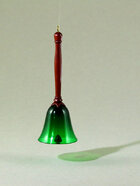
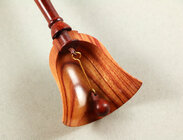
This is an example of the acrylic I turn. I buy acrylic rods, usually in 1-1/2" diameter, 4' long, quite expensive. Easy to turn with sharp tools. I made the handbell ornament from a piece that was so dark I thought it was black. When holding it to a bright light came through the edge where the rod was cut I noticed a hint of green. Turned the green bell from it. I cut one from wood in half to show others the wall profile I use - thick at the top, thin at the rim.

1776540446288.jpeg 1776540484314.jpeg

I don't cast resin to turn, never have, don't every want to. I know people who use resin to fill cracks and voids to salvage a piece of wood that might not otherwise survive. That's doesn't interest me.

As you described in another thread, you take green wood, probably up to 30% moisture content, sticker it, check moisture content, log it and wait, check again in six months or so, log it. Takes a couple of years to level out at 10 to 12%. Good solid way to air dry wood. (I have always been told it takes 6 to 7 years to air dry 1 inch lumber, but this is stored outside in covered area.)
When I air dry wet wood, I monitor the existence of any moisture by the weight. When it quits changing, I consider it dry. The time till dry depends on the cross sectional size, the length, the type of wood (specifically the number/size/type of pores), the sealer used, and the temperature/humidity in my shop where I dry. Wood with large open pores might dry quicker than pores filled with tyloses..

When I cut turning blanks for drying, I loosely stack small turning squares but put large blanks on wire shelves to dry. I don't generally use any weight or binding constraint except in exceptional cases.

My shop is heated and air conditioned so the environment doesn't change much over the seasons.

Some pieces of some species will dry in 2 weeks. Some large piece of other species might take years - I've had big blocks of certain species take 10 years to dry. I have Eastern Red Cedar blanks I cut from logs in March of this year that are dry now. I have Persimmon blanks (ebony) hard, dense wood with fine grain and fine pores I don't expect to be dry for 6 months to 3 years, again depending the size of the blanks.

I've always heard that for air most drying some domestic lumber outside, off the ground, stickered properly (if the stacks are wide include central "chimneys" to allow moisture to escape), covered with old boards or tin roofing (never a tarp) - allow one year per inch plus a year. This has been the advice on wood and sawmill forums for years. For more info, ask Sir Googe about the phrase "one year per inch for boards to dry" This is only for boards, a rough estimate that doesn't take species into account and certainly doesn't apply to turning squares, bowl blanks, etc.

On the other hand, I've had 1 and 2" eastern red cedar fresh from my sawmill dry in a day with a possibly unusual method: I lay the boards out flat in the sun on a big flat-bed trailer. This by itself will cause one side to dry quickly and introduce cup warping. However, I flip the boards over continually, watching for the least bit of cup to start. This exposes the other side to the sun which straightens out the cup. Repeat and repeat until there is no more cupping, the boards lay flat, they are dry. Verify with a high-end pinless moisture meter. Then bring them inside to acclimate in the temperature/humidity controlled space. I've dried cedar boards up to 2" thick this way in less than a day.

Cherry is another species that is easy to dry. Holly will dry quickly BUT can warp badly if sawn and dried improperly. One year I used my 3D graphics and analysis software I often used when working for a living, and analyzed the reason sawn boards warp by twisting and cupping. I have learned to exercise certain care when sawing so warp is minimized.

Holly (and other woods) can warp like this when drying if the JKJ doesn't follow his own rules:
1776553685522.jpeg

Persimmon is the worst I've seen to warp. I have pictures but hit the picture limit for this message.

Dogwood and some other dense woods can warp badly IF the blanks are cut too close to the juvenile wood. A good thing to keep in mind when cutting blanks for lidded boxes.

The left side of this box lid was cut too close to the juvenile wood and the wood was not completely dry - a double death knell for a box lid cut too close to finial diameter. Lessons were learned.
1776553580160.jpeg

JKJ
 
I don't think it's necessary to match the humidity level of the surrounding environment, just getting very close will make any changes slow and minimal. (or basically undetectable)

It's pretty easy to tell when your microwaved piece is dry, it quits getting hot; no moisture, no heating.
 
It's pretty easy to tell when your microwaved piece is dry, it quits getting hot; no moisture, no heating.
Darryl, The reason I thought of checking the Microwaved wood with and IR thermometer was that it gets too hot after the moisture is boiled out. I have had a piece catch fire internally, and scorched a couple more. Could you expand on your system? Bowl size vs cycle time vs temp of microwave vs number of cycles.
 
The reason I thought of checking the Microwaved wood with and IR thermometer was that it gets too hot after the moisture is boiled out. I have had a piece catch fire internally, and scorched a couple more.

Many people have gone through this over the years. It is very easy to overheat deep in the wood, make a lot of smoke, and even start a fire. MANY people have set wood on fire like this, made a mess, and destroyed the blank. (This is one reason for the advice to never use the house microwave and work in the kitchen if you have a spouse or live with other family members! I had a separate microwave oven in the shop.)

The microwave's energy doesn't have much effect on parts of the wood that are dry, only heats where at least some moisture is present. During heating some moisture from below the surface will escape through the sides and pores causing the blank to feel warm or hot, but a lot of moisture, at least at first, will be closer to the center of the blank.) The recipe I remember from maybe 15 or more years ago from other forums and discussions (if my memory hasn't failed completely)
  • Set the microwave oven on low power.
  • Heat and cool in cycles.
  • Heat each cycle for a very short time, maybe 30 seconds, might get away with more, depending. (I've known some people who would heat just 10 or 15 seconds each time with expensive wood to err on the side of caution.)
  • Let the wood cool completely after each cycle. This may take 30 minutes or more, depending on the type of wood, the heating time, and size of the blank. It doesn't matter if the outside feels cool - the steam coming from inside may make the outside feel warm or hot but the inside may be much hotter. The wood needs to be completely cool all the way through. Since it difficult to measure the internal temperature, allowing lots of time to cool is best. The longer, the better. While cooling, the moisture inside will tend to equalize but still may have an internal gradient depending on the wood and the geometry of the blank.
  • Weigh the wood with a good gram scale after cooling and write it down.
  • When the weight quits dropping, the wood is dry. This part is exactly like when I air dry blanks for weeks, months, or years.
  • If you burn one, try again a with less power and/or shorter heating times and longer cooling times.
I realize others may have very different and successful methods. But if comparing methods, it might be useful to compare the power of the microwave and the size and type of wood. Might do a google search to find old experience on other forums.

If all this seems like a lot of trouble it's because it is. Depending on the blank and the species, the whole process may take a half a day or more.

All this is why I prefer to let the blanks air dry stickered or on wire shelves. But I usually have a bunch of blanks in a batch and have the luxury of SO many batches in various stages of drying I can afford to be patient - there are always plenty completely dry to choose from. If for some reason I was in a hurry, I might consider the microwave. The microwave method, even done slowly, will be quicker than air drying.

BTW, after trying several scales, this is what I use. I keep two, for "just in case."
www.amazon.com/dp/B07QP4XQNV

JKJ
 
Back
Top