• The forum upgrades have been completed. These were moderate security fixes from our software vendor and it looks like everything is working well. If you see any problems please post in the Forum Technical Support forum or email us at forum_moderator (at) aawforum.org. Thank you
  • Congratulations to David Wyke, People's Choice in the April 2026 Turning Challenge (click here for details)
  • Congratulations to Ted Pelfrey for "Cherry Blossoms on Cherry" being selected as Turning of the Week for April 27, 2026 (click here for details)
  • Welcome new registering member. Your username must be your real First and Last name (for example: John Doe). "Screen names" and "handles" are not allowed and your registration will be deleted if you don't use your real name. Also, do not use all caps nor all lower case.

Minimum thickness for a platter?

Joined
Jan 24, 2010
Messages
3,457
Likes
1,092
Location
Cleveland, Tennessee
Will measure some pecan boards to see if it is feasible to turn shallow platters. Not sure of the thickness as I have a bunch of boards of various sizes and thicknesses from eyeballing them.
 
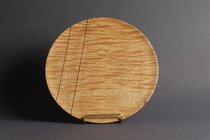
I’ve turned lots of platters from blanks that were as thin as 1”. One was even thinner, maybe 3/4”, but I always used a waste block - something thick enough to make a substantial tenon on so that the chuck jaws can get a good grip. Here’s the final result of the one that was from a 3/4” blank. Sorry, I can’t find the photo that shows an edge view. Figured maple with ebony veneer.

The River2a.jpeg
 
Last edited:
David, thaks for sharing your experience. Love the grain in that platter. How did you do the veneer? I have some thin walnut that could work.
 
I made two cuts through the SQUARE blank with a wide (3/4”) bandsaw blade, then glued in the veneer, BEFORE putting it on the lathe and turning it round. That way, assuming the two sides of the blank are parallel, you can put a strip of the veneer in each cut, put glue on every surface, and clamp across the blank with a few Jorgenson clamps. This one’s about 12” in final diameter, so the blank was probably 13” square. The glue surfaces of the blank were sanded by hand to be sure they were square to each other and with no gaps. When you put the final tighten on the clamps, take care that nothing rises up. I do all this on a Melamine board, the glue won’t stick to that (much) and if one piece or another does rise up, you can tap it back down as you tighten. If you don’t have a piece of Melamine that big, a sheet of wax paper underneath is almost as good. I use Titebond I (original) glue. Once the glue dries, get rid of the squeeze-out and center your waste block on the blank. Then bandsaw it round and t’s ready to go on the lathe. As you turn, measure thickness frequently and keep the gouge sharp. Really sharp.

 
Last edited:
Back
Top