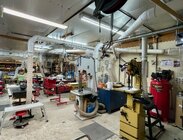
• Congratulations to Bernie Hyrtzak, People's Choice in the January 2026 Turning Challenge (click here for details)
  • Congratulations to David Croxton for "Geri's Basket Illusion" being selected as Turning of the Week for February 2, 2026 (click here for details)
  • AAW Symposium demonstrators announced - If the 2026 AAW International Woodturning Symposium is not on your calendar, now is the time to register. And there are discounts available if you sign up early, by Feb. 28. Early Bird pricing gives you the best rate for our 40th Anniversary Symposium in Raleigh, North Carolina, June 4–7, 2026. (There are discounts for AAW chapter members too) For more information vist the discussion thread here or the AAW registration page
  • Welcome new registering member. Your username must be your real First and Last name (for example: John Doe). "Screen names" and "handles" are not allowed and your registration will be deleted if you don't use your real name. Also, do not use all caps nor all lower case.

Mullet boom arm dust collector

Joined
Feb 7, 2020
Messages
250
Likes
185
Location
Sykesville, Maryland
Anyone using the Mullet boom arm?

Seems like it could use a wider funnel, but the maneuverability of the arm might be an advantage. Wondering how well it stays in place, and how easy it is to re-position.
 
Well, when I sand bowls, I run a 5 inch like to my sanding hood. This thing does not appear to have that option. I have been pondering a big X scissor expand/contract type set up.

robo hippy
 
I drooled over it when I saw it in Texas. I'm more interested in using it on my workbench for carving and routing. Might look into adding it as a second pickup on my lathe.
 
I want to improve my lathe dust collection and am looking at the Mullet Tools Boom Arm set up… it looks good, I like the Mullet it self has only one place to seal. I am concerned about the joints, which look like they are each 2-90 degree bends reducing the suction. Most Important use would for collecting sanding dust.
 
I've seen this boom arm before, and the main thing is that it's got a long, small diameter tube. This isn't going to permit very high CFM, and will basically require a vacuum cleaner (which can achieve the high static pressure this boom is going to require). That as compared to a good, typical dust collector which will generally have much better air movement/CFM but won't fare well with relatively high resistance ducting like this boom.

I do think this tool has its place, but I don't see it serving as a general collector for turning/sanding work [edit, to add:] at the lathe.
 
Last edited:
John, I’m going to disagree with you. Bernoulli’s Principal is at work. The same volume of air will flow through different size tubes. Smaller diameter will have lower pressure but higher velocity. Large diameter will have higher pressure but less velocity. Regardless of size, the CFM remains the same. As a pilot, it’s one of the first things you learn about airflow and why lift occurs on a wing.

Regarding resistance, sharp elbows in a tube increase resistance to flow just as distance does. A rule of thumb is a 90 equals 10 feet of straight. It’s why gentle curves are preferred of sharp turns.
 
John, I’m going to disagree with you. Bernoulli’s Principal is at work. The same volume of air will flow through different size tubes. Smaller diameter will have lower pressure but higher velocity. Large diameter will have higher pressure but less velocity. Regardless of size, the CFM remains the same. As a pilot, it’s one of the first things you learn about airflow and why lift occurs on a wing.

Regarding resistance, sharp elbows in a tube increase resistance to flow just as distance does. A rule of thumb is a 90 equals 10 feet of straight. It’s why gentle curves are preferred of sharp turns.

It’s been a bunch of decades since I studied Burnoulli. My more recent experience with my 5hp cyclone with 6” diameter ducts is two-fold:

1) transitioning from 6” duct to a 4” blast gate then to a 2” flexible corrugated vacuum cleaner hose and then to a tapered nozzle with a 1” opening appears to greatly reduce the suction based on an uncalibrated instrument, my hand. And

2) when closing a blast gate connecting the 6” duct to a 4” corrugated flexible hose to the lathe pickup nozzle, the airflow does not appear to approach infinity but drops rapidly as the opening in the blast gate approaches zero. :) Even restricting the area to 1/2 much reduces the dust pickup at the lathe, all else equal. I’d have to review some principles but I suspect in both significant turbulence and friction in the compressible fluid (air) flow may need to be considered. Might be much different if guillotine blast gates and the ClearVue 6” to dual 4” splitter box had been designed to smoothly reduce the restriction area to something more like I remember seeing in the ideal diagrams in the books.

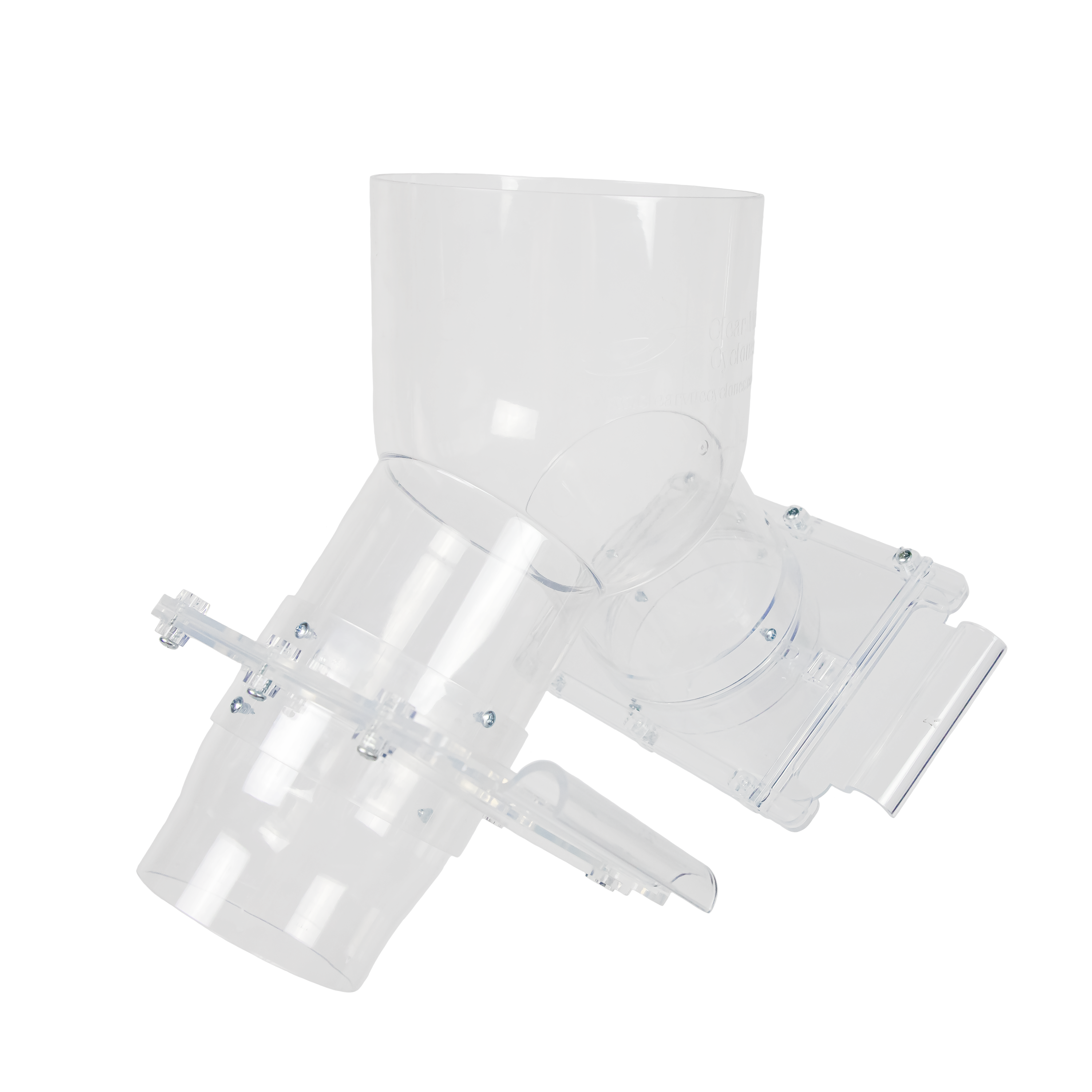
BTW, this is one of the ClearVue 6" to 2-4" splitter boxes with two blast gates I use at drum sander, similar to what I use at the the lathe:
1769866388440.jpeg

Regardless, the Mullet boom arm, which is new to me, might be useful with small burrs in a rotary carver.
 
Last edited:
John, suction as in the pressure differential between the hose pressure and the room pressure will be less in a small diameter hose than the pressure differential in a larger hose assuming the source is the same at an equal distance from the source and without additional resistance to diminish the volume of air moved. The velocity of the air will be greater in the smaller hose. However the volume of air moved will be the same.

And when you add turbulence such as your gate boxes and corrugated hoses, and distance from the source including turns, of course the smaller diameter will be moving less air so you can’t really make a true comparison.

The Bernoulli effect is why a venturi makes a engine carburetor pull gas into the carb. It’s also why funnel shaped openings on dust extraction hoses are more effective than just a hose end.

Clear as mud, right. I do think the boom is a neat idea.
 
Thanks. With the patina my brain cells have developed I don't do the math anymore but I like to keep up. I understand the carburetor venturi and the airfoil function and can make a good guess about resistance factors in a real world (shop) situations. Turbulence and other chaotic effects, in particular, are "difficult" to model. Wind tunnels are unlikely to go away. Calculations for physical systems can be a good starting point but measurements with sensors tell the real story.

The Mallet web site raises more questions for me than it answers, some about the intended market and some about effectiveness to woodturners. Some who buy and try might provide useful 1st hand evaluations and side=by-side comparisons to other methods.. (I can't do it - don't have room in my shop for ONE MORE THING. I'm getting closer to having a give-it-away-free sale.)

I use a wide intake nozzle on a 4" hose at the lathe and with it positioned near the headstock end I've watched fine sanding dust travel maybe 18-20" along a spindle to be pulled into the DC. Keep your cat and wallet and measuring tape away from the business end of a 5hp cyclone DC.
 
As far as Bernoulli, airplane wings, and carbs, things are a bit different with a DC system. The smaller hose creates more friction/pressure drop to the impeller. All the impellers have a cfm vs pressure drop curve, REDUCING FLOW with increased pressure drop, so no, the smaller hose does not flow the same cfm. I have in fact tested it on my DC, but it years ago and I have no I deer where it is. Airplanes fly because the flow over the upper wing moves faster than the flow under the wing, creating lift. I'm not 100% sure why the air on top increases speed to "catch up" to the air under the wing (airfoil top has a longer distance to travel) but I know it does.
 
I think citing Bernoulli's principle in isolation is a misrepresentation of the full engineering problem involved in designing a dust collection system or endpoint like we're discussing here. JKJ's comments above provide a practical anecdote, which in turn gets to the issues Bill Pentz cites in his dust collection writings. E.g. this on ducting size:
A shop vacuum has the pressure to suck air around many obstructions and through smaller openings. Dust collector blowers generate about one tenth the pressure leaving the air more like water, hardly compressible at all. Any restriction, small machine port, obstruction, or even sharp bend kills airflow just like opening a water faucet a little.


To reiterate my deeper point above, it matters greatly what's on the other end of the pipe. This boom, by design, is articulating (i.e. a bunch of bends), and has a small diameter relative to what most dust collectors will work well with. A shop vac, or something like Oneida's Supercell system, with much higher static pressure capacity will fare better.

That said, what I'd originally planned for my own setup was to use the Woodturners Wonders Lathe Track System to position an inlet, but with a custom 3D printed bellmouth (just because I can...). That's been unavailable for all the reasons discussed elsewhere, so I've been looking into cobbling together something similar with off the shelf aluminum extrusion and other parts... In my Copious Free Time and all... 😅 There's a 6-inch port and blast gate sitting idle behind the lathe until I finally sort all that out.
 
Bill Pentz also said you shouldn't have just a single 4 in pipe at the end of a 6 in pipe, so I use two 4 in pipes at each 6 in outlet. (Total areas are close to the same.) At my lathe, I have one behind the item being sanded and one to a box below, between the lathe ways. (dust seems to go down more than back.) It seems to work well, because I don't see as much dust around the shop using it that way.
 
Bill Pentz also said you shouldn't have just a single 4 in pipe at the end of a 6 in pipe, so I use two 4 in pipes at each 6 in outlet.

This is true - good advice. As with many things in woodturning, the need might depend on several things. Those who do heavy power sanding might benefit a lot. The 6 to 4" is effective for me at the lathe, what I mostly turn, and how I work. 6" to double 4" is extremely effective at my bandsaw.

I monitor dust in the air with a Dylos air quality monitor.

JKJ
 
That said, what I'd originally planned for my own setup was to use the Woodturners Wonders Lathe Track System to position an inlet, but with a custom 3D printed bellmouth (just because I can...). That's been unavailable for all the reasons discussed elsewhere, so I've been looking into cobbling together something similar with off the shelf aluminum extrusion and other parts... In my Copious Free Time and all... 😅 There's a 6-inch port and blast gate sitting idle behind the lathe until I finally sort all that out.
John, I made a nice bellmouth end piece for my upgraded dust system, but the weight of it has created problems with the brackets that hold it. Is your 3D printed bellmouth substantially lighter? Light enough that an articulated arm for a reading/shop light could hold it? If so, do you have a printable file that you would be willing to share?
 
John, I made a nice bellmouth end piece for my upgraded dust system, but the weight of it has created problems with the brackets that hold it. Is your 3D printed bellmouth substantially lighter? Light enough that an articulated arm for a reading/shop light could hold it? If so, do you have a printable file that you would be willing to share?
Here's a dust collection bellmouth I found on Printables, designed for 150mm PVC, which should also work fine for 6" flex hose as I'm planning to. My slicing software says it's 91g per segment(**), thus six segments totals 546g or about 1.2lb. It'll be lighter should you scale it down, e.g. to a 4" connection.

I hadn't fully decided whether to go with that one, or to redesign my own version. Should I go my own way, l'll certainly leverage its great idea to cut the model into radial slices for printing (tho some assembly tabs might be helpful).

**: default slicer settings with PETG, 15% grid infill, two wall loops.
 
John, I made a nice bellmouth end piece for my upgraded dust system, but the weight of it has created problems with the brackets that hold it. Is your 3D printed bellmouth substantially lighter? Light enough that an articulated arm for a reading/shop light could hold it? If so, do you have a printable file that you would be willing to share?
I made an elliptical 3d printed bell mouth. I never did CFP on it, so it might be horrible, but it seems to work. Weight is a non-issue. I also made the mount so I can move the flexible hose between two stations. It is on an articulated monitor mount.

1000007895.jpg
 
I made an elliptical 3d printed bell mouth. I never did CFP on it, so it might be horrible, but it seems to work. Weight is a non-issue. I also made the mount so I can move the flexible hose between two stations. It is on an articulated monitor mount.
Thank you, Paul. "non-issue" because it's so light, or for some other reason? Can you provide some detail on the articulated mount you use?

Sorry to be hogging the conversation, folks. Hopefully it's of value to more than just me.
 
Thank you, Paul. "non-issue" because it's so light, or for some other reason? Can you provide some detail on the articulated mount you use?

Sorry to be hogging the conversation, folks. Hopefully it's of value to more than just me.
Non-issue because it is light, around 200g printed in PETG. The articulated mount is not very good . It is very much meant to be mounted vertically, but I have it horizontal because of space issues. I rescued it from a dumpster and had it sitting around. The one thing I do like about is that it has a ball head so I can get pretty much all the vertical height difference I need for the bellmouth by swiveling around that ball. The rest of articulated mount is just used to increase or decrease the distance from the lathe.
 
Reading different responses I think I might have went backwards in efficiency with my dust collection. I replaced a 6" Y with a homemade 6" to 2-6" splitter box similar to the smaller ClearVue one. I did it because of the weight of the PVC and appearance. Am I loosing enough air flow to make it worthwhile to switch it back? (I only run one machine at a time.) I also have the ClearVue 6" to 2-4" splitter box behind a 20" bandsaw, would it make enough difference in airflow to change to the new style?

IMG_5182.jpg
IMG_5207.jpg
 
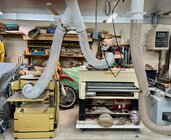
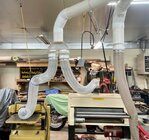
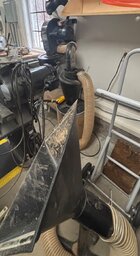
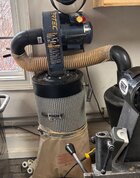
Jim, here are a couple of pictures of my little system. The rated fan capacity is 535 CFM and I can measure 525 at the entry… and at my hood entry at the lathe I measure 350 CFM. So I am loosing 35% of the CFM in the 4” flex hose. I think I need to minimize the flex. Also, I understand now that my big hood is not so efficient… I will change to a velocity stack adaptor as was suggested in this conversation. The velocity stack will arrive tomorrow from Amazon. Having an anemometer is very informative, there are many on Amazon.
 

Attachments

  • IMG_1508.jpeg
    IMG_1508.jpeg
    542 KB · Views: 17
  • IMG_1509.jpeg
    IMG_1509.jpeg
    799.8 KB · Views: 17
Jim, here are a couple of pictures of my little system. The rated fan capacity is 535 CFM and I can measure 525 at the entry… and at my hood entry at the lathe I measure 350 CFM. So I am loosing 35% of the CFM in the 4” flex hose. I think I need to minimize the flex. Also, I understand now that my big hood is not so efficient… I will change to a velocity stack adaptor as was suggested in this conversation. The velocity stack will arrive tomorrow from Amazon. Having an anemometer is very informative, there are many on Amazon.
Those 90’s are not helping. My old HVAC guy told me a 90 was the equivalent of 10’ of straight pipe.
 
Am I loosing enough air flow to make it worthwhile to switch it back?

If using just one at a time with a powerful cyclone it might not be enough loss to matter much. The suction and air moved by my 5hp Clearvue really surprised me. (The first steel bin I used collapsed from the vacuum!) I too close off everything but the duct to one machine at a time.

I think you can measure the static pressure at different points at the same time with with a dual port manometer which might help characterize the loss. (However, I haven't done this but read about it) Digital manometers are inexpensive now. I think most are made for HVAC which is low pressure compared to a dust collector but some might work. I haven't read Pentz in over a decade and now forget - I wonder how he tested.
 
If using just one at a time with a powerful cyclone it might not be enough loss to matter much. The suction and air moved by my 5hp Clearvue really surprised me.
That's what I do and I have a 5hp Clearvue. I also studied the the info Clearvue had when laying out my dust collection. I also have the shortest run to my lathe, that what I use the most. I'm sure there is room for improvement though. I would like a closet to reduce noise. I also think it is a great Idea to actually measure performance. I have a couple of HVAC friends maybe they have a meter to check it.
IMG_5215.jpg

I also really like the Mullet boom arm. Now that they make a 4" one it seems like it would work well with a dust collection system.
 
I would like a closet to reduce noise.

CLOSET I've posted all this before so sorry if you've already seen it. Or maybe someone else would be interested. When I built my shop I put in a 4x8' sound insulated closet. It holds the tall ClearVue cyclone and the 5hp 60gal air compressor (not as deafening as the ClearVue screamer but still loud!) When in use, I can still talk to someone in a whisper right outside the closet.

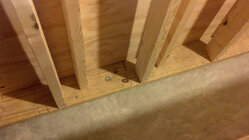
The closet is sound insulated above the ceiling and all the way around except for a double door that opens into a back room - I did use insulated steel doors there but the sound back there doesn't matter. The double doors are a big help when emptying the bin.

I used the "staggered stud" method of insulation: 2x6 wall but with 2x4 studs, one on the outside wall, the next on the inside wall, with insulation woven between them. (Eliminates direct sound conduction through the studs.) I read this method was sometimes used in sound studios.

Maybe a bit hard to see the design with all the shadows:
1770407079280.jpeg

I ran the main 6" duct angled upwards to go through the ceiling, gentle bends, then long straight sections in the trusses, all hidden above the ceiling. Since the long horizontal ducts are all above the ceiling, inspection and cleanout caps are at the ends of the lines. The airflow is so strong I haven't seen or ever expect to see anything accumulating in the ducts.

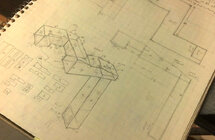
Built a wide baffled plywood duct between the roof trusses to return the filtered air to the shop, coated with rubber spray on the inside and several turns to minimize sound reflections. My sketch for the air return duct:
1770407306571.jpeg

A sub-panel and all the wiring is in boxes inside the closet with remote control of the DC anywhere in the shop and a motor disconnect for the air compressor on the wall outside the closet.

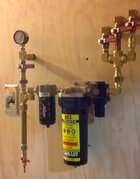
I did one thing for the air compressor that I'm really happy with - I ran the air line through the wall and put all valves and things out in the main shop instead of inside the closet - water separator, desiccant dryer, regulator, and valves to distribution lines installed in the walls. One big advantage of building everything myself was it ended up exactly like I wanted it! The disadvantage was if the dumb builder messed up I could only blame myself...
1770408431901.jpeg

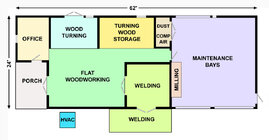
Floor plan showing closet location. (the maintenance bays are now 1/2 full of dry and drying turning blanks on wire shelves. Couldn't get a vehicle in there if I had to)
1770408681010.jpeg
JKJ
 
Back
Top