• The forum upgrades have been completed. These were moderate security fixes from our software vendor and it looks like everything is working well. If you see any problems please post in the Forum Technical Support forum or email us at forum_moderator (at) aawforum.org. Thank you
  • April 2026 Turning Challenge: Salad Bowl! (click here for details)
  • Congratulations to David Bartell, People's Choice in the March 2026 Turning Challenge (click here for details)
  • Congratulations to Ted Pelfrey for "Cherry Blossoms on Cherry" being selected as Turning of the Week for April 27, 2026 (click here for details)
  • Welcome new registering member. Your username must be your real First and Last name (for example: John Doe). "Screen names" and "handles" are not allowed and your registration will be deleted if you don't use your real name. Also, do not use all caps nor all lower case.

Multiple wood finial

Joined
Dec 19, 2013
Messages
13
Likes
35
Location
Albany, OR
I have often wondered how these multiple wood finials are done. Is it simply to glue end grain to end grain, or should they be connected by dowels? Or a metal rod through them?


IMG_3643.jpeg
 
I have always done that by drilling a hole through the piece for the bulb. Then make a tenon on both of the other pieces that fits in the hole to glue it up.
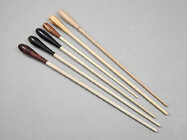
I make similar connections basically the same way, drill a hole part way through, depending, and turn and glue in a tenon. I do this with lots of spindles including conductors batons where I drill a hole in the top of the handle and glue in a fairly long tenon turned on the shaft.

There is usually little strength needed.

Depending on the transition wanted, I sometimes glue first then turn. Half the fun of turning is figuring out good ways to hold and connect things.

1776988605345.jpeg
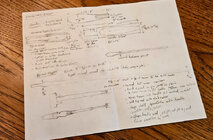
The notes I made for myself. Should prob make a document with better drawings and photos. I'd do that if I did a demo on these but how many conductors does the typical turning club audience know. Custom batons could be a good money maker for someone but not me. I give them away.
1776988643145.jpeg
 
Thanks you both for your replies, this helps immensely. Now if need to work on how to make tenons that are consistent diameter along their length
 
Thanks you both for your replies, this helps immensely. Now if need to work on how to make tenons that are consistent diameter along their length

I drill the hole first.

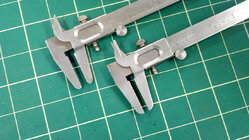
To size the tenon I set cheap, stamped calipers to the desired diameter plus a smidgen to be on the safe side.

Use a parting tool to make several sizing cuts spaced down the tenon. Use the same tool to cut away the high spots. Can use a skew or a straight NRS or even a bit of sandpaper on a stick to carefully clean up the tenon. (If the tenon is slightly loose, epoxy will take care of it.)

Fortunately a long time ago I found these cheap calipers on sale on Amazon for about $4 each and bought a bunch. I put magnets on a spot on the wall above the lathe to keep some handy. The jaws on these cheap calipers are thin and fit nicely into the parting tool groove.

For sizing, of course, the tips need to be rounded with a file like the first one in the pic - this lets the caliper slip nicely over the wood when the parting tool groove reaches the right depth.
1777430052950.jpeg

I never use the scale on these to measure or set a size. For sizing a tenon I set the caliper to the diameter of the hole: close it on the shaft of the drill bit used to drill the hole, tilt the caliper a bit to add the safety "smidgen", then tighten the locking screw.

BTW, unsurprisingly I see calipers like these (not the identical model) are now about twice what I paid in 2013:
www.amazon.com/Vernier-Caliper-Adjustment-Measuring-Micrometer/dp/B08F3G4CTP
I've also found them at HD on pegs with the cheap tools.

JKJ
 
Thanks you both for your replies, this helps immensely. Now if need to work on how to make tenons that are consistent diameter along their length
Jeff, a good way to have consistent size on a tenon for finials and other mall tenons - an open end wrench. I make coffee scoops and other thinks with small handles connecting them with a 1/4" tenon. I use a 1/4" open end wrench. Parten tenon to about that diameter, check if the wrench slide on the tenon (lathe off). If not, take a little more wood off and check again. Repeat as necessary until sze is reached. I usually go for a snug fit with the wrench not a loose fit. I have done this with other sizes too. Works great!

Here is another idea from Cap' Eddie who used to do a lot of videos on youtube. I have done this and it works great. BUT NOTE: like anything with "homemade tools" (or really any tools) use with caution and proceed at your own risk!!

View: https://www.youtube.com/watch?v=qATykxAuZ-E
 
I also use a wrench to size tenons - sharpen the top and use it like a scraper (that's what the Cap'n Eddie video Ricc posted is about). I get close with a parting tool then use the wrench to get down to size. I usually use the wrench away from the 'good part' of the turning (in case the wrench catches I still have something to work with), and then use a parting tool to match that size for the rest of the tenon. Haven't had a problem with the wrench catching, but it just seems prudent to do it that way.
 
Jeff, a good way to have consistent size on a tenon for finials and other mall tenons - an open end wrench. I make coffee scoops and other thinks with small handles connecting them with a 1/4" tenon. I use a 1/4" open end wrench. Parten tenon to about that diameter, check if the wrench slide on the tenon (lathe off). If not, take a little more wood off and check again. Repeat as necessary until sze is reached. I usually go for a snug fit with the wrench not a loose fit. I have done this with other sizes too. Works great!
I do this a lot. However, you really need to check that, e.g., the 1/4" gap width in the wrench is indeed a true 1/4" or at least matches up with your supposed 1/4" also drill bit. I've found some wrenches have a slightly oversize gap, so that resulting tenon may be snug (or worse). I looked at the Capn Eddie video -- he emphasizes matching your wrench and drill bit. Just because the drill bit and wrench both say 1/4" doesn't mean that they actually match. CHECK. I do a LOT of spindle work with 1/4" and 5/16" tenons.
 
I do this a lot. However, you really need to check that, e.g., the 1/4" gap width in the wrench is indeed a true 1/4" or at least matches up with your supposed 1/4" also drill bit. I've found some wrenches have a slightly oversize gap, so that resulting tenon may be snug (or worse). I looked at the Capn Eddie video -- he emphasizes matching your wrench and drill bit. Just because the drill bit and wrench both say 1/4" doesn't mean that they actually match. CHECK. I do a LOT of spindle work with 1/4" and 5/16" tenons.
Good point. I figure if a wrench is supposed to fit over a 1/4" nut, it probably needs to be a bit over-sized or you'll never get it on/off the nut.

I have a specific wrench (15/64") and a specific bit (1/4" straight router bit) I use for coupling a goblet's stem/bowl/foot. I want those tenons to fit loosely - they are mainly for alignment and glue surface, not a snug structural fit. So that wrench makes a slightly smaller tenon that, for me, works well with that bit.
 
Back
Top