Has anyone compared scraping and shear-scraping with conventional scrapers and shear-scrapers with scraping and shear-scraping with negative-rake scrapers? My rough-and-ready trials indicate that negative-rake scrapers leave less tearout. If others confirm my findings, then it would seem sensible to convert one’s conventional scrapers and shear-scrapers to negative-rake versions by grinding a 25 degree top bevel a couple of millimetres wide on them. Any thoughts?

-
December 2025 Turning Challenge: Single Tree! (click here for details) -
Congratulations to Bob Henrickson, People's Choice in the November 2025 Turning Challenge (click here for details) -
Congratulations to John Dillon for "Chinquapin Oak" being selected as Turning of the Week for December 22, 2025 (click here for details) -
Welcome new registering member. Your username must be your real First and Last name (for example: John Doe). "Screen names" and "handles" are not allowed and your registration will be deleted if you don't use your real name. Also, do not use all caps nor all lower case.
You are using an out of date browser. It may not display this or other websites correctly.
You should upgrade or use an alternative browser.
You should upgrade or use an alternative browser.
Negative-rake scraping
- Thread starter Mike Darlow
- Start date
In reference to scrapers, all I use are NR. Both store bought and regrinding regular scrappers. I do a lot of open segmented work and NRs come in very handy for me.
A disclaimer about me. I am not trying to be the best turner in the world. I like making things and using whatever is the easiest to use. I use mostly carbide cutters and NR scrapers.
A disclaimer about me. I am not trying to be the best turner in the world. I like making things and using whatever is the easiest to use. I use mostly carbide cutters and NR scrapers.
Before they were in vogue, 20-some years ago I ground one to negative rake on the advice of a traveling turner presenting at a club meeting. But I never felt it offered anything superior to a normal scraper with a proper burnished hook held "handle high", or held with the edge tilted on an angle in shear mode. That tool pretty much sits untouched in a drawer.
yep, confirmed. only have one negative rake scraper and it does a much better job.Has anyone compared scraping and shear-scraping with conventional scrapers and shear-scrapers with scraping and shear-scraping with negative-rake scrapers? My rough-and-ready trials indicate that negative-rake scrapers leave less tearout. If others confirm my findings, then it would seem sensible to convert one’s conventional scrapers and shear-scrapers to negative-rake versions by grinding a 25 degree top bevel a couple of millimetres wide on them. Any thoughts?
Havent converted mine as yet, but tend to lift the handle into the negative position, it works for me. But then I think it depends on the species you are turning.Has anyone compared scraping and shear-scraping with conventional scrapers and shear-scrapers with scraping and shear-scraping with negative-rake scrapers? My rough-and-ready trials indicate that negative-rake scrapers leave less tearout. If others confirm my findings, then it would seem sensible to convert one’s conventional scrapers and shear-scrapers to negative-rake versions by grinding a 25 degree top bevel a couple of millimetres wide on them. Any thoughts?

I haven’t tried ‘shear scraping’ (angled up on side) with my NR. One of the benefits I’ve found with NR is it’s simplicity to use - just bring in level and it leaves a very clean cut.
Years ago I scared myself with a scraper up on its side; it caught and slapped the tool rest *hard*. Additionally I’ve had occasions with a scraper angled down where it self-feeds at the bottom of a bowl.
I still use scrapers, but not as much as the NR. There are uses for both, but you can’t beat an NR for a simple light cleanup.
Years ago I scared myself with a scraper up on its side; it caught and slapped the tool rest *hard*. Additionally I’ve had occasions with a scraper angled down where it self-feeds at the bottom of a bowl.
I still use scrapers, but not as much as the NR. There are uses for both, but you can’t beat an NR for a simple light cleanup.
Has anyone compared scraping and shear-scraping with conventional scrapers and shear-scrapers with scraping and shear-scraping with negative-rake scrapers? My rough-and-ready trials indicate that negative-rake scrapers leave less tearout. If others confirm my findings, then it would seem sensible to convert one’s conventional scrapers and shear-scrapers to negative-rake versions by grinding a 25 degree top bevel a couple of millimetres wide on them. Any thoughts?
I have thoughts!

I've done such comparisons. I my opinion the NRS are far better for smoothing, no tearout on good wood, very controllable, can make incredibly smooth surfaces and surface refinements with little effort. Unlike potentially aggressive conventional scrapers, I can hand a negative rake scraper to a first-day beginner and with 30 seconds of introduction they are instant experts! The aggressiveness or delicateness depends somewhat on the burr added after sharpening.
When I first started reading about NRS I tried converting one. Ooo! I converted most of my scrapers to NRS then bought some more square-end scrapers and skews from Doug Thompson and ground those into NRS with various shapes. I've made small NRS from spindle gouges. and round stock. I do keep a couple of conventional scrapers now but the rest are now NRS, from a tiny Ashley Isles radiused scraper to a 1.25" wide curved scraper, probably about 10 different shapes and a few duplicates so I can quickly pick up a "fresh" one. I still have the John Jordan double-ended shear scraper but gave away the massive long-landled scrapers I didn't think would make good NRS.
I've tried different top and bottom bevels and found most work about the same as long as the included angle is less than 90-deg.
BTW, I shape with a 60 grit CBN wheel and sharpen with 600 grit CBN, remove any grinder burr with an extra fine diamond hone and/or the leather stopping wheel on the Tormek. Then use a burnisher to create the burr. Can refresh the edge multiple times before going back to the grinder.
I experimented a lot with various edge shapes and the curved NRS in the first photo below have been the most useful for me - I grind a long curve down one side and a short flat on the end, unlike any I'd seen. (I do know some who made this shape later.)
I grind these with an equal bevel on both sides (a bit like a skew) so I can make them "left" or "right" simply by changing the direction I burnish the burr. The second photo shows the view from the sharpened edge and the little platform angle-setting gauge I made for this style.
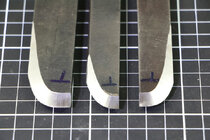
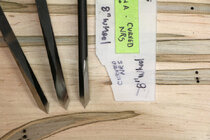
This shape lets me remove gouge marks from bowls, platters, and "dished" platters. The burnished burr will take off amazingly fine shavings. The second photo show just one reason for the flat on the end - to gently smooth the wings/corners when "turning air." A conventional scraper on the corners might be a problem.
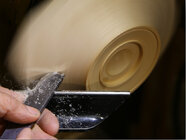
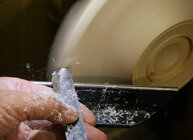
These work so well I haven't reached for a conventional scraper for years. So far two students have asked me to grind one for them with this shape.
To double-up on scrapers, I almost always grind a different shape on the other end, whether it's a narrower NRS on the tang or different shapes on both ends of 1/4" and 3/8" round stock. I don't put handles on any of these. Used the only way I know, there are no significant forces on the tool - could hold and guide one with just the thumb and one finger of each hand.
If anyone is interested, I've tried various methods of burnishing a burr and now only use the Arno burnishers - they have several advantages for both NRS and conventional card scrapers.
Amazon.com: Arno French Carbur 2 Double Sided Carbide Cabinet Scraper Burnisher 115508 : Tools & Home Improvement
Amazon.com: Arno French Carbur 2 Double Sided Carbide Cabinet Scraper Burnisher 115508 : Tools & Home Improvement
www.amazon.com
When useful, I use a different type of scraper for spindles.
(I realize this is more than you asked but hey, someone else might be interested!)
JKJ
Video, at the 17:50 mark is a good explanation of shear scraping with a conventional scraper.
View: https://youtu.be/vguvnSEhokE?
I didn't mention that on occasion I will lay down a skew on its side for a quick scraping action, so in essence it is a negative rake scraper. Usually it would be to define a tenon for chuck mounting, or some similar limited action. I would not drag a skew across an entire surface.
I didn't mention that on occasion I will lay down a skew on its side for a quick scraping action, so in essence it is a negative rake scraper. Usually it would be to define a tenon for chuck mounting, or some similar limited action. I would not drag a skew across an entire surface.
A big thankyou to those who have contributed to the debate on comparing conventional scraping with negative-rake scraping. The consensus seems to be that the latter is better. No-one has mentioned any disadvantages from negative-rake scraping, so it does seem to be worthwhile converting all your conventional scrapers (except those used for parting).
I started this thread because I’m preparing a second edition of Sharpening Woodturning Tools and was conscious that I had rather neglected scraping in the first edition. Also trials which compare techniques can be inconclusive.
I have a second query which I’d be grateful for some input on. The sharpening angles recommended in books for conventional scrapers range from 45 to 80 degrees. A conventional negative-rake scraper has two bevels, both with a bevel angle of 25 degrees, giving a sharpening angle of 50 degrees. Is there a particular sharpening angle which is optimum for conventional scrapers? and can the bottom bevel of a negative-rake scraper be steeper without adversely affecting performance?
Thank you, Mike Darlow
I started this thread because I’m preparing a second edition of Sharpening Woodturning Tools and was conscious that I had rather neglected scraping in the first edition. Also trials which compare techniques can be inconclusive.
I have a second query which I’d be grateful for some input on. The sharpening angles recommended in books for conventional scrapers range from 45 to 80 degrees. A conventional negative-rake scraper has two bevels, both with a bevel angle of 25 degrees, giving a sharpening angle of 50 degrees. Is there a particular sharpening angle which is optimum for conventional scrapers? and can the bottom bevel of a negative-rake scraper be steeper without adversely affecting performance?
Thank you, Mike Darlow

A scraper is a scraper no matter the grind. The only difference is how you hold it in relation to the cut. Perpendicular to the cut - NRS or tilted down - regular scraper. I have never found one to be better than the other.

Thanks!I have thoughts!
I've done such comparisons. I my opinion the NRS are far better for smoothing, no tearout on good wood, very controllable, can make incredibly smooth surfaces and surface refinements with little effort. Unlike potentially aggressive conventional scrapers, I can hand a negative rake scraper to a first-day beginner and with 30 seconds of introduction they are instant experts! The aggressiveness or delicateness depends somewhat on the burr added after sharpening.
When I first started reading about NRS I tried converting one. Ooo! I converted most of my scrapers to NRS then bought some more square-end scrapers and skews from Doug Thompson and ground those into NRS with various shapes. I've made small NRS from spindle gouges. and round stock. I do keep a couple of conventional scrapers now but the rest are now NRS, from a tiny Ashley Isles radiused scraper to a 1.25" wide curved scraper, probably about 10 different shapes and a few duplicates so I can quickly pick up a "fresh" one. I still have the John Jordan double-ended shear scraper but gave away the massive long-landled scrapers I didn't think would make good NRS.
I've tried different top and bottom bevels and found most work about the same as long as the included angle is less than 90-deg.
BTW, I shape with a 60 grit CBN wheel and sharpen with 600 grit CBN, remove any grinder burr with an extra fine diamond hone and/or the leather stopping wheel on the Tormek. Then use a burnisher to create the burr. Can refresh the edge multiple times before going back to the grinder.
I experimented a lot with various edge shapes and the curved NRS in the first photo below have been the most useful for me - I grind a long curve down one side and a short flat on the end, unlike any I'd seen. (I do know some who made this shape later.)
I grind these with an equal bevel on both sides (a bit like a skew) so I can make them "left" or "right" simply by changing the direction I burnish the burr. The second photo shows the view from the sharpened edge and the little platform angle-setting gauge I made for this style.
View attachment 83439 View attachment 83440
This shape lets me remove gouge marks from bowls, platters, and "dished" platters. The burnished burr will take off amazingly fine shavings. The second photo show just one reason for the flat on the end - to gently smooth the wings/corners when "turning air." A conventional scraper on the corners might be a problem.
View attachment 83441 View attachment 83442
These work so well I haven't reached for a conventional scraper for years. So far two students have asked me to grind one for them with this shape.
To double-up on scrapers, I almost always grind a different shape on the other end, whether it's a narrower NRS on the tang or different shapes on both ends of 1/4" and 3/8" round stock. I don't put handles on any of these. Used the only way I know, there are no significant forces on the tool - could hold and guide one with just the thumb and one finger of each hand.
If anyone is interested, I've tried various methods of burnishing a burr and now only use the Arno burnishers - they have several advantages for both NRS and conventional card scrapers.
Amazon.com: Arno French Carbur 2 Double Sided Carbide Cabinet Scraper Burnisher 115508 : Tools & Home Improvement
Amazon.com: Arno French Carbur 2 Double Sided Carbide Cabinet Scraper Burnisher 115508 : Tools & Home Improvementwww.amazon.com
When useful, I use a different type of scraper for spindles.
(I realize this is more than you asked but hey, someone else might be interested!)
JKJ
John, what angles do you use on your NRS?grind these with an equal bevel on both sides (a bit like a skew)
A big thankyou to those who have contributed to the debate on comparing conventional scraping with negative-rake scraping. The consensus seems to be that the latter is better. No-one has mentioned any disadvantages from negative-rake scraping, so it does seem to be worthwhile converting all your conventional scrapers (except those used for parting).
@Mike Darlow The only disadvantage I know of is the NRS is much less aggressive than a conventional scraper. This might prevent someone hollowing a big bowl with a scraper!
I have a second query which I’d be grateful for some input on. The sharpening angles recommended in books for conventional scrapers range from 45 to 80 degrees. A conventional negative-rake scraper has two bevels, both with a bevel angle of 25 degrees, giving a sharpening angle of 50 degrees. Is there a particular sharpening angle which is optimum for conventional scrapers? and can the bottom bevel of a negative-rake scraper be steeper without adversely affecting performance?
You may have missed it but I wrote above "I've tried different top and bottom bevels and found most work about the same as long as the included angle is less than 90-deg."
The 60-deg included angle I use on the curved scrapers is perfect for my use for the reason I mentioned in the other message. However, I have a bunch special-purpose ground differently. They all work.
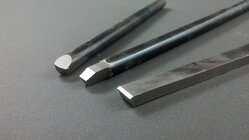
Here are a few I use a lot, depending on the need.
And if writing about these, consider the burr.
Some use the burr from the grinder - not desirable in my opinion since it doesn't last long. (Just look at a grinder burr with a microscope to see why.)
For how I use scrapers, a burnished burr is superior. Best to test different burrs and see for yourself. Three things matter: the working diameter of the burnisher, the angle burnished, and the pressure used. You can add a burr, test it, then remove it with a very fine diamond hone, then burnish another with different angle and/or pressure, test that. I prefer the blue Eze-Lap extra fine diamond hones for dressing the cutting edges of tools and for removing a NRS burr for renewal.
I burnish the burr on NRS differently than on conventional cabinet scrapers (which I also use a lot in turning).
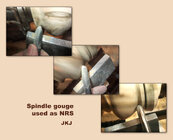
Oh, when thinking of the included angle I don't think there is a minimum. Consider this, a spindle gouge used as a negative rake scraper. If it were turned up the other way and held just right, it could be shear scraping. When inverted like this it works well as a rounded-tip NRS.
The middle one could almost be considered "shear scraping" the way it's rotated. But the others, held with the flut flat against the rest, I think not. At some angles there's not much difference. But rotate a tiny bit to far - possible big catch!
This method of smoothing, BTW, works extremely well and is perfect for some situations. I may use it when I don't have just the right NRS at hand. (Note there is no burr added and it still works. I should try this after adding a burr sometimes.)
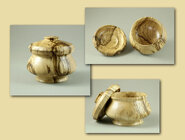
I think it's this box, the bot two pic are before parting off the lid and turning the inside:
JKJ
Last edited:
I think I use 30-deg on each side of the curved NRS with the short straight section at the tip. This would give a 60-deg included angle.John, what angles do you use on your NRS?
I could measure, but I as mentioned, I don't think it's critical.
A sharper angle, like a skew with a 40 to 45-deg included angle would work well.
I remember an extremely well known pro turner at a symposium using the skew as a NRS on the outside of a bowl while saying it makes a great a paint can opener. Some excellent bowl, platter, vessel, and hollow form turners never learned to be comfortable with a skew where it excels, on spindles.
JKJ
I will be doing a club demo on NRSs in August. Probably past time for me to make that video.... NRSs excel on end grain, you can get surfaces that 400 grit roughs up, once you get the hang of them. They work okay on bowls, mostly for sweeping across the bottom, but once you go up the sides and through the transition area, they are still scrapers, so they will still pull at the grain. Your end results depend a lot on the wood. For me, I prefer a shear scrape for the final cut on all of my bowls. The one exception is in my recess. I use the NRS because it is very difficult to get a good shear scrape in the inside of a recess. What the NRS does inside the recess, and on a tenon too if I used those, is as you ease it in, it nibbles off the high spots. This makes for a more true mount when you reverse the bowl so you get less tear out. The shear scrape works the same way, it just nibbles off the high spots till your bowl is running pretty much true. I have watched Richard Raffen and Tomislav with their 50 degree bevel scrapers for final cuts on their bowls, and they get far better surfaces than I do. I never get to start sanding on bowls under about 120 grit. Again, this depends on the wood. If you use a gouge for your final pass on a bowl, try this: just ease a pencil into the wood as it spins till it just starts to mark the wood and turn the lathe off. You get an interrupted line which corresponds to the uphill/down hill parts of the bowl. As near as I can tell, this is due to rubbing the bevel and how a gouge cuts through end grain and side grain. A shear scrape will remove most it if you are patient enough. So will a NRS, but to me, the NRS doesn't leave as good of a surface as the shear scrape. I liken this all to hitting speed bumps in parking lots. A scraper is hitting the bump straight on. A shear scrape is hitting it at a 45 or so degree angle which smooths out the bump. You can go higher than 45 degrees, and I often do. A spear point is used on the outside only of a bowl, and a round nose or ) nose works on the inside. Note here, with a shear scrape, you ALWAYS keep the handle low, and like the skew, never work/cut above the center line of the tool. I have heard people say that it does not make any difference since you are not rubbing the bevel, but I still won't do it. I did a video on shear scraping.
Now for angles, the skew was the first NRS. I remember a work shop with Allan Batty where he told us of turning billiard balls out of elephant ivory, and they used the skews as NRSs, and it was a couple of years of turning them to get them to final size and perfectly round. Stuart Batty claims to have coined the phrase. I think there were NRS saw blades long before he coined the phrase. One problem with them is that they are very high maintenance tools. On the skew chisel styles, the burr is gone in seconds. If you have a 1/4 round profile and are turning a 10 inch bowl, and you are NRSing the inside of a bowl, you start on the heel of the tool in dead center, pull through the cut to the rim and keep moving the cutting edge, and the burr is gone and/or done/dull by the time you get to the rim. I figured long ago that there needs to be a certain amount of metal under the burr to support it. On my robo rest, I sharpen at 30 degree setting for the top bevel, and 80 degrees for the bottom bevel. Actual measures are 25/55 since my angles are off by 5 degrees. The grinder burr outlasts any I have had on a skew type by far, several times longer. I can burnish it down, then back up a couple of times before it wears out and I need another trip to the grinder. I did make one that was 45/45, and it was nowhere close to the 30/60 grind that I use. There are some that say you should form the top side burr by sharpening upside down since that makes for a sharper burr. I did try it a few times, and I didn't notice any difference, other than the burr was gone in much less time.... Stuart claims that the included angles need to be less than 90 degrees. Well, maybe. I will stick with my 30/60.
robo hippy
Now for angles, the skew was the first NRS. I remember a work shop with Allan Batty where he told us of turning billiard balls out of elephant ivory, and they used the skews as NRSs, and it was a couple of years of turning them to get them to final size and perfectly round. Stuart Batty claims to have coined the phrase. I think there were NRS saw blades long before he coined the phrase. One problem with them is that they are very high maintenance tools. On the skew chisel styles, the burr is gone in seconds. If you have a 1/4 round profile and are turning a 10 inch bowl, and you are NRSing the inside of a bowl, you start on the heel of the tool in dead center, pull through the cut to the rim and keep moving the cutting edge, and the burr is gone and/or done/dull by the time you get to the rim. I figured long ago that there needs to be a certain amount of metal under the burr to support it. On my robo rest, I sharpen at 30 degree setting for the top bevel, and 80 degrees for the bottom bevel. Actual measures are 25/55 since my angles are off by 5 degrees. The grinder burr outlasts any I have had on a skew type by far, several times longer. I can burnish it down, then back up a couple of times before it wears out and I need another trip to the grinder. I did make one that was 45/45, and it was nowhere close to the 30/60 grind that I use. There are some that say you should form the top side burr by sharpening upside down since that makes for a sharper burr. I did try it a few times, and I didn't notice any difference, other than the burr was gone in much less time.... Stuart claims that the included angles need to be less than 90 degrees. Well, maybe. I will stick with my 30/60.
robo hippy