• January 2026 Turning Challenge: Turned and Bent! (click here for details)
  • Congratulations to Phil Hamel, People's Choice in the December 2025 Turning Challenge (click here for details)
  • Congratulations to Ric Taylor for "Black Ash Burl" being selected as Turning of the Week for January 26, 2026 (click here for details)
  • Welcome new registering member. Your username must be your real First and Last name (for example: John Doe). "Screen names" and "handles" are not allowed and your registration will be deleted if you don't use your real name. Also, do not use all caps nor all lower case.

Negative-rake scraping

The Hook produced by the Veritas tool can be as big or small as you like, unlike the burr produced by a grinder.
The hook from a Veritas tool is a real hook edge, bevel and all. The burr produced by a grinding wheel is waste metal just waiting to break off.
 
Last edited:
The article Scraper Sharpness by Alan Lacer and Jeryl Wright shows the top part of the burnisher presented at an angle to the top face of the scraper's shank of about 86 degrees, and the scraper's sharpening angle of 55 degrees. I tried this, but couldn't raise a usable burr. The commonly recommended sharpening angle for a burr raised only by grinding is 70 degrees. With this coarse a sharpening angle, I couldn't raise a burr with the burnisher at 86 degrees. I tried burnishing at 86 degrees to the top face of the shank of a negative-rake scraper, but this didn't raise a burr either. Would I be correct in concluding?
1. To raise a burr by grinding the bevel angle between the top face of the shank and the bevel must be less than 90 degrees
2. To raise a burr by burnishing/ticketing the bevel immediately below the edge must be at an angle of less than say 60 degrees to the top face of the shank, and the angle between that face and the top part of the ticketer/burnisher must be greater than 90 degrees.

As an aside, Salaman's Dictionary of Woodworking Tools defines ticketing as 'raising a burr', but doesn't include burnishing. Webster's College Dictionary defines burnishing as 'making shiny', but doesn't include ticketing as a woodworking term. This suggests we should using ticketing for 'raising a burr by using a hard rod'.
 
The article Scraper Sharpness by Alan Lacer and Jeryl Wright shows the top part of the burnisher presented at an angle to the top face of the scraper's shank of about 86 degrees, and the scraper's sharpening angle of 55 degrees. I tried this, but couldn't raise a usable burr.

@Mike Darlow: Are you using a polished round tungsten carbide rod or something else? I've never had a problem raising a usable burr on any scraper I've tried, conventional or NRS, with a variety of included angles such as - 50, 60, 70, 80-deg. Hard to guess the problem without being there. Some tools/burnishers do need more pressure than others. The geometry, in particular the radius, of the burnisher can make a big difference in how easy or difficult it is to create the burr. (I haven't seen the article by Lacer/Wright)

For most scrapers made of steel/tool steel/HSS it should be easy to feel a burr with the finger/finger nail after one moderate pass with a good burnisher. The angle of the burnisher and the pressure used are both factors to consider.

For more about burnishing a burr perhaps look at instructions for card (cabinet) scrapers. Not trying to confuse the issue, since they are entirely different tools - for one thing the face and edge of card/cabinet scrapers are ground (and honed) at exactly 90-deg.

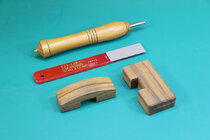
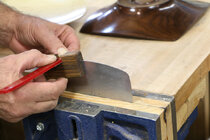
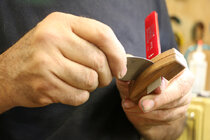
FWIW, after grinding a hand scraper at 90-deg I sometimes use an idea from a FWW article to sharpen the edge of a hand scraper, made a smaller one for small hand scrapers. (But these days with an Arno burnisher instead of the one shown.)
1767496041037.jpeg
1767497048968.jpeg 1767496122615.jpeg


The commonly recommended sharpening angle for a burr raised only by grinding is 70 degrees. With this coarse a sharpening angle, I couldn't raise a burr with the burnisher at 86 degrees. I tried burnishing at 86 degrees to the top face of the shank of a negative-rake scraper, but this didn't raise a burr either. Would I be correct in concluding?
1. To raise a burr by grinding the bevel angle between the top face of the shank and the bevel must be less than 90 degrees
2. To raise a burr by burnishing/ticketing the bevel immediately below the edge must be at an angle of less than say 60 degrees to the top face of the shank, and the angle between that face and the top part of the ticketer/burnisher must be greater than 90 degrees.

My opinion from what I've learned by reading is mentioned earlier in this thread: the angle between the top bevel and bottom bevel needs to be less than 90-deg both NRS, and for the angle between the top face of the tool and the bevel on a conventional scraper regardless of the type of burr.

However, I say "needs to be" based only on my reading - I've never tried to make a woodturning scraper with the an angle equal to or greater than 90-deg.

Some woodturners apparently use a burr raised by grinding. Some who said in the past they used a grinder burr now say they use a burnished burr. Examining a burr from a grinder under a microscope, both freshly ground and after briefly touching it to wood, told me why this wasn't optimal. (I keep a good low-power stereo microscope in my shop for things such as tool edges, wood ID, and self-surgery to remove deep splinters.) I personally remove the grinding burr by stropping on a leather Tormek wheel, treated with with some type of honing/polishing compound, before burnishing a burr.

Also, if discussing a burr raised by grinding it might be useful to mention the effect of the grinding wheel grit. The grinder burr from a coarse AlOx wheel looks quite different than that from a 600-grit CBN wheel.

Your point #2 is not clear to my feeble brain. A diagram might help. I make and use many NRS with a variety of top and bottom angles. I've never thought about the bottom bevel angle relative to the top face of the tool. Putting useful burrs on all has always been quick and easy.

As an aside, Salaman's Dictionary of Woodworking Tools defines ticketing as 'raising a burr', but doesn't include burnishing. Webster's College Dictionary defines burnishing as 'making shiny', but doesn't include ticketing as a woodworking term. This suggests we should using ticketing for 'raising a burr by using a hard rod'.

In my experience differences in terminology between authors is not uncommon.

Historically (according to an old book) the term "ticketing" was used with card/cabinet scrappers - one author said the term comes from a 'tick, tick' sound when creating the burr. I've never heard that myself - perhaps I'm using card scrapers made from different steel or maybe the sound is not as common with polished tungsten carbide burnishers. The term "burnishing" appears far more common now with both card and woodturning scrapers. If putting something in print it might be best to define the terms just before use. I personally would use the word burnishing.

JKJ
 
Thank you John for your input. I have a Veritas scraper/burnisher, but used the back of a gouge to ticket in most of my recent trials. I've just ordered a Veritas carbide rod burnisher to see if that is more successful. Obviously the finer the grinding and/or lapping grit, the better the burr. I'm now buffing the surfaces. This is cheaper and better than a 600-grit CBN wheel. Mike Darlow
 
I tried the Veritas jig about 12 years ago and found that it was very difficult to get even force on the entire edge.
As with Bill, I have not had this problem at all with the Veritas burnishing jig. You do have to apply even pressure as you move the edge of the scraper across the burnishing point, but if the plate is mounted, this is not difficult.

With that said, I also love the Arno burnisher (which I got from Lee Valley): of the two rods on the Arno burnisher, the one with the relatively narrow edge (like the rounded point of a triangle) is very effective at a relatively low effort.

Mike, I have found the Arno burnisher to be more versatile and effective than the Veritas carbide rod burnisher. I'm not sure why, they are both just carbide rods on handles, but that is my take. If I am not using the Veritas jig, I use the Arno.
 
I find different steels form burrs differently. A few com my tools form a great burr right off thev180 cbn wheel. A few others need to be firmed by using a ceramic rod or carbide rod. I think its two things but certsinlybdont know for sure. One is the hardness of the steel. The other is possibly tge shape of the burr. The included angle im guessing changes the shape of the burr. I get a great burr off the grinder on my Thompson steel scrapers. John Jordan's sgear scraper works much better using the ceramic rod John sells.
John k Jordan above mentioned that a smaller diameter rod may raise a better burr. That is correct. I have an old tear drop shaped furnishing tool designed to be used on my cabinet scraper. There is a noticeable difference in the burr formed by the large diameter vs the small diameter.
 
Thanks for linking this, Bill. And thank you, @Carl Ford, for the drawings and explanation! Carl shows what I and others have said forever- the burr off the grinding wheel is not a suitable cutting edge, it is a placebo. "But I get feathery, whispy shavings from it..." Sure, but not for long, because it is not durable, uniform steel, it's the waste left behind from the grinding wheel contact. It is torn-up material from the wheel abrasive. It is sparks that have re-welded themselves in place. It's rubbish.

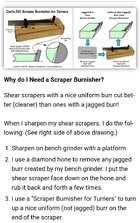
Carl Ford, from the website Bill linked, has a great graphic. This first screenshot from his site shows the drawing and text explanation. Thank you, Carl!
1000017107.jpg
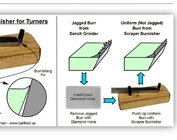
This second screenshot (below) is a close-up of Carl's drawing showing the difference between a grinding burr and an actual hook edge on a scraper. Pick your burnishing tool- Arno, Veritas, Carl's homemade Veritas-inspired jig, a homemade hardened rod in a handle... Any of these tools, even hand-held, will allow you to apply many thousands of psi pressure on the tool edge (waste burr polished off first) to reform that angled edge of your honed scraper upward into an actual hook edge, with a supporting bevel of solid steel that has strength and integrity to support that upward rolled edge. The radius shape of the burninshing tool contacting the edge of the scraper puts a tremendous amount of pressure/force on that edge at a singular point, deforming the honed edge upward into the hook edge. (A radius shape, no matter how big its circumference, can only contact a 2-dimensional edge at a singular point.) The hook edge will last far, far longer than the grinding wheel burr, and depending how much you burnish that hook edge, you can create a very tiny hook edge your fingertip will barely feel, or a relatively heavy hook that can work quite agressively for heavier stock removal (not gouge-heavy, but heavier than whispy shavings).
1000017108.jpg
Lastly, a thread from a year ago about making hand-held hook burnishing tools from carbide rod-
Thread 'cutting a carbide rod' https://www.aawforum.org/community/threads/cutting-a-carbide-rod.23649/
 
Thank you John for your input. I have a Veritas scraper/burnisher, but used the back of a gouge to ticket in most of my recent trials.
Thats why you had trouble raising the burr - the burnisher tool you use MUST be harder than the steel you're burnishing - M2 vs M2 HSS isn't gonna cut it. so as you noted , getting your carbide burnisher should make the difference
I've just ordered a Veritas carbide rod burnisher to see if that is more successful. Obviously the finer the grinding and/or lapping grit, the better the burr. I'm now buffing the surfaces. This is cheaper and better than a 600-grit CBN wheel. Mike Darlow
The "tick tick" sound from burnishing a card scraper typically only happens with the old traditional method of creating the burr where once you hone the edge of the scraper to 90 degrees (and the sides, too) the scraper is laid on its side on bench and run the hardened rod along the sides to first roll a little bit of steel to be "proud" of the edges , resulting in that "tick- tick" as you run your rod end to end (and then scraper is turned edge up and final hook rolled down from the edge using the tiny bit of steel "extruded" from the first side burnishing) new purpose made burnishing tools have machined "v-grooves" with tapered sides so you just run them square across the edge in that "groove" and the side angles do all the work almost effortlessly - but that can't do the trick on turning tools - the veritas burnisher works on a similar principle however - it's a scaled up version of the card scraper burnisher... but with a carbide rod in hand (smaller diameter is better, just like when carving with a knife - smaller shavings are easier to remove than big ones.. stands to reason smaller diameter burnisher is less contact area hence a smaller "shaving")
 
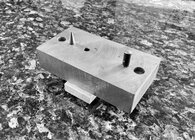
A smaller rod should certainly make forming a hook much easier in tough steels? The carbide rod I got from Veritas is quite small, and using it in a fixture makes it easy to form a hook. I wasn’t sure whether to buy the 5° or 10° pin but I went for the ten and it works well. This is my jig, just a piece of steel plate from the scrap bin.

IMG_7292.jpeg
 
with a carbide rod in hand (smaller diameter is better, just like when carving with a knife - smaller shavings are easier to remove than big ones.. stands to reason smaller diameter burnisher is less contact area hence a smaller

The carbide rod I got from Veritas is quite small, and using it in a fixture makes it easy to form a hook
101_0439.JPG
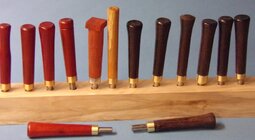
These burnishing tools were made in 2015 using scrape carbide purchased at $20.00 per pound from a sharpening service in Minneapolis. The reason I used 1/2" is that was what was available. The cutting flutes are set in epoxy and the ferals are made of brass plumbing fittings screwed on for a tight fit then turned round (the 5th from left has not been turned round.
The rod is perfectly round so therefore it is one point contact no matter what the diameter may be. The only difference may be the larger diameter may be smoother in forming the burr.
The bottom line is I have been using them continuously since 2015 with excellent results on all shapes and sizes of turning tools and card scrappers.
IMG_0288.jpg
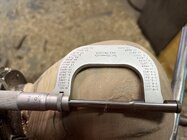
This is an example of shear scraping on a walnut urn and below is a micrometer measuring the thickness of the shaving at less than 1/2 of a 0.001" = 0.0005"
IMG_0289.jpg
 
I do prefer the hand held burnishers for my turning tools since it fits in the pocket of my turning smock. It is as flexible as the Veritas one as in I can put more pressure or less pressure to form the desired burr. I did go with the 180 grit CBN wheels for my scraper burrs, and couldn't really tell any difference in the burr that was formed. Eric Lofstrom prefers a 3/16 burnishing tool, I use 1/8. I do believe that the idea is that a smaller rod makes it easier to put more pressure on the bevel for forming the burr. Can't think of why anyone would want 1/2 inch burnishers, but the "that's all they had" is probably a good reason. My first burnishing tool was one from a carbide set of mini drill bits.

Since we are on the topic of burnished burrs, how do you all form your burnished burr? "Proper" burr forming for the flat work world is to strop off the grinder/file burr , or at least very light and very fine grit removal of most of it and then burnish. Me, I will use the grinder burr till it is dull, then go with "refreshing" the grinder burr by burnishing the burr down, then back up for a fresh edge. It seems that I can do this 2 or three times before I need to go back to the grinder. I do have a 320 stone at the grinder to remove the old burr before I raise a new one. Some times when I am being energetic, I will burnish the old burr off before using the grinder again. I do this with the Big Ugly (burr lasts about half a day), and standard M42 and V10 last a couple of bowls of heavy roughing.

robo hippy
 
Thank you John for your input. I have a Veritas scraper/burnisher, but used the back of a gouge to ticket in most of my recent trials. I've just ordered a Veritas carbide rod burnisher to see if that is more successful.

@Mike Darlow
Good, the 1/8" carbide burnisher should be a big improvement. A 1.8" carbide rod worked for me for years, worked far better than my previous 1/4" (I went to the the smaller rod after a kind and thoughtful well-known gentleman turner bought some rods in quantity about 8 years ago and offered to share. I haven't told him how many people have benefited from these!)

If you plan to use NRS, conventional scrapers, and curved card scrapers in your own turning I STILL strongly recommend acquiring the French made Arno burnisher - readily available from Amazon around here. As mentioned before, it has several advantages over a round rod. If you can't get one where you live and would really like to try it send me an address by private message and I'll send you one in trade for a copy of the book when published. (I bought some spares before the price went up)

BTW, I think I have all of your books except for two. So far I've bought four copies of Fundamentals to have extras to give and loan to students and friends, especially those who seem serious about woodturning (are not spoiled by the youtube snapshots and adverse to reading printed information) but show a desire to learn - this book as some of the best photos, technical diagrams, and exercises I've seen anywhere.

I basically developed my expertise in woodturning from that book and Raffan's Turning Wood. The advice to start with spindle turning is so valuable (from numerous experts that the first tool I put in a beginners hand is a skew chisel even if they've never seen a lathe before. So far with dozens of students not one has gotten a catch with the method I developed to teach (knock on Bubbinga).

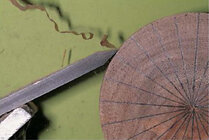
This peeling cut is one of my favorite photos stolen from your book. (Please forgive me) This and the series that show the effects of various clearance angles are priceless - dispels or at least refines the common advice to "rub the bevel." Once you understand the why, EVERYTHING gets easier, fine tool control becomes second nature, catches are banished - and best of all: everything gets easier to teach others!
1767544871760.jpeg

Obviously the finer the grinding and/or lapping grit, the better the burr. I'm now buffing the surfaces. This is cheaper and better than a 600-grit CBN wheel.

I'm not so sure about that. I've burnished scrapers from various grits and I prefer 600 grit CBN on a bench grinder both to sharpen most tools and to sharpen and burnish burrs on NRS and my custom curved hand scrapers. I think I get a better burnished burr quicker with the finer wheel. Fortuanatly, CBN wheels made from aluminum are fairly cheap here; I've given away five so far to friends and schools.

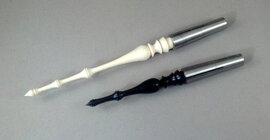
Other reasons for finer grit sharpening: I use the 1200 on the Tormek for my spindle gouges since I'm incredibly "picky", for a reason. For example, the Holly finial below is straight off the tools, zero sanding (no finish). I did use some very fine sanding on the Ebony finial.
1767543683272.jpeg

The above has nothing to do with scraping except it's my opinion that using a finer grit wheels in general can give better edges. I grind all my scrapers, NRS, card scrapers, skews, and parting tools on a 600 grit CBN then remove the grinder burr with a light touch with the leather stropping wheel. I used to use a coarser grit for NRS but I like the 600 better. (For grinding tools to shape I use a 60 grit wheel.)

Another advantages of finer wheels is they remove very little material so tools last longer. A disadvantage is grinding freehand with fine grits might require developing some skill to be efficient.

But as usual in woodturning, much of what we use depends on what we turn and how we work. I don't think there is a universal "right" way for everyone. Long, thin spindles? Roughing or finish turning big bowls and hollow forms from green wood or hollowing then drying, finish turning then smothed with power sanding? Each requires different methods, tools, and skill sets.

JKJ

 
Back
Top