• The forum upgrades have been completed. These were moderate security fixes from our software vendor and it looks like everything is working well. If you see any problems please post in the Forum Technical Support forum or email us at forum_moderator (at) aawforum.org. Thank you
  • It's time to cast your vote in the April 2026 Turning Challenge. (click here for details)
  • Congratulations to Ted Pelfrey for "Cherry Blossoms on Cherry" being selected as Turning of the Week for April 27, 2026 (click here for details)
  • Welcome new registering member. Your username must be your real First and Last name (for example: John Doe). "Screen names" and "handles" are not allowed and your registration will be deleted if you don't use your real name. Also, do not use all caps nor all lower case.

New hollow form...finally

Joined
Jan 24, 2010
Messages
3,441
Likes
1,091
Location
Cleveland, Tennessee
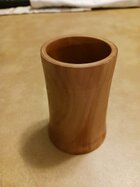
I started this yesterday and the journey was a learning experience, to say the least. I was only able to turn to 1-3/4 inches as I started to get chatter with the piece. I had drilled a 1/4 inch hole to get started but had to stop and leave a drill bit dimple in the bottom; next time only drill much shallower. I have a round nose scraper, half round scraper with the side bevel, Viceroy #1 and square end scraper with side bevel for smoothing the sides. Got it sanded and applied a coat of DIY friction polish. This piece will go on the sofa table in the living room as a display. Will show a photo when dry. I think it is Bradford pear.

 
Yeah, that’s a cup/pencil holder vs a hf, but what the heck, good for a 1st attempt. Chatter - did you keep the cutting edge above center? Full bar scrapers can be troublesome at much depth, tending the get too much edge engaged - with lathe off, move the handle around, twist the handle (for a shear cut), etc to observe how much edge can quickly get into the cut.

A forstner bit ~ 1/2” smaller than final dim can hog things out quickly, if wanting a curved bottom be careful with depth.

Small cutters are best for hollowing (I use 3/16” hss square bar, 6 mm cupped carbide, 8.9mm flat top carbide tips mounted on various dia mild steel bars. Less edge to get into the cut, easier to control.

Scrapers and scraper tips are good for smoothing/finishing the surface, not the actual hollowing.
 
Holding with a good chuck? Dry wood?
Some things I can think of about chatter:
Can be related to lathe speed, the tool and too size, heavy shaft, sharpness, position of the tool rest and firmness of pressure on the rest, the right tool rest for the job, tool presentation, the force and depth of cut (lighter is usually better(, and type and variations in the wood, wall thickness, flexibility (some thin sections can use support outside with the hand.)

I hog out wood with different tools than smoothing. Hard to beat a the right Hunter tool for such projects.
I tend to cut at high speed and smooth/shear scrape at slower.

If possible, even a short a session with a mentor might do wonders.
 
Back
Top