• The forum upgrades have been completed. These were moderate security fixes from our software vendor and it looks like everything is working well. If you see any problems please post in the Forum Technical Support forum or email us at forum_moderator (at) aawforum.org. Thank you
  • February 2026 Turning Challenge: Cookie Jar! (click here for details)
  • Congratulations to Chad Eames for "Red Tines" being selected as Turning of the Week for February 23, 2026 (click here for details)
  • AAW Symposium demonstrators announced - If the 2026 AAW International Woodturning Symposium is not on your calendar, now is the time to register. And there are discounts available if you sign up early, by Feb. 28. Early Bird pricing gives you the best rate for our 40th Anniversary Symposium in Raleigh, North Carolina, June 4–7, 2026. (There are discounts for AAW chapter members too) For more information vist the discussion thread here or the AAW registration page
  • Welcome new registering member. Your username must be your real First and Last name (for example: John Doe). "Screen names" and "handles" are not allowed and your registration will be deleted if you don't use your real name. Also, do not use all caps nor all lower case.

New olive wood!

Joined
Feb 2, 2016
Messages
3,498
Likes
3,975
Location
Clinton, TN
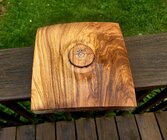
Yippie, my Lovely Bride just returned from Italy with a new, heavy Olivewood cutting board for me! Said it was very cheap.
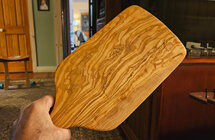
Olive_cutting_board_20250630_123225_ce.jpg

It can sometimes be a problem bringing unprocessed wood through US customs, but never a problem for products made of wood. Several times now I've bought or had made things from Olive, then cut them up at home into sizes I can turn. The figure on this one is nice. Have to think about what to make out of it.

An Italian friend once took me to visit a woodworker high in the hills of northern Italy. He rummaged around in he back room and pulled out a short, thick, dusty olivewood board. I had him cut it into a rectangle, smooth the surfaces, relieve the sharp edges a bit, then apply some oil. I took the "cutting board" home in my suitcase and promptly cut it up into 2" turning squares! Still using some.
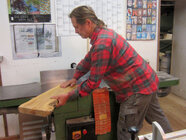
olive_Italy_2016_IMG_4953.jpg

This guy has been in business for decades supplying businesses and homes with cabinets, furniture. The #1 desirable wood in that area: white pine. When leaving, I gave him one of the little turned finger tops I always carry in my pocket when traveling. He was so excited - he turns bedposts and threaded joinery but never saw anything that detailed.

On another trip I found a shop in Athens, Greece that had NOTHING inside but things made from Olivewood, most by the owner's son, some turning but not refined. I gave the owner a little top and he wanted me to come back the next day and meet his son! But we had to leave early for our next flight...

BTW, I highly recommend making and carrying small tops to give away. Nice little "thank yous", great conversation starters. Long story, but we made life-long friends in Northern Italy starting with an encounter on a train from Austria that included little finger tops and other trinkets. I've turned many hundreds of tops.
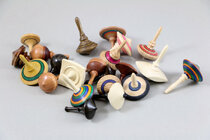
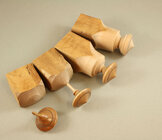
Christmas_2018_IMG_7919.jpg

top_sequence.jpg

JKJ
 
Last edited:
Looking forward to seeing what that cutting board becomes! I’ve often thought about doing the same with some of the cheap Teak and Acacia boards you find at places like TJ Maxx.
 
That cutting boards looks wonderful as it is. I'd leave it that way and show it off as natural art. Drill a hang hole in the handle and display it on the kitchen wall, or if you have one, a dining room wall.
 
We found a similar olive wood store in Eze, France, and bought a cheese board, but this was before I started turning. Hmm, that cheese board may disappear now and transform . . .
 
Best behave, it looks like your wife could give you a solid whack on the backside.

Oh, too late, it's in the shop now. She's never been in the shop. Besides, she likes the things I make for her from olive.

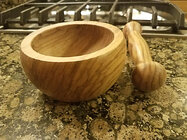
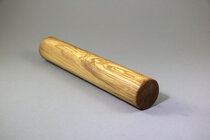
Olive_mortar_and_pestle_E.jpg Rolling_pin_olive_IMG_8137.jpg
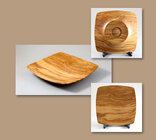
penta_olive_comp_IMG_7459.jpg
One of my favorites to turn. Smells great.

JKJ
 
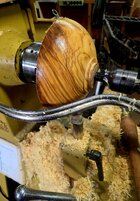
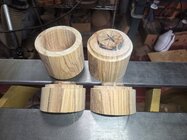
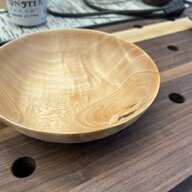
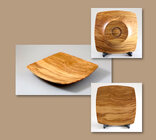
I just recently turned some green/wet olive that I got sealed in wax from Brad at GotWoodLLC a couple of years ago; that heavy wax coating they use certainly kept it from drying out. Anyway, I roughed out a square tray and a bowl from the 8-inch squares I had, and a couple of lidded boxes from a 12" spindle. I didn't know how much it would move, so just assumed a lot, thus the oversize thickness on all the walls. They are currently in paper bags in a cardboard box in my shop. I know olive can crack a lot, so we'll see; the spindle had already started cracking as you can see in the pic. I will figure out a complementary color if I need to do any CA or epoxy inlays, probably something coppery as I already did with the spindles. And John, I agree on the smell; I think it was the most wonderful smell of any wood I have ever turned. In fact, I went and raided the local fancy olive bar that very day! (But sadly, my next turning of camphor burl took over in eye-watering fashion. My shop still smells like it!).

And let me add that it was probably the easiest wood to turn and shear-scrape that I have ever had on my lathe as that pile of fluffy shavings will attest. I will definitely be turning more olive!
20250528_120030.jpg20250528_152306 (1).jpg20250529_134542.jpg
 
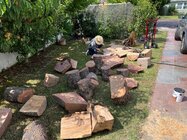
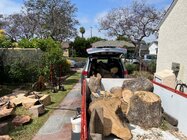
Sometimes an Olive tree comes down in the neighborhood…..lots of work, lots of great wood!! Lot’s of happy local Woodturners!!

Do you know what kind of olive is it? Is it the same or similar to that from the Mediterranean areas?
My brother had what he called a Russian Olive removed and the wood was not even close in figure, color, or density.

From the olive orchards I've seen in Italy and elsewhere that diameter tree would be HUGE!

JKJ
 
Do you know what kind of olive is it? Is it the same or similar to that from the Mediterranean areas?
My brother had what he called a Russian Olive removed and the wood was not even close in figure, color, or density.

From the olive orchards I've seen in Italy and elsewhere that diameter tree would be HUGE!

JKJ
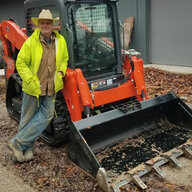
I, too, was shocked at the size of these trunks. I’m not sure of the genus. Very wet, very heavy. For the comedic value, when I first set my eyes on this stash, I was giddy as heck. 6 hrs later in the hot sun, I could barely muster up the effort to load the prepped pieces in my truck! I came to my senses the next morning and returned for more bounty. Lugging wet wood and golfing is a poor mix but the wood whore in me will guarantee another effort down the road…especially with Olive!
 
Sometimes an Olive tree comes down in the neighborhood…..lots of work, lots of great wood!! Lot’s of happy local Woodturners!!
That is the motherlode for sure-I would love to see the piece made from that big crotch in the 1st pic!
 
With the amount of Anchorseal needed, might be a good time to buy some stock in the company.

What a fantastic load you picked up. I eyeballed each piece and thought how lucky your neighbor was to have such a nice guy to help them get rid of all those big pieces of wood.

Great things come out of great beginnings. Can’t wait to see what you will turn.
 
The Escondido/Rancho Bernardo area of San Diego county was once home to huge orchards growing culinary olives. I would assume it's the same species as Mediterranean olive trees, though the variety might be different. The olives look like moose poop out on the local golf courses, so probably black olives as opposed to the green, oil making olives of Italy.
 
The Escondido/Rancho Bernardo area of San Diego county was once home to huge orchards growing culinary olives. I would assume it's the same species as Mediterranean olive trees, though the variety might be different. The olives look like moose poop out on the local golf courses, so probably black olives as opposed to the green, oil making olives of Italy.
Dean-I might be showing my ignorance here, but I thought a black olive is just a ripe green olive? Either way, I love 'em both. In fact, my standard pizza order is pepperoni, mushrooms, onions and LOTS of black olives! Now I wanna turn some more too, though it's pricey here in the East when you can get it.
 
Dean-I might be showing my ignorance here, but I thought a black olive is just a ripe green olive? Either way, I love 'em both. In fact, my standard pizza order is pepperoni, mushrooms, onions and LOTS of black olives! Now I wanna turn some more too, though it's pricey here in the East when you can get it.
Yes. Green are unripe and they turn black when they ripen. There’s a wonderful Provençal olive oil made from ripe black olives. Can’t remember the name now . . .
 
I just recently turned some green/wet olive that I got sealed in wax from Brad at GotWoodLLC a couple of years ago; that heavy wax coating they use certainly kept it from drying out. Anyway, I roughed out a square tray and a bowl from the 8-inch squares I had, and a couple of lidded boxes from a 12" spindle. I didn't know how much it would move, so just assumed a lot, thus the oversize thickness on all the walls. They are currently in paper bags in a cardboard box in my shop. I know olive can crack a lot, so we'll see; the spindle had already started cracking as you can see in the pic. I will figure out a complementary color if I need to do any CA or epoxy inlays, probably something coppery as I already did with the spindles. And John, I agree on the smell; I think it was the most wonderful smell of any wood I have ever turned. In fact, I went and raided the local fancy olive bar that very day! (But sadly, my next turning of camphor burl took over in eye-watering fashion. My shop still smells like it!).

And let me add that it was probably the easiest wood to turn and shear-scrape that I have ever had on my lathe as that pile of fluffy shavings will attest. I will definitely be turning more olive!
View attachment 77085View attachment 77086View attachment 77087
On the little box, twice turn? Sorry for my ignorance, only seen people making them out of dried stuff, but makes sense to treat it like any other bowl/platter/vessel asking because i need to start seriously processing a stack o logs and am kinda lost
 
I just recently turned some green/wet olive that I got sealed in wax from Brad at GotWoodLLC a couple of years ago; that heavy wax coating they use certainly kept it from drying out. Anyway, I roughed out a square tray and a bowl from the 8-inch squares I had, and a couple of lidded boxes from a 12" spindle. I didn't know how much it would move, so just assumed a lot, thus the oversize thickness on all the walls. They are currently in paper bags in a cardboard box in my shop. I know olive can crack a lot, so we'll see; the spindle had already started cracking as you can see in the pic. …

And let me add that it was probably the easiest wood to turn and shear-scrape that I have ever had on my lathe as that pile of fluffy shavings will attest. I will definitely be turning more olive!

Wood dealers often dip many or most exotic blanks, including Olive, in hot paraffin to stop or extremely slow the drying to minimize cracking. This makes a blank take a LONG time to dry, often years. As with other wood, I weigh expensive blanks and write the weight in grams and the month/year on a piece of tape on the side. Periodically reweigh and record the weight/date. When the weight absolutely quits dropping (or even goes back up a tiny bit due to seasonal humidity) the wood will be dry. Large exotics will take a LOT of patience!

You can plot weight vs time on graph paper to get a good idea of where the blank currently is in the drying process. The shape of the curve will tell - if it's leveling out it getting close!

I have a number of olive blanks 6x6 and larger. To safely speed up the drying a little, I first let a blank dry through the paraffin for a year or so. Then I use a cabinet scraper to scrape away some of the thick paraffin. By that time, enough of the moisture is gone that the blank MIGHT survive a bit of accelerated drying. However, since olive is expensive (some blocks I have were over $200) I generally just wait. And wait.

If I have a thick block, say 8x8x4" and want have some shorter turnings in mind, I after some initial drying I might slice the blank in half with the bandsaw and immediately re-coat the cut surfaces with thickened Anchorseal. Then start monitoring the drying on both pieces again. They will dry a little faster since they are both now thinner.

I have some large blocks of Olive still coated with heavy paraffin that have been drying for well over 10 years now. When I get a chance I'll recheck the drying curve and decide if I can remove some of the wax. I hope to use some of this before I get too old and it all goes into someone's fireplace! (I do write the orig price on the piece so maybe that will make some estate sale person pause a moment.)

Another option many use is boiling the wood, 1 hr per inch or so, but I haven't tried that with olive. It's said by some to diminish the color contrast in certain species.

Note that all this may be moot if you are lucky enough to get a thick block of Olive that is cut from a specific tree and position (quartersawn?) that is naturally more stable so you might use it much quicker with no problem. I don't like to take the chance. If a blank cracks, I'll cut it into smaller pieces. If a turned piece cracks, it goes into my Box o' Shame.

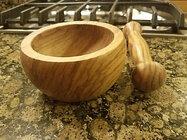
I think I let the block for this mortar for our kitchen dry for about 5 years before turning it. I made the pestle from a small square which had dried quickly. No cracks in either. The large blank was not QUITE dry since it went a bit out of round after turning but that doesn't affect the function.

1772206221870.jpeg

I was fortunate to get a large 6/4 slab of dry olive from a friend (I forget, maybe 16"-18" across) - having visited olive orchards in Italy it was hard to believe the size of the tree it came from.

I could use it immediately and made a number of things that, since the wood was dried, were stable. Love the wood.

1772206499045.jpeg

JKJ
 
Back
Top