• December 2025 Turning Challenge: Single Tree! (click here for details)
  • Congratulations to Bob Henrickson, People's Choice in the November 2025 Turning Challenge (click here for details)
  • Congratulations to Guillaume Fontaine for "Old Tea Pot" being selected as Turning of the Week for December 15, 2025 (click here for details)
  • Welcome new registering member. Your username must be your real First and Last name (for example: John Doe). "Screen names" and "handles" are not allowed and your registration will be deleted if you don't use your real name. Also, do not use all caps nor all lower case.

Oneway Coring System with end grain cuts

Joined
Nov 29, 2025
Messages
19
Likes
6
Location
Wilbraham, MA
Wasn't sure whether to tag this onto another Oneway thread, but it seems unique enough to start a new discussion.

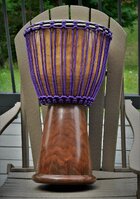
I have a long-term plan to cut large goblet shaped drums from green end-grain heartwood maple. Until a recent introduction into coring, I thought it was going to be a slow wasteful slog of woodchips and sweat. Coring makes so much sense, not only from a work perspective, but having useful blanks to work with is much more practical than bags of wood chips.

The drum will have the pith removed prior to drying; the bowls would obviously not. Not sure how that will play out, but I know there are end grain bowls out there.

The primary thing I wonder about is how coring works with end grain cuts in green wood. If anyone has insight, I would greatly appreciate it!

 
Wasn't sure whether to tag this onto another Oneway thread, but it seems unique enough to start a new discussion.

I have a long-term plan to cut large goblet shaped drums from green end-grain heartwood maple. Until a recent introduction into coring, I thought it was going to be a slow wasteful slog of woodchips and sweat. Coring makes so much sense, not only from a work perspective, but having useful blanks to work with is much more practical than bags of wood chips.

The drum will have the pith removed prior to drying; the bowls would obviously not. Not sure how that will play out, but I know there are end grain bowls out there.

The primary thing I wonder about is how coring works with end grain cuts in green wood. If anyone has insight, I would greatly appreciate it!

If you have done any end-grain turning, you will recall that it is done from the center, out towards the rim. A pilot hole is drilled in the center of the blank, either using a drill bit, or using a sharp 3/8" spindle gouge. The cuts are made by putting the tool into that hole and pulling the cutting edge to the left toward the edge or rim of the blank. This is the most efficient way to cut because of the orientation of the grain, which is running parallel to the bed of the lathe. If you tried to cut downward, just as you would cutting a side-grain bowl, the grain would strongly resist the cut. That's because all the grain is tightly bound together in that orientation, and it's quite strong.

Another way of visualizing this, take a large paintbrush, and grab the bristles just above the metal ferule, and squeeze them together. Now, with all those individual bristles bound in a bunch, try to push down on the top of the bunched bristles with your other hand, or with a tool. They will resist your efforts. But if you (in theory) could drill a small hole in the middle of that bristle bunch, and put the tool in, and cut from the side, drawing away, it's a lot easier.

Typically, coring blanks is done when the wood is presented as side grain. The cores are cut in the same way that you would hollow out a single bowl. That said, I know that it is possible to take a core from a log, in end-grain orientation. Peter Bloch made lamp shades for over 30 years, from Quaking Aspen logs. He used a Dennis Stewart arm brace, and a McNaughton straight cutter to cut a core out, which he used for smaller diameter shades for desk lamps. I've watched him do it. It was a single chunk, taken out to reduce the weight, and time it took to remove the interior of those 18–22-inch diameter logs. It was slow going, compared to how quickly a bowl coring set up can make multiple bowl blanks. It can be done. Slow and tedious, but still faster than trying to use a bowl or spindle gouge (or even a hook tool) to remove all that wood.

I hope this helps. If you try it, let us know how it worked for you.
 
End grain cores do work, but they generally progress more slowly than side/bowl grian cores. If you have the stock Oneway coring bit, as far as I am concerned, it is a terrible desagn, which is why so many switch to the Hunter Core Pro from Hunter tools. A much more efficient design and cutter. I did see one You Tube video some years back where some guy had a Volkswagon Beetle up on jacks, and he had a huge auger bit on one wheel, and he was coring out Djembe style drums from log sections. It can be done. I have seen it done with a chainsaw also. I would guess that if you want to go into production, then methods would change....

robo hippy
 
I’ve done quite a few end grain cores (woodcut bowlsaver 2 blade).

One thing really different with end grain - make sure to position the rig so the cutter goes through center. Unlike x-grain where the core with an 1” or so hub center can be popped out buy cracking along the grain, end grain needs to be cut through. I learned the hard way - pulled the center right out of a core using a crow bar.

Other than that, it isn’t much different. One thing I like to do is take a length of log and start the coring cut on the OD, and for the next core move down the OD and cut another, etc. You end up with multiple “cores” that are the same OD.
 
Your last discussion involved cottonwood as a material. That is one of the few woods that does not make sense to core.
Actually, I posted a video of someone making a drum from cottonwood more for a conceptual approach rather than the wood. Good to know it wouldn't be worth using coring techniques for it
 
If you have done any end-grain turning, you will recall that it is done from the center, out towards the rim. A pilot hole is drilled in the center of the blank, either using a drill bit, or using a sharp 3/8" spindle gouge. The cuts are made by putting the tool into that hole and pulling the cutting edge to the left toward the edge or rim of the blank. This is the most efficient way to cut because of the orientation of the grain, which is running parallel to the bed of the lathe. If you tried to cut downward, just as you would cutting a side-grain bowl, the grain would strongly resist the cut. That's because all the grain is tightly bound together in that orientation, and it's quite strong.

Another way of visualizing this, take a large paintbrush, and grab the bristles just above the metal ferule, and squeeze them together. Now, with all those individual bristles bound in a bunch, try to push down on the top of the bunched bristles with your other hand, or with a tool. They will resist your efforts. But if you (in theory) could drill a small hole in the middle of that bristle bunch, and put the tool in, and cut from the side, drawing away, it's a lot easier.

Typically, coring blanks is done when the wood is presented as side grain. The cores are cut in the same way that you would hollow out a single bowl. That said, I know that it is possible to take a core from a log, in end-grain orientation. Peter Bloch made lamp shades for over 30 years, from Quaking Aspen logs. He used a Dennis Stewart arm brace, and a McNaughton straight cutter to cut a core out, which he used for smaller diameter shades for desk lamps. I've watched him do it. It was a single chunk, taken out to reduce the weight, and time it took to remove the interior of those 18–22-inch diameter logs. It was slow going, compared to how quickly a bowl coring set up can make multiple bowl blanks. It can be done. Slow and tedious, but still faster than trying to use a bowl or spindle gouge (or even a hook tool) to remove all that wood.

I hope this helps. If you try it, let us know how it worked for you.
Thank you for this, Donna. I hope to be able to play around with this Oneway setup soon. I will start with side grain and work my way into more challenging approaches over time.
 
End grain cores do work, but they generally progress more slowly than side/bowl grian cores. If you have the stock Oneway coring bit, as far as I am concerned, it is a terrible desagn, which is why so many switch to the Hunter Core Pro from Hunter tools. A much more efficient design and cutter. I did see one You Tube video some years back where some guy had a Volkswagon Beetle up on jacks, and he had a huge auger bit on one wheel, and he was coring out Djembe style drums from log sections. It can be done. I have seen it done with a chainsaw also. I would guess that if you want to go into production, then methods would change....

robo hippy
VW Beetle! So versatile...

I saw a video which might be the one you mentioned with the chainsaw. The wood was vertical on a turnstyle?

I only heard about coring a week ago, and Oneway was the name that was knocking around. I imagine as I start working with it, I will get a sense of how things work. Will def look at Hunter.
 
I just looked on Hunter's website. They sell parts but not the unit. Are they no longer manufacturing?
Mike Hunter only makes the carbide cutters that are made for use in the Oneway Coring Unit. That setup you would need to buy from Oneway directly, or one of the woodworking / Woodturning specialty brick and mortar or online vendors.
 
It's hard to imagine how a Oneway coring system will work on end grain, as it's designed, fairly rigidly, to make a hemispheric core. If you're going to remove the waste wood from the center of an endgrain blank, even if it's going to be goblet shaped with a curved bottom, one of the straighter McNaughton cutters seems like it would work a lot better. You would have to cut the inside curve by hand, but with the waste out of the way, that would be pretty simple.
 
Back
Top