• December 2025 Turning Challenge: Single Tree! (click here for details)
  • Congratulations to Bob Henrickson, People's Choice in the November 2025 Turning Challenge (click here for details)
  • Congratulations to Guillaume Fontaine for "Old Tea Pot" being selected as Turning of the Week for December 15, 2025 (click here for details)
  • Welcome new registering member. Your username must be your real First and Last name (for example: John Doe). "Screen names" and "handles" are not allowed and your registration will be deleted if you don't use your real name. Also, do not use all caps nor all lower case.

Other helpful non-turning tools of note

Joined
Oct 25, 2020
Messages
1,301
Likes
1,153
Location
Minneapolis, MN
Similar to the recent vernier caliper thread, what other little tools or gadgets, that are not specifically woodturning tools, do you keep at or near the lathe to help with your turning endeavors?

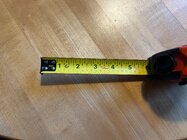
I'll start with Stanley's alternative retracting tape measure, the Leverlock. Unlike their tried and tested Powerlock tapes that have been around forever (a bunch of versions lay around my shop and garage), I found their Leverlock on the store shelf about 20-some years ago, a green 12-footer, and brought it home. Brilliant! No more shoving that Powerlock thumb lever clumsily if the tool is not situated just right in your hands. The Leverlock works intuitively- as the tape is in your hand, squeeze between the 12 and 6 o'clock portions (the lever is at 6:00) to release the tape to either pull out or retract.

I don't know where that old one wandered off to (it'll show up eventually) but the new'ish yellow and orange 12-footers live at the lathes, and the 25' is just for general shop use.
1000016949.jpg
 
I have the usual motley collection of tape measures, various ages and conditions. They all go walk-about from time to time and turn up in obsecure places, as you mentioned Steve
Recently I have stepped into the 21st century with 3 in 1 laser range finder tape, 5m tape , 40m laser. The only draw back is its heavy and large and doesnt sit comfortably in the pocket, I am not sure now how good a buy this one was.
 
I’ve got at least four tape measures in the house, one in the car and two in the workshop.

Many, many years ago I thought that once you bought a tool like a tape measure, that was it.
I then realised the big advantage in having several of them in different places! This also applies to other items like calipers, micrometers, rulers etc.
 
I’ve got at least four tape measures in the house, one in the car and two in the workshop.

Many, many years ago I thought that once you bought a tool like a tape measure, that was it.
I then realised the big advantage in having several of them in different places! This also applies to other items like calipers, micrometers, rulers etc.
I think it is safe to say there are about a dozen tape measures in my life. And then there are straight edge rules, from 4" - 48"...
 
Stanley's alternative retracting tape measure, the Leverlock.

All my measuring tapes are Lever Lock and have been since I discovered them years ago. I don't know how many I have, maybe 10 in the shop, two in the little farm truck, one each in the excavator and skid steer, and one in the chainsaw accessory bag. I use the 30' tapes around the farm.

BTW, I can't make myself call these things tape measures. I hardly ever need to measure tape. :)

what other little tools or gadgets, that are not specifically woodturning tools, do you keep at or near the lathe to help with your turning endeavors

Other "little" things I'd hate to be without:

Really big vernier calipers that open to about 24"
Precision scales for checking dryness of blanks
Gimlets
Scribes
Good lights, really good lights
Spare reading glasses
High power closeup lenses
Vibrating electric engraving tool
Thermostat to control the HVAC for all-season turning
Sensor system on the wall that alerts me when someone is at the security gate
1st aid kits, eye glasses cleaner
Dust masks/respirators
4-leg center marking tool that self aligns on a square blank - tap to make a center mark (can't remember the name)
Plastic center finder
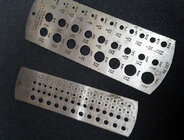
Angle and hole gauges
A pressurized cylinder of inert gas
Magnets, magnets, magnets and more magnets
Certain T-handle allen wrenches stuck to lathe with magnets
Pencils and sharpies with two turns of soft iron wire wrapped around so they will stick to magnets above the lathe
High velocity rechargeable air duster - measured 40mph a foot from the nozzle
Proportional dividers - these are amazing
Compass with long extension arm
Scotch 2060 tape in various widths - can't live without it
Remote fobs for the cyclone DC
Battery tester and spare batteries
Small sledgehammer in case I want to smash something
Water cooler and fridge
Not too little but just around the corner is a reference library of real books with paper pages and a comfy chair
Long reach grabber to fetch finishes and things from the top shelf behind the lathe
A flashlight and a wall-mounted emergency light and exit sign in case the power should ever go out
Metal lathe and mill in the next room
Calibrated hardness testing files
Magic Rub erasers for soft sanding blocks
Sketch pad, clip board, portable drafting/drawing table
12"x17" light board for tracing
An 88-key electronic piano - soothes the soul
Cell phone in case my Lovely Bride needs something
A big wall clock to know when to quit
 
Last edited:
Jointer, Planner, drum sander, stationary belt/disk sander, table saw, miter saw, band saw, metal lathe - for threading wood wood turned items, Bridgeport milling machine - for the ultimate drill press, routers, and just about every small hand tool known to man.
 
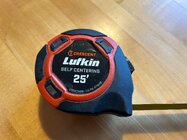
I’ve found this Self-centering steel tape tremendously useful for all kinds of turning and non-turning functions. Saves a bit of mental gymnastics.
NO WAY!! Great, something else to add to the shopping cart.
 
I’ve found this Self-centering steel tape tremendously useful for all kinds of turning and non-turning functions. Saves a bit of mental gymnastics.

From my Amazon orders list it looks like I bought the exact measuring tape in May of 2018.
I haven't used it since.

However, I have a great precision center-finding steel ruler stuck to my bandsaw with magnets I use a lot. It's made differently - zero is in the center of the rule and marking extend in both directions from the center to the end. To use, guess the center, position the ruler, and look at the two numbers on the sides of the thing you want to find the center of. Shift the ruler a bit until the numbers on both sides are the same and the zero will be in the center.

To me, it's easier to use than the self-centering measuring tape, at least for relatively small things. (Mine might be 18" or so.) However, the measuring tape would be great for LONG things such as when marking the center of a shelf, carpentry, centering a light fixture.

I see Amazon has a bunch of them - search for "center finding rule". I see some have the zero mark centered on one edge and a normal scale on the other edge.

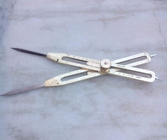
Another great little tool that can give the center or any proportion is a proportional divider. It has a geared pivot and scales and is easily set to any proportion. It's a great way to scale a sketch or a turning, divide something into thirds or any number. Great for scaling things on engineering or architectural drawings Or woodturnings!. Can divide the circumference of a circle into equal parts to make polygons, etc. I don't use it everyday but when the need strikes it's in the drawer!

Mine looks like this one I see on Amazon. I often use it set to 2:1 to find centers.
1766367670627.png
www.amazon.com/Proportional-Divider-Engineer-Drafting-Scientific/dp/B07T1GWQJ6

JKJ
 
Similar to the recent vernier caliper thread, what other little tools or gadgets, that are not specifically woodturning tools, do you keep at or near the lathe to help with your turning endeavors?

I'll start with Stanley's alternative retracting tape measure, the Leverlock. Unlike their tried and tested Powerlock tapes that have been around forever (a bunch of versions lay around my shop and garage), I found their Leverlock on the store shelf about 20-some years ago, a green 12-footer, and brought it home. Brilliant! No more shoving that Powerlock thumb lever clumsily if the tool is not situated just right in your hands. The Leverlock works intuitively- as the tape is in your hand, squeeze between the 12 and 6 o'clock portions (the lever is at 6:00) to release the tape to either pull out or retract.

I don't know where that old one wandered off to (it'll show up eventually) but the new'ish yellow and orange 12-footers live at the lathes, and the 25' is just for general shop use.
View attachment 83042
I like the older LeverLock tapes best, because I have smaller hands and the modern Stanley tapes are all too bulky. I've even searched out and bought new old stock Leverlocks. They're really nice tapes.
 
(Huh, I posted this over in the vernier caliper thread responding to John's protractor post. See the 12" center finder rule in my pic. I thinkbI found it at a local Blick Art store, or maybe Michael's Crafts store.)
--------
I agree on the General-brand (USA-made) protractor/angle finder. Cheaper HF versions have come to me, into the trash they went.

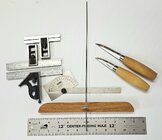
My 6" and 4" double squares (top left USA made PEC-brand from www.HarryEpstein.com as lower cost blemish models), and 6" Starrett combo squares are beloved little tools that may appear at the lathe. Right side, carving knives Morakniv #106 (long blade) or #120 (short blade) as general purpose shop knives, kept at the lathe, surgically sharp, for when I need to trim a little nub off something. The 12" center-finding ruler. And my homemade depth gauge, made from coat hanger wire, a 10" scrap of oak, and a thumb screw threaded into the oak. This has been with me forever.
1000016953.jpg
 
I like the older LeverLock tapes best, because I have smaller hands and the modern Stanley tapes are all too bulky. I've even searched out and bought new old stock Leverlocks. They're really nice tapes.
The 12' Leverlocks in my photo above will fit in a pants pocket, esp. if you remove the belt clip. Fairly low profile. The 25' is bulky, for sure.
 
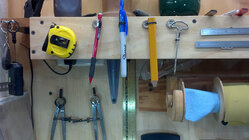
I keep one Leverlock measuring tape on a magnet above the lathe.

1766378289375.jpeg
I keep another one on a magnet epoxied to the bandsaw.

I keep a third one in the wood storage room so I can make sure the blank I'm considering is the right size for the project.

Two small Leverlocks live in drawers the house.

Note: I put a plywood face on the front of the narrow shelf above the lathe for several reasons: one to hide the two switched quad receptacles for the lathe lights, to hide short pieces of soft iron wire bent to keep the electrical wires orderly, and most important, for a handy place to mount magnets to hold stuff.

JKJ
 
Another great little tool that can give the center or any proportion is a proportional divider. It has a geared pivot and scales and is easily set to any proportion. It's a great way to scale a sketch or a turning, divide something into thirds or any number. Great for scaling things on engineering or architectural drawings Or woodturnings!. Can divide the circumference of a circle into equal parts to make polygons, etc. I don't use it everyday but when the need strikes it's in the drawer!

I have a couple proportional dividers from my earlier days. I used one a bit in my archaeological days, in doing a few pottery drawings, but almost all drawings I did (a total of around 10,000) were 1:1 -- even some pithoi (storage jars, up to 48" high and approaching 36" diameter). Those were a challenge.

I used them more in my plank-on-frame ship model building years, working up plans and scaling 'timbers'. Most of the planked models I did were at scales ranging for 1:12 to 1:48. I don't think I've used them in woodturning, although they probably could be useful for some planning some of my more peculiar turnings.
 
I keep an old pair of hoof nippers on the same rack as my turning tools. They’re perfect for removing small nubs from a live center when doing it on the lathe isn’t practical. I found them years ago in a random bucket of tools at a yard sale, and I use them often—the slightly concave jaw profile bites cleanly and gives excellent control.
 
I have a couple proportional dividers from my earlier days. I used one a bit in my archaeological days, in doing a few pottery drawings, but almost all drawings I did (a total of around 10,000) were 1:1

I'm in the early planning stages for a new house and barn. When I get to the finial drawings I'll try to do them 1:1 but I might need a bigger drawing board. 🤣

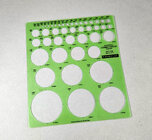
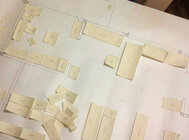
For internal layout of shop machines, benches, and even house furniture I like to make paper cut-outs with the proportions right and move them around on scale floor plan. When designing my shop I made paper circles proportional to the space comfortable for walking and carrying things, and slide them through the space.

1766416570035.jpeg

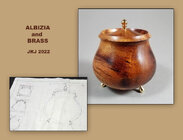
But I do like to do full scale drawings of turnings and carvings, easy since I mostly do small things. I like to measure directly from the drawing so the proportions, although I modify at whim, are somewhat close to the plan. I'm not much for putting a chunk of wood on the late and letting it "speak to me" - when it does it usually says something not appropriate for polite company.

1766419693819.jpeg

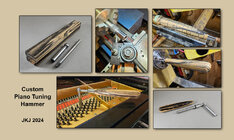
Even this started as a careful full-size tracing/sketch of a handle my friend found comfortable in his hand. B&W Ebony and steel.
Tuning a grand piano can benefit from a design a bit different from that for an upright.

1766421294220.jpeg

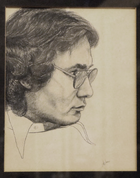
I've used proportional dividers in various other drawings and artwork. For example, they can sometimes mask my visual deficiencies if I take proportions from a photograph, such as for this pencil drawing. (I did this about 1/2 century ago of a friend who passed away far too young.) Mechanical pencil, .5mm, working from a photo. I found the hair challenging. I've also stolen proportions from photos of birds, animals, sheds, etc.

To me, a sketch seems more personal than a photo.
(Sorry, I've posted this before)
1766415692774.png

I'd love to hear sometime about your archaeological experiences!

JKJ
 
There's no end to the "non-turning" tools a turner needs. I have a well equipped cabinet shop, but I still need to call upon my metalworking cronies at times. Still, I would be literally lost, as in buried, without a grain scoop, push broom and 30 gallon bucket
 
I have an ancient Craftman tool box full of all sorts of wrenches and screw drivers. I have multiple tape measures, and I prefer the ones where you push the lever to have the tape retract rather than the ones you pull out and then push the button to keep it out since the button never works. One tape is over 25 years old, and it has always been a shop tape, not a work tape.... Multiple straight edges, including plywood strips for laying out cut lines on log sections. All sorts of pencils and sharpie pens to mark stuff out with. Just got 4 Slick Sticks from Ken Rizza since I use it religiously on bandsaw blades, tool rests, and the soles of my planes. Not on my CBN wheels though. I am sure there are others I am not remembering..... Oh, hand truck, and 2 heavy duty "garden wagons" from U Line for hauling firewood and log sections after I cut them up. Multiple wire shelf racks with big plywood tops for tools and bowl blanks.

robo hippy
 
It's actually used to check the curvature of a bowl or HF. The glue stick is flexible, so easily bent into a continuous curve. Placed on the curved side of the workpiece it can reveal high and low spots on the curve that might be hard to see.
yes, I have extra long glue gun refill sticks that work well for checking if curvature is even on pieces
 
It's actually used to check the curvature of a bowl or HF. The glue stick is flexible, so easily bent into a continuous curve. Placed on the curved side of the workpiece it can reveal high and low spots on the curve that might be hard to see.
That's a neat trick! I was imagining how the heck you would use a child's craft glue stick to check a HF, not a hot glue gun glue stick.
 
I started making small hollow forms this year. I finally found a use for all those hex wrenches I have been saving for years, making tiny hollowing tools.

On a related topic, a carbide burnisher and a credit card size diamond file. I home made the burnisher years ago for flat work. I use them to touch up and raise a bur on my mini hollowing tools instead of using the grinder.
 
Back
Top