• The forum upgrades have been completed. These were moderate security fixes from our software vendor and it looks like everything is working well. If you see any problems please post in the Forum Technical Support forum or email us at forum_moderator (at) aawforum.org. Thank you
  • Congratulations to Bernie Hyrtzak, People's Choice in the January 2026 Turning Challenge (click here for details)
  • Congratulations to Matt Carvalho for "Red Mallee Folded Form" being selected as Turning of the Week for February 9, 2026 (click here for details)
  • AAW Symposium demonstrators announced - If the 2026 AAW International Woodturning Symposium is not on your calendar, now is the time to register. And there are discounts available if you sign up early, by Feb. 28. Early Bird pricing gives you the best rate for our 40th Anniversary Symposium in Raleigh, North Carolina, June 4–7, 2026. (There are discounts for AAW chapter members too) For more information vist the discussion thread here or the AAW registration page
  • Welcome new registering member. Your username must be your real First and Last name (for example: John Doe). "Screen names" and "handles" are not allowed and your registration will be deleted if you don't use your real name. Also, do not use all caps nor all lower case.

Over drying twice turned bowls?

Joined
Apr 15, 2023
Messages
142
Likes
90
Location
Stanfeld, NC
I turn mostly bowls and most of those are twice turned. I have a very nice drying box that is both humidity and temperature monitored. Like most here, I dry my bowls until they have quit losing weight (grams), but from that point in time, they may sit a long time until I finish turn them. I live in a very humid part of the country (NC) but have noticed that my bowls gain a lot of their weight back while they are sitting around. I have not checked them at any point with a moisture meter because a moisture meter can leave pin holes and they do no read moisture very deep in the wood.

Why do we dry to their maximin weight loss if they are just going to pick up moisture from the atmosphere? My shop is heated/cooled year around via a heat pump, so the temperature is stable. I dry my bowls to a 110* setting. It seems like I might be wasting time and resources

Inquiring minds would like to know.

 
I live in north Georgia and consider ~14% moisture “dry” given the high levels of humidity we have here. Drying wood any further than that via manufactured means is a waste of time IMO. As soon as the wood leaves the box, it’s going to reabsorb moisture until it reaches equilibrium with its environment.
 
It's possible in your drying box that you are drying the bowls down to 0 percent moisture content. This low, they will always regain moisture. I'm guessing sitting in the open, in your conditioned shop, they would end up at 6-8 percent moisture content.

The only way I know to monitor the moisture content in the drying box is with a meter. Pinless meters are available that will measure 1/4" and deeper. Skip the cheap ones and get one made by a name brand company. I have Wagner and Delmhorst.

On the other hand, I don't think you're hurting anything by over drying. I often dry the tenons on stool and chair legs to zero before glue-up in the seat.
 
I have stopped using anchor seal and moved to the brown paper bag for everything. My shop is not air conditioned and in the winter I have floor heat that I set the thermostat to about 45 degrees F, then when I go into the shop I light a fire in my wood burning furnace to bring it up to a comfortable temp for working. The green turned pieces are weighed and put in a bag, then after a day or two I reweigh them, record and put them back in the bag. The weighing time interval gradually increases and I don't change the bag, because slow drying is always the best way. The summertime humidity usually results in a slight increase in in weight. Note the 3 replies that came up as I was typing mine.
 
I turn in my non-climate-controlled shed (minus the fan and small space heater) but dry in paper bags in my finished basement until weight loss plateaus. I do run a dehumidifier in my basement 6 mos per year as I am in the Ohio Valley with high humidity half the year This approximates the climate in which most my product will reside. I do notice minor fluctuations in weight for those that sit around longer than usual. I'm not sure of the value-add of a tightly regulated temp and humidity controlled box. Seems that simple equilibration with the typical indoor environment in which your items will reside is all that is necessary-- at least that has been my experience.
 
What is the relative humidity in your drying chamber when your pieces stop losing weight? You should set it at the average humidity your work will experience in service, or whatever conditions it will be in before you finish turn it. Overdrying is a waste of energy, and very dry (<6%) wood is harder to turn without tearout.
 
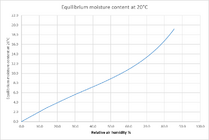
After rough turning, the bowl should be dried to the moisture content that is in equilibrium with the relative humidity of the air it will be exposed to as a finished piece. Fortunately, this equilibrium is fairly independent of species. Indoor air humidity often varies a lot over the year, depending on where you live. Here in Stockholm, Sweden, it typically ranges between 20% and 50% RH, giving an equilibrium moisture content of about 4–9% in wood.

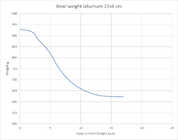
If you dry the rough-turned bowls in the same air conditions they will have as finished pieces, you can monitor the drying by weighing them. There’s no need to overthink it: once the weight is constant, the bowl has reached the correct moisture content. Depending on the initial moisture content, wood species, shape, size, indoor RH, and other factors, you may need to prevent it from drying too quickly. I never use any sealant; sometimes I start by putting the bowl in a paper bag with or without wet shavings. Usually, I simply place it on a shelf. Typically, it takes about three weeks to dry unless the initial moisture content is very high, but the time varies a lot with species. The example here is laburnum, which dries well despite its relatively high density. First two days in wet shavings. I used to dry in a dryer, but soon skipped that, I am usually not that much in a hurry. If I really want quick drying I use a microwave oven. (If you are a production turner, I would recommend a kiln, but then you have to regularly check the moisture content at the end, preferably with pinless meter.)

Also remember that the shape must allow for the wood to shrink without stress as it dries.

1770889943966.png1770890089664.png
 
Last edited:
Why do we dry to their maximin weight loss if they are just going to pick up moisture from the atmosphere?

Inquiring minds would like to know.

We don't, simply put. No such thing as truly DRY wood - for best results one would only dry to equilibrium moisture with the environment, which wood will naturally do over time we dry *UNTIL* it no longer loses weight in *its environment* - So, drying it in a drying box until it stops losing weight is pointless because your atmospheric conditions are going to be quite different from your drying box. For that reason, it's just fine to dry that way BUT you still want to leave it out in the environment it is going to sit in before finish turning. It is the same reason that flooring installers want you to store the flooring in the room(s) which it is to be installed so the materials (even engineered flooring) will acclimatize to the environment. If you dry in a drying box to fully dry and then immediately turn it, it's still gonna warp unless the environment it is being kept in MATCHES the drying box...
 
Back
Top