• The forum upgrades have been completed. These were moderate security fixes from our software vendor and it looks like everything is working well. If you see any problems please post in the Forum Technical Support forum or email us at forum_moderator (at) aawforum.org. Thank you
  • February 2026 Turning Challenge: Cookie Jar! (click here for details)
  • Congratulations to Chad Eames for "Red Tines" being selected as Turning of the Week for February 23, 2026 (click here for details)
  • AAW Symposium demonstrators announced - If the 2026 AAW International Woodturning Symposium is not on your calendar, now is the time to register. And there are discounts available if you sign up early, by Feb. 28. Early Bird pricing gives you the best rate for our 40th Anniversary Symposium in Raleigh, North Carolina, June 4–7, 2026. (There are discounts for AAW chapter members too) For more information vist the discussion thread here or the AAW registration page
  • Welcome new registering member. Your username must be your real First and Last name (for example: John Doe). "Screen names" and "handles" are not allowed and your registration will be deleted if you don't use your real name. Also, do not use all caps nor all lower case.

Question for those familiar with laser engraving...

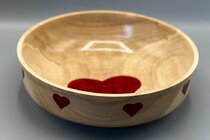
I think it depends on the size of the engraving and maybe the laser. I have the Xtool d1 pro 20w and engraved some hearts on the outside. Each was done individually. My laser focal point is somewhat forgiving, If you are going to try to go around the bowl you would need a rotary suggested by Rob. You can get distortion if it is a large engraving. Here is a picture of the hearts I engraved.

heart.jpg
 
Yes, laser engraving can be done on most any surface, flat, round, highly contoured surfaces, etc. It does depend heavily on your equipment though. I do it on a CNC machine so any place the cutter can go so can the laser beam with some rare limitations.

My recommendation is to buy a CNC router rather than a machine specifically made for laser engraving. To be really effective the machine needs to move the laser head up/down to follow surface contours to maintain focal distance. Woodcraft frequently has their small CNC's on sale with a free laser head included. A rotary head attachment is a nice addition to the CNC for round objects. All told a CNC machine to do laser'ing plus much more can be purchased for a fraction of the cost of a high end lathe.
 
Yes, but you would typically want a rotary attachment to have it work well (this is what they use for engraving tumblers). You would be limited in diameter with the rotary attachment depending on the style and also the laser setup itself. You could also checkout https://transpirationturning.com/ for doing this at the lathe. Paul Paukstelis has some posts on this.
The big advantage of the LatheEngraver for doing laser or router work around the rim of the bowl is that you can rotate your tool to be normal to the surface of the workpiece. Additionally, the way I have written the control software you can use any 3-axis gcode from your favorite CAM package (Vectric, LightBurn, etc.). You input the diameter of the workpiece where your design will be centered and it will do all the necessary coordinate modifications (and it is free).
 
o directly answer your question, yes it’s possible. There is a certain amount of tolerance on how out of focus the laser can get before you loose clarity in the work.

Again, this depends on machine you're using. With a CNC router the laser head moves vertically (Z axis) to maintain the focal distance.

Here's a random image I found online. Think of this as a surface you might want to laser engrave. The highs and lows might exceed the focal length of your laser so the laser head has to move up/down to compensate for surface irregularity.

Capture.JPG
 
Again, this depends on machine you're using. With a CNC router the laser head moves vertically (Z axis) to maintain the focal distance.

Here's a random image I found online. Think of this as a surface you might want to laser engrave. The highs and lows might exceed the focal length of your laser so the laser head has to move up/down to compensate for surface irregularity.
Most basic CAM packages aren't going to have the necessary tools to generate this gcode. Those that are designed for generating laser gcode almost certainly aren't (they might have basic rotary at best).
The other problem you run into is that the Z travel on a hobby machine is likely to be fairly limited. Assuming you are on a rotary setup (which itself takes up some Z travel unless you are build a drop table) you may not be able to reach either the rim or the base of the bowl.
 
Most basic CAM packages aren't going to have the necessary tools to generate this gcode. Those that are designed for generating laser gcode almost certainly aren't (they might have basic rotary at best).
The other problem you run into is that the Z travel on a hobby machine is likely to be fairly limited. Assuming you are on a rotary setup (which itself takes up some Z travel unless you are build a drop table) you may not be able to reach either the rim or the base of the bowl.
Vectric's Desktop at $349 will do it. Some CNC routers sold at Woodcraft include Desktop. Desktop also supports a rotary 4th axis. Vectric software is very widely supported, hundreds of Youtube videos.

Here's how I would do it using Desktop. Desktop includes quite a collection of free clipart. That clipart can be manipulated (stretched, resized, distorted, etc, etc) to create a 3D surface or wrapped on a circular work piece. Design your laser path as a 2D file using the design tools in Desktop. Then using the project cutter path option onto the 3D surface. The Gcode generated will be a cutter path. The cutter path is easy to modified to a laser path by using search and replace in free Notepad++. Then use another free software to modify the Gcode to raise the laser head in Z axis to the correct focal length off the 3D surface.

This isn't speculation on my part. I've had my 4 watt laser head at least 20 years and used dozes of times..

I recommend CNC's because they're so versatile. They can even cut your complete bowls to a finish that hardly needs any sanding.

The CNC skeptics will say CNC is not woodturning, but then neither is laser engraving.
 
Back
Top