• The forum upgrades have been completed. These were moderate security fixes from our software vendor and it looks like everything is working well. If you see any problems please post in the Forum Technical Support forum or email us at forum_moderator (at) aawforum.org. Thank you
  • February 2026 Turning Challenge: Cookie Jar! (click here for details)
  • Congratulations to Dean Center for "After Life" being selected as Turning of the Week for February 16, 2026 (click here for details)
  • AAW Symposium demonstrators announced - If the 2026 AAW International Woodturning Symposium is not on your calendar, now is the time to register. And there are discounts available if you sign up early, by Feb. 28. Early Bird pricing gives you the best rate for our 40th Anniversary Symposium in Raleigh, North Carolina, June 4–7, 2026. (There are discounts for AAW chapter members too) For more information vist the discussion thread here or the AAW registration page
  • Welcome new registering member. Your username must be your real First and Last name (for example: John Doe). "Screen names" and "handles" are not allowed and your registration will be deleted if you don't use your real name. Also, do not use all caps nor all lower case.

Raffan demonstrates effective dust collection/extraction

Joined
Oct 25, 2020
Messages
1,425
Likes
1,303
Location
Minneapolis, MN
In this 13 minute Richard Raffan video (below), he's rescuing a previously damaged piece. But, by about the half-way point, the sun is shining in from the background, and boy does it show the dust made during the cutting process. He is not running the dust collector/extractor while cutting. Watch the clouds of dust blow about.

Then he starts the sanding process by turning on the collector. A completely different world emerges. The sun is lighting up the dust cloud coming off the wood and sandpaper, and you see how his hood system captures and contains the dust cloud, the single most important feature of effective dust collection. Do not let it escape into the atmosphere- capture, contain, and remove it at the source. This is most effective with a hood/box surrounding the 5 sides immediately behind the spinning wood. The suction flow of air comes fully from where the dust is being produced, dust is never allowed to escape the hood/box.

Any sort of shaped inlet (velocity stack, big plastic bowl, etc) simply attached to the hose/duct and supported in open air behind the spinning wood is drawing air from all directions and cannot capture and contain the dust cloud even half as effectively as the 5-sided hood/box that he has behind his lathe. And this video is providing proof of concept.
View: https://youtu.be/7dcXymZ2gUo?si=YjZss-QXg4fQMIla


Wood dust is an allergen, it is carcinogenic, it is absolutely a nuisance. Don't let it escape into the shop, don't let your lungs filter the shop air. Masks over your mouth/face/head, ambient air filtration systems, and cross-venting open windows are passive and secondary compared to a simple hood behind the lathe. Here are a few versions on the theme.
https://www.aawforum.org/community/threads/raffans-dust-hood-part-2-my-version.23338/

 
I first saw Raffan's dust collection box in a Tomasic video. When I got a second lathe (Harvey T-40) which stands in the middle of the shop, not on the wall, that box-on-a-shelf seemed like a good plan, and it has worked great! I find it more effective than a dust hood, and the right side slides to make the box adjust to the size of the stock on the lathe. The shelf along the back of the lathe, and the top of the box, are both handy for temporary storage. Go to 6:00 in this video to see Tomasic's set-up. Not having a wall handy meant bolting shelf supports onto the ends of the lathe. [Sorry, don't know why link doesn't work. It's Tomislav Tomasic's "Q&A is back: three common questions" video.] Here's a screenshot from Tomasic's shop:
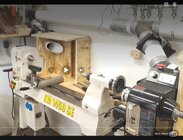
Screenshot_20260215_164103_Chrome.jpg
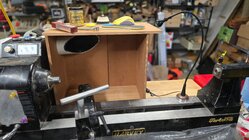
And behind my Harvey:20260215_171821.jpg
 
Last edited:
Mine is held in place with magnets so it can be removed when turning something not dusty.

I do think it is better at collecting the dust cloud than other designs.
 

Attachments

  • IMG_2861.jpeg
    IMG_2861.jpeg
    876 KB · Views: 18
  • IMG_2860.jpeg
    IMG_2860.jpeg
    820.4 KB · Views: 18
Hi @Jamie Straw, I've wondered about that diagonal pipe cut Raffan and Tomasic have used, but my brain can't see how it would contribute to a better capture and flow of air and dust. I'm sure it doesn't hurt anything.

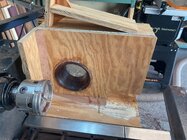
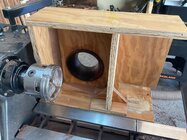
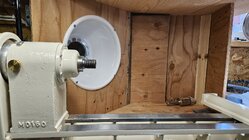
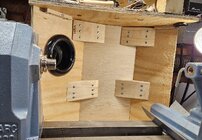
Here are perspective views of my air inlets at the back of my boxes. Both are roughly 45° to the lathe, both are a bit left of the working end of the headstock spindle, and both are centered just a bit (and inch or 2) above the centerline of the spindle. Both are plumbed with 4" duct/tubing.
1000017552.jpg
1000017553.jpg

My Oneway 1224 hood (white lathe) uses a cheap 11" diameter plastic bowl as an intake funnel- I used to use just this bowl without the surrounding box. My Vicmarc VL200 (blue lathe) intake uses a bell mouth/velocity stack I had on hand as the inlet. I rebuilt the Vicmarc hood since previous postings when the intake was at the same height, but located on the back wall of the hood box pretty much perpendicular to whatever was being turned, and lots of shavings went right in the path of the intake. Where I've got the inlet located at each lathe now, it's rare to have a shaving (or mishandled sandpaper...) go into the collector pipe, but the dust cloud disapprears down the inlet perfectly, no dust escapes the hood boxes. Unlike the Oneway hood, the new plywood hood at the Vicmarc is non-adjustible for length, since the lathe is a shortbed with only 16" between centers, this hood is completely effective like this. And this lathe is rarely used to the 16" length capacity anyway.
 
Hi @Jamie Straw, I've wondered about that diagonal pipe cut Raffan and Tomasic have used, but my brain can't see how it would contribute to a better capture and flow of air and dust. I'm sure it doesn't hurt anything.

Here are perspective views of my air inlets at the back of my boxes. Both are roughly 45° to the lathe, both are a bit left of the working end of the headstock spindle, and both are centered just a bit (and inch or 2) above the centerline of the spindle.

My Oneway 1224 hood (white lathe) uses a cheap 11" diameter plastic bowl as an intake funnel- I used to use just this bowl without the surrounding box. My Vicmarc VL200 (blue lathe) intake uses a bell mouth/velocity stack I had on hand as the inlet. Where I've got the inlet located at each lathe now, it's rare to have a shaving (or mishandled sandpaper...) go into the collector pipe, but the dust cloud disapprears down the inlet perfectly, no dust escapes the hood boxes.

Being pretty uneducated about the fine points of airflow and dust collection, I had to look up "velocity stack." 😊 Google tells me "The smooth, tapered shape reduces air turbulence and prevents boundary layer separation at the inlet. This allows more air to flow through the same diameter opening compared to a standard, straight-cut pipe." I wonder if the tapered shape of Raffan's isn't similar in function without the fancy name. Doesn't seem like many shavings go in, but the dust does (rather dramatically). There are always some shavings on the bottom of the box. QUESTION : what the heck does "...prevents boundary layer separation at the inlet" mean?
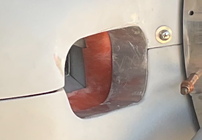
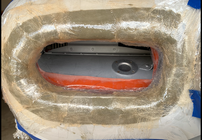
 
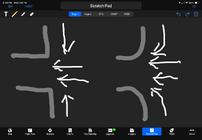
Maybe these two pictures will help. As I was building my airplane, the original opening had sharp edges and that causes turbulence and boundary (outside) layer separation of the airflow can occur and the volume of air entering the cowl would be reduced. The other picture is where the opening was modified to a more rounded opening a there is less disruption of the airflow which improves the volume of air entering the cowl. The drawing may explain it better.

Also dust particles are more suspended in the air than shavings and easier to be sucked into the opening than heavier shavings than don’t suspend like dust does.
 

Attachments

  • IMG_2871.png
    IMG_2871.png
    3 MB · Views: 15
  • IMG_2872.png
    IMG_2872.png
    4.7 MB · Views: 16
  • IMG_2873.png
    IMG_2873.png
    201.3 KB · Views: 15
Last edited:
Maybe these two pictures will help. As I was building my airplane, the original opening had sharp edges and that causes turbulence and boundary (outside) layer separation of the airflow can occur and the volume of air entering the cowl would be reduced. The other picture is where the opening was modified to a more rounded opening a there is less disruption of the airflow which improves the volume of air entering the cowl. The drawing may explain it better.

Also dust particles are more suspended in the air than shavings and easier to be sucked into the opening than heavier shavings than don’t suspend like dust does.
So now I'm thinking I sould layer some chewing gum around the edges of the pipe to soften the edges. Just kidding....😁
 
I would say that there are two important points, a rounded inlet to the duct drastically reduces inlet resistance. A hood directs the suction to the source; there is no use sucking in air from behind. Also I only want to connect dust. The chips are easier to shovel up than emptying the extractor. Example of my extraction. As you can see there is no dust going towards me. Dust capture
 
Back
Top