I am not at all familiar with workholding a square end.
Depth of the tenon, I had no real clue what is safe and secure. Especially so when after all outside turning is done, and its time to attack the Interior, the piece will be supported only at the chuck.
I turn a lot of spindles, boxes, many things in end-grain (spindle) orientation.
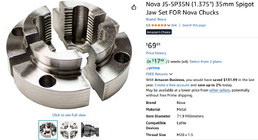
I often mount a square in chuck jaws. I like the Nove 35 and 45mm jaws like shown for most squares. (Mount the square with the corners sticking through the gaps in the jaws!) The bit of extra length on a square can help since the blank is only held by the sharp corners of the jaws. The serrated jaws give a bit more holding.
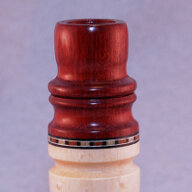
I often turn fairly long blanks like this. For example, when turning small things like finger tops I might mount a 10" long square in the jaws, turn one top at the end, then turn others until I run out of wood. The jaws hold find without tailstock support.
If turning something longer, tailstock support will help, at least until the block is rounded.
HOWEVER, it is better to turn a tenon first on a blank although it does take a bit more time. A properly sized tenon will fit very securely in even the short 50mm jaws that come with Nova chucks. For the most secure holding make the tenon just a little bigger than the closed circle of the jaws. I almost never turn a dovetail into the tenon on small pieces like these. Note that the bottom of the tenon must never touch the inside bottom of the jaws. Instead, the flat top surface of the jaws need to securely contact a flat at the top of the tenon a little wider than the tenon. (You probably know all this) The flat, etc, are not needed when putting square stock directly into the jaws.
Square stock can be a little out of square but for best strength, not much. The inside corners of the jaws crush the fibers in eight places - if not exactly square the fibers will be crushed a little more where needed.
For things like I think you're making, I'd mark the center of the tailstock end, place the square in the jaws but don't tighten yet, bring up the tailstock to the marked center point, start to tighten the jaws, and apply increasing tailstock pressure as the jaws are tightened very firmly. This is quick, secure, and centers the wood nicely.
Note if a square blank mounted in this way is removed from the chuck, you may have very little chance of being remounting it concentrically. If that is needed, I turn a careful tenon, mount the piece with center tailstock support, then put a mark on the wood matching some feature on the chuck (I mark at the gap between jaw #1and jaw #4) so when I remount it I can put the wood back in the same spot.
All this is so much quicker to show that write about!
JKJ