• December 2025 Turning Challenge: Single Tree! (click here for details)
  • Congratulations to Bob Henrickson, People's Choice in the November 2025 Turning Challenge (click here for details)
  • Congratulations to John Dillon for "Chinquapin Oak" being selected as Turning of the Week for December 22, 2025 (click here for details)
  • Welcome new registering member. Your username must be your real First and Last name (for example: John Doe). "Screen names" and "handles" are not allowed and your registration will be deleted if you don't use your real name. Also, do not use all caps nor all lower case.

Relaxing hobby my %$#

Joined
Dec 29, 2022
Messages
1,176
Likes
1,470
Location
USA
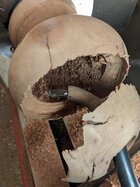
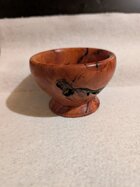
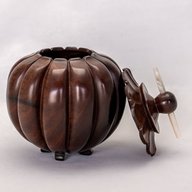
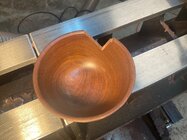
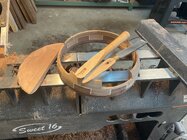
So this was my first attempt at a little hollow form....... Come on black Friday sales for the hollowing stabilizers.. (which I know there won't be but a person can dream right?)

It morphed into the second picture. Really makes a person appreciate the bowl gouge.
 

Attachments

  • PXL_20251116_222008482.MP.jpg
    PXL_20251116_222008482.MP.jpg
    409.7 KB · Views: 93
  • PXL_20251116_225250448.MP.jpg
    PXL_20251116_225250448.MP.jpg
    210.7 KB · Views: 93
You will have many of those if you follow my footsteps. Use calipers often, try to understand where your tool tip is, and go slowly. Use cheap wood at first that you don’t mind “modifying” and use your hollow form tools a couple times on open bowls to see how they work.
 
You will have many of those if you follow my footsteps. Use calipers often, try to understand where your tool tip is, and go slowly. Use cheap wood at first that you don’t mind “modifying” and use your hollow form tools a couple times on open bowls to see how they work.
Hind sight I probably shouldn't have used a chunk of Briar burl but it was calling to me from the shelf.
 
I have blown up several hollow forms. The biggest problem was cutting in a different spot than I thought I was. Check with calipers not only where you think you are cutting, but a few inches above and below. You may be surprised what you get.
 
This is where a laser or camera system is extremely helpful, and stress relieving. Also, as you progress to wider/deeper forms with more tool hang off, catches will likely increase, and the concentration level required to prevent catches increases. A hollowing system relieves the stress of potentially blowing up something and possibly injuring oneself. Makes hollowing a lot more fun.
 
This is where a laser or camera system is extremely helpful, and stress relieving. Also, as you progress to wider/deeper forms with more tool hang off, catches will likely increase, and the concentration level required to prevent catches increases. A hollowing system relieves the stress of potentially blowing up something and possibly injuring oneself. Makes hollowing a lot more fun.
I really need to make one of those.
 
I really need to make one of those.
I looked at making at least some parts before buying mine (Lyle jaimieson captive “I Want It All”). If experienced with metal working, have the tools, and a good place to get the proper material, it’s doable. I knew a good metal worker but I was going to need to buy the material and didn’t have a good source, so the #’s told me I could maybe save $100 if I got lucky, and give myself a lot of frustration.

The bars and tool holders should be purchased unless you have them available to copy. Once you see the 3/4” and 1-1/8” bars with various machined holes etc to fit the tool holders, it makes sense, but it can’t be done correctly from just the pictures I could find.

The D handle just needs to be “flat” so it passes through the back rest properly. The back rest should be made with springs and bolts/nuts to adjust the gap. If you go this route get Lyle’s threaded tool rest - the threaded tool post and nut make height adj very easy and accurate, and the rest itself is softer than the bars so the bars dont get dinged.

I use his laser rig but have replaced the laser with a camera.

 
I looked at making at least some parts before buying mine (Lyle jaimieson captive “I Want It All”). If experienced with metal working, have the tools, and a good place to get the proper material, it’s doable. I knew a good metal worker but I was going to need to buy the material and didn’t have a good source, so the #’s told me I could maybe save $100 if I got lucky, and give myself a lot of frustration.

The bars and tool holders should be purchased unless you have them available to copy. Once you see the 3/4” and 1-1/8” bars with various machined holes etc to fit the tool holders, it makes sense, but it can’t be done correctly from just the pictures I could find.

The D handle just needs to be “flat” so it passes through the back rest properly. The back rest should be made with springs and bolts/nuts to adjust the gap. If you go this route get Lyle’s threaded tool rest - the threaded tool post and nut make height adj very easy and accurate, and the rest itself is softer than the bars so the bars dont get dinged.

I use his laser rig but have replaced the laser with a camera.

I have the Bosch stabilizer, but his visualizer is too spendy at $600. Can be made for $100 or less.
 
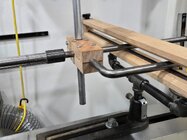
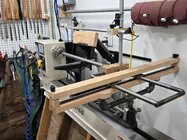
I made a captive hollower with laser out of scrap steel rod & alum from a local scrap metal yard ... after cleanup, paid a welder to form the D handle ... rest was pretty easy ... made my own boring bars (3/4" & 1 1/8") got the cutter holder and cutters from AZ Carbide. Changed the orig design of the back end rest from plywood to threaded black pipe fittings and an old spare banjo. Lasers are dirt cheap on Amazon, wired to a cheap AA battery box. Fun project ... works like a champ.

Hollower_Mod_1.jpgHollower_Mod_2.jpg

Here's a link to some of the original build pics.
 
It’s so relaxing I almost fell asleep

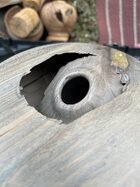
Now is know why Richard Raffan says don’t turn wood with splits in it. I felt sure some CA would stabilize the crack. I had one last pass on the outside to finish.
 

Attachments

  • IMG_2732.jpeg
    IMG_2732.jpeg
    836.3 KB · Views: 22
Webb, those cracks "can" be repaired. Generally not worth the effort because CA glue does not always work. If I am going to fix a crack, first, I chase the crack with the thin CA glue, than put some medium or thick on top of that. The idea is that the thin stuff will wick the thicker stuff down into the crack and fill it. I never use the accelerator. The problem with it if you are trying to fill a crack is that the inside can honeycomb so you do not get a total "filling" of the crack. If I pack a little saw dust into the crack, I still do the same process. Thin CA first, then pack some saw dust into the crack, then medium on top of that. Make sure to let it cure totally before turning, and again, I do this without the accelerators. Most of the time, I don't bother. I have one show that I still do, and take a box of "seconds" out and put price tag of about $1 on them. They are usually gone very shortly. People know to look for them. Great for animal fooc scoops, or to take to the garden to bring harvest inside the house. Some go into the wood stove....

robo hippy
 
Depends on who you ask 😉 I love the challenge of freehand hollowing.
I experienced plenty of “challenges” in life, acquiring many surgical metal parts, scars measured in feet not inches, many worn joints, and plenty of mental challenges in pro sports and engineering careers. I put myself at hi risk every time I ride one of my motorcycles, no need to add to the mental challenge and physical risk equation while turning.
 
I experienced plenty of “challenges” in life, acquiring many surgical metal parts, scars measured in feet not inches, many worn joints, and plenty of mental challenges in pro sports and engineering careers. I put myself at hi risk every time I ride one of my motorcycles, no need to add to the mental challenge and physical risk equation while turning.
Not trying to argue with you, Doug. Just saying, to each his own. If you use good technique and avoid unnecessary risk, freehand hollowing can be as safe as turning a bowl. After a crash in my 20s, I no longer ride motorcycles. Doesn’t mean I need to convince you not to ride.
 
Depends on who you ask 😉 I love the challenge of freehand hollowing.
I experienced plenty of “challenges” in life, acquiring many surgical metal parts, scars measured in feet not inches, many worn joints, and plenty of mental challenges in pro sports and engineering careers. I put myself at hi risk every time I ride one of my motorcycles, no need to add to the mental challenge and physical risk equation while turning.
I was trying to think of a response to Jaramiah. This sums it up perfectly. I don't need the stabilizer, but I don't want to hollow without it. I have enough challenges.
 
I’m going to ruffle some feathers with this comment, but that’s never stopped me before 😅.

For me, personally, hollowing with a stabilizer is like riding a bike with training wheels. They keep you from falling over, but they limit where you can ride. I’ll gladly risk falling over occasionally (blowing through the side of a piece, getting a catch at the rim) for the freedom of riding wherever I want (super small openings, using a wide variety of hollowing tools, making/using my own tools).

I’m not being critical or casting judgements. Stabilizers and freehand turning both have pros and cons. I just happen to prefer the trade offs that come with freehand turning and encourage anyone interested in making hollow forms to do a freehand vessel once in a while, even if you usually prefer a stabilizer. The tool feedback alone can teach you a lot about the hollowing process.

Again, not knocking stabilizers or those that use them. Just sharing my POV and why I embrace and find fulfillment in the challenges of turning freehand.
 
Not trying to argue with you, Doug. Just saying, to each his own. If you use good technique and avoid unnecessary risk, freehand hollowing can be as safe as turning a bowl.
I have a lot of freehand hollowing experience, and strongly disagree that freehand hollowing of larger hf’s 5-6” tool overhang and up is nowhere near as safe as turning a bowl. It’s just too easy to have a lapse in concentration, letting the edge drift down too far, and BANG, hopefully there are no damaged body parts.
 
I have a lot of freehand hollowing experience, and strongly disagree that freehand hollowing of larger hf’s 5-6” tool overhang and up is nowhere near as safe as turning a bowl. It’s just too easy to have a lapse in concentration, letting the edge drift down too far, and BANG, hopefully there are no damaged body parts.
Different strokes, different folks 🤷‍♂️ As long as we’re all having fun and keeping all our fingers, it’s all good 👍🏻
 
I’m more in Jaramiah’s camp and don’t use my Bosch stabilizer. Won’t sell it and may buy the visualizer but I love freehand hollowing—the challenge of achieving smooth thin walls. Kind of like driving my manual transmission vs my wife’s automatic—more hands on if that makes sense. Jaramiah’s training wheels analogy is a good one.
 
My personal experience is that I can hollow anything with the stabilizer that I could with hand held tools. The stabilizer just supports the tool instead of my body providing support. I have made my own bars and specialized cutting tools that can fit in hand held handles or the articulating arm. Any opening I can fit a handheld tool in will also take a tool on the end of my articulating arm. I can certainly understand the joy of feeling the tool operation through your body and the thought that things are more hand cut. If you can do that you are lucky. With all the damage I've caused to my right shoulder and neck, I can't take the chance of using a hand held hollowing tool unless it is very small and on a tiny hollow form. Even then a catch could hurt a lot. I am grateful every day for my articulating arm hollower, otherwise I would not be able to make any of the large hollow forms that are my favorite. As an added note, we do have a manual transmission on both vehicles, even the wife likes driving manual.
 
Last edited:
An interesting topic, a hobby and relaxation, some how they dont really go togther for me. Seeing I like to turn hardwood and often go for the blanks nobody wants or is game to have a go at. This sort of challange is not for the faint hearted and there are times of no relaxation, rather it get fairly tense. Its the completion, and satisfaction of over coming all the hassle and producing a stunning piece.Do I win always? Nah! but the stats are pretty darn high these days.
Like Darryn I make a great deal of my Hollowers, jigs, tools etc , having a solid engineering history helps, although the two skills do clash, wood dust get every where.
 
I’m in the camp of “if it works for you, do it that way.” I free form small hollow forms and do 90 percent of larger ones freehand but then breakout the stabilizer and laser for the last 10 percent. My reason is that it’s that last few minutes that I blow it up after hours of work. I have the utmost respect for those that can do it start to finish freehand. It’s just better for my well being if I don’t.
 
Back
Top