• December 2025 Turning Challenge: Single Tree! (click here for details)
  • Congratulations to Bob Henrickson, People's Choice in the November 2025 Turning Challenge (click here for details)
  • Congratulations to Guillaume Fontaine for "Old Tea Pot" being selected as Turning of the Week for December 15, 2025 (click here for details)
  • Welcome new registering member. Your username must be your real First and Last name (for example: John Doe). "Screen names" and "handles" are not allowed and your registration will be deleted if you don't use your real name. Also, do not use all caps nor all lower case.

Replay: Favoite woods for French rolling pins?

Joined
May 28, 2015
Messages
1,620
Likes
227
Location
Bainbridge Island, WA
My thread asking about French rolling pins went "poof" with the crash and days-old restoration. Do you-all mind reposting your recommendations for wood. I read them, and there were some good ideas! but I didn't memorize them.:p The back-story: a good friend is having a combo graduation (Master's)/birthday bash at the end of the month, fabulous cook, with great desire for a FRP in her kitchen. I was going to use the figured maple I have (Big Leaf Maple), but moisture content is too high.
 
Last edited:

Most any diffuse porous wood that is not prone to cracking should work.

My faves are maple or cherry.
 
Hard maple, cherry, or perhaps walnut. The wood chosen should be a diffuse-porous wood species which are preferred over any ring-porous wood (e.g. oak, ash, hackberry, mulberry, etc), the exception being Osage orange which would produce an excellent, smooth, and attractive rolling pin, but would be quite heavy in comparison to other wood species. The lack of large early wood pores (vessels) in diffuse-porous woods makes for a more uniformly smooth surface, and thus has much less of a likelihood to "catch" the dough as it is rolled. Some say smoother, denser woods are also easier to keep clean.

Rob
 
I turned a half dozen from tulip poplar for my neighbor about 15 years ago.
He supplied the wood and the design and he put the first one through an operational test and evaluation process.
We kept one the others went to my neighbor's daughters and a freind who worked in their catering business.
Poplar is a bit soft but it is light and easy to turn and looks good with a walnut oil finish.
 
I turned a half dozen from tulip poplar for my neighbor about 15 years ago.
< snip! >
Poplar is a bit soft but it is light and easy to turn and looks good with a walnut oil finish.

Hi Al!

Recall that 'tulip poplar' (Liriodendron tulipifera; Magnolia Family) and "poplar" (Populus sp.; Willow Family) are two very different species; these woods, although superficially looking similar are actually quite distinct structurally. Practically speaking, they are both relatively soft woods (...but not softwoods!), and since both Liriodendron and Populus are diffuse-porous woods, both would work OK as cooking "treen", although in use they would have a tendency to get "banged up" and dented, given their softness. "True" poplar might be favored over tulip poplar for its marginally harder character.

Give my best to Sherry - Good to see you both in Atlanta!

Rob
 
Live oak is excellent, but not readily available. Also white oak is considered a close grain wood and I think would be acceptable. Red oak, on the other hand, has very large pores.

Correct. White oak is acceptable for the same reason Osage orange is - the presence of tyloses (cellular "plugs") in the vessel pores, despite both of these woods being classified as ring-porous. They are the exceptions because they possess tyloses, making them "closed-grain" in the hands and applications of woodworkers.

Rob
 
Professional grade rolling pins are almost always hard/sugar maple or beech. Both are closed grained, and hard enough not to dent or ding with heavy use... 'No, you can't use it on him as that will only put dents in that pretty wood....' Most other woods are too soft.

As for 'French' rolling pins, there seem to be as many varieties of them as there are of oak or maple. Only common bit about them is that they don't have roller handles. Some have a slight quarter round on the ends. Some have a slight taper. Some taper from the center to the ends. Lengths can vary. I make small ones about 12 inches long, both straight and tapered. They are called a 'palote', which is traditional Mexican for tortillas. The fathers would make them for their daughters. Most over about 16 inches are more of a specialty item.

robo hippy
 
My favorite is Osage Orange wood. I made one for my wife and it came out beautifully. But I made a straight dowel. I use it more than she does.
Some cooking magazine my wife gets did a study on rolling pins. Which one is the most preferred. Turns out most cooks like a straight dowel. The ones who like the "French" rolling pin...like a 7-8 inch flat in the center with the ends tapered.
I find that people really like Black Acacia rolling pins. But I also use Black Locust, Big Leaf Maple, Silver Maple (but I do not think these maples are hard enough really), and I like Black Oak also, Black Walnut. On the open grained woods.....hold a piece of bees wax on it while it is spinning and melt it into the wood. If your tooling is good and your sanding is good.....the open grained woods work just fine I think.
People like the woods that you can not buy in the cooking store. Rolling pins that look good on the counter.
Hugh
 
I make small ones about 12 inches long, both straight and tapered. They are called a 'palote', which is traditional Mexican for tortillas.
Wow, thanks for that info, Reed, I had no idea. Will make a couple of palote (plural=??) for practice.

Most over about 16 inches are more of a specialty item.
Hmmm, elaborate please. I do not bake, and can't even surreptitiously ask her husband what she wants -- he would be clueless. What kinds of things are the >16" used for? I was headed for 23" or so, but perhaps too long.
 
Jamie,

I have turned a number of rolling pins over the years, and many of them have been under 16" in length.
The shorter rolling pin is easier to store in a kitchen drawer and easier to handle. If the person is processing
a large amount of dough, a larger rolling pin would be preferred, the average person baking a pie does not need
a large rolling pin.
 
My favorite is Osage Orange wood. I made one for my wife and it came out beautifully. But I made a straight dowel. I use it more than she does.
Some cooking magazine my wife gets did a study on rolling pins. Which one is the most preferred. Turns out most cooks like a straight dowel. The ones who like the "French" rolling pin...like a 7-8 inch flat in the center with the ends tapered.
I find that people really like Black Acacia rolling pins. But I also use Black Locust, Big Leaf Maple, Silver Maple (but I do not think these maples are hard enough really), and I like Black Oak also, Black Walnut. On the open grained woods.....hold a piece of bees wax on it while it is spinning and melt it into the wood. If your tooling is good and your sanding is good.....the open grained woods work just fine I think.
People like the woods that you can not buy in the cooking store. Rolling pins that look good on the counter.
Hugh
Hugh, this is great info. Next time I go to Edensaw in Port Townsend, I'll buy some Osage Orange big enough to make rolling pins. I think I'll design based on the suggestions here, and let her know if she wants something a little different, I can make a second one.
 
Jamie,

I have turned a number of rolling pins over the years, and many of them have been under 16" in length.
The shorter rolling pin is easier to store in a kitchen drawer and easier to handle. If the person is processing
a large amount of dough, a larger rolling pin would be preferred, the average person baking a pie does not need
a large rolling pin.
Ahhhh, good, practical info. She is a pie baker, extraordinaire.
 
Jamie......length of rolling pins.....I try for a 18" - 20" long rolling pin. The problem with too long and they do not fit in a drawer as someone else pointed out. My Osage Orange rolling pin is close to 22" long and it may be too long. But you can just hold one end and roll with the other. I have a great pie crust recipe.......make a pretty good blackberry pie when the berries are in season.
Google - wood rolling pins and look around at the shape and lengths. Also look at the diameter......I have made a couple that were too big around....but someone bought them...so maybe not.
Hugh
 
We did loose quite a few responses. Ash is another option. In my researching it seemed that most American bakers liked some sort of flat on the pin, but in France pastry chefs like the gently curved pin. There are some good cooking videos that show the various types in action.
 
We did loose quite a few responses. Ash is another option. In my researching it seemed that most American bakers liked some sort of flat on the pin, but in France pastry chefs like the gently curved pin. There are some good cooking videos that show the various types in action.

Ash is very hard. It's used for axe handles and turning tool handles. However, it is ring porous with very large pores in the early wood. I would think that would make it less desirable for treenware.
 
I made a couple of the tapered French style rolling pins right around 10-12" long and let my
wife use them for a while. She has an assortment of rolling pins to use and now prefers using
the smaller ones, she sometimes uses one hand to roll out a pie crust or pizza crust on a small
cutting board. There is a learning curve to using a French style rolling pin, but once you master
the technique of using it they are very efficient to use.
 
I made a couple of the tapered French style rolling pins right around 10-12" long and let my
wife use them for a while. She has an assortment of rolling pins to use and now prefers using
the smaller ones, she sometimes uses one hand to roll out a pie crust or pizza crust on a small
cutting board. There is a learning curve to using a French style rolling pin, but once you master
the technique of using it they are very efficient to use.
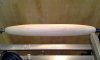
Have done a bit of reading now, and it seems a major advantage to a French-style rolling pin is the ability to pivot it around. I made my first and last pie around 1978, so I'm not sure exactly what this means.:D:D (It was a really good apple pie, decided to quit while I was ahead) The practice one I'm just now putting finish on is 12" long and ~1.75 diameter. Not perfectly symmetrical, have to work on that.
First Rolling Pin.jpg
 
Have done a bit of reading now, and it seems a major advantage to a French-style rolling pin is the ability to pivot it around. I made my first and last pie around 1978, so I'm not sure exactly what this means.:D:D

I think that means it was your first, but perhaps not last pie.

My dad made his last batch of oat meal cookies when he was 93. He would always say after making a batch of cookies that was the last ones he was going to make. I always let him know how much I liked his cookies so he kept making them, but I didn't get the chance to compliment him on his last batch. If I had only been a few hours sooner, I could have told him.
 
I don't bake . I grill!!!
Last year at my open house, a pastry chef stopped by after seeing my open house signs and decided to stop by and bought one (can't remember if French or conventional -or whatever the term is!!!). While talking about getting woods long enuf , he offered that the pins needn't be long at all. 15-16? not necessarily 18" +. I have used birch from my yard ice storm. Any open grains (Bk walnut) I use 2-4 coats of my shellac/alcohol sanding sealer-after 1200 grit, open woods seem pretty smooth. . I do finish with Danish oil. If it wears off then the natural friction use of the pin would continue to smooth it-I think!!!! Gretch
 
he offered that the pins needn't be long at all. 15-16? not necessarily 18" +.
Well, it's looking like 15.5" is max for me if I want to use the Comet lathe (which is much better for spindle work than my old Jet). I can get a 16" blank on the Comet II.
Any open grains (Bk walnut) I use 2-4 coats of my shellac/alcohol sanding sealer-after 1200 grit, open woods seem pretty smooth. . I do finish with Danish oil. If it wears off then the natural friction use of the pin would continue to smooth it-I think!!!!
I met up with our Board Hoarder last week, when he was coming this way on the ferry (saving money and time!), and he brought beech, Black Locust, dense cherry, and myrtle blanks (plus a couple of exotics I didn't buy -- yet). I think I'll prefer the General salad bowl finish for the pins. Question about your sealer application -- you put it on after 1200 grit. Do you then re-sand with 1200?? or something else. I like Hugh's idea of melting beeswax into open-pored pin, but need ask a follow-up question about it.
 
On the open grained woods.....hold a piece of bees wax on it while it is spinning and melt it into the wood.
I like that idea! Are you able to apply a finish after -- perhaps with a barrier coat of shellac? At this time, I'm using General Finishes salad bowl finish, but sticking with tight-grained woods such as beech or hard maple.
 
I like that idea! Are you able to apply a finish after -- perhaps with a barrier coat of shellac? At this time, I'm using General Finishes salad bowl finish, but sticking with tight-grained woods such as beech or hard maple.

Well, to at least some degree you are applying a finish to the wax and not the wood. How well do you think that would work over the long term? It's likely that the item will occasionally be dunked in a sink of hot sudsy water and scrubbed a bit before being rinsed in scalding water and allowed to air dry. :D Just sayin'
 
Jamie,
Beeswax......I have a small piece of beeswax that I hold to the spinning rolling pin. Then I use a small piece of t-shirt material to hold to the spinning wood. Hold it in the same spot long enough and the wax melts. Move on down the rolling pin......pushing melted wax as you go. Wear a face shield as there will be little bits of wax flying around. Harmless pretty much....but you always want to protect your eyes. I know one is not supposed to use cloth on turning wood.......but I only use a small square and if it caught, it would fly out of my fingers. You can use paper towels if you think that is safer.

Some people mix beeswax with mineral oil and come up with a paste. Mineral oil never dries........so I do no use it.
Hugh
 
Every time I try and use my T-shirt to apply finish to a wood piece, my wife has to shut off the lathe and
help extract me from the machine. :eek:
Old T-shirts cut up into pieces are great re-purpose items in the wood shop!
 
You could use naphtha which is a better solvent, but then it would smell for a couple weeks. MEK is an even better solvent, but stinkier yet and toxic until it has completely evaporated. Chestnut micro-crystalline wax is easy to apply and dries very hard.
 
The more I use the Doctor's Woodshop finish, the more I like it. The carnuba wax in it does not have to be heated to flow on. Getting some finishes to penetrate 1200 grit sanding is difficult because the higher grits, to some extent polish and burnish the surface. I go to 400, then use the grey synthetic steel wool. Nice soft feeling after, and the Carnuba wax won't wash away like the bees wax.

robo hippy
 
Me oh my, I like pie! (And with as many fabulous pies as my wife made, it's a miracle I'm not as heavy as my powermatic)

If the recipient is actually going to use the rolling pin, you want a surface that won't hold onto the flour used instead of WD-40 to keep the dough from sticking. Mineral oil would seem a poor choice and I would be concerned that beeswax would be soft enough to hold some flour. You don't need a shiny surface or a barrier film. I'd vote for a hardening oil over a nicely sanded surface.
 
Every time I try and use my T-shirt to apply finish to a wood piece, my wife has to shut off the lathe and help extract me from the machine. :eek:

I hope the t-shirt wasn't damaged. :D

I know it's a lot of extra effort for you, but it's less work for her if you remove the shirt before using it to apply the finish. :D
 
Well, to at least some degree you are applying a finish to the wax and not the wood. How well do you think that would work over the long term? It's likely that the item will occasionally be dunked in a sink of hot sudsy water and scrubbed a bit before being rinsed in scalding water and allowed to air dry. :D Just sayin'

Bill I know you were joking but it's good to mention here:

A rolling pin should never be dunked. If one of my guys had done that back when I had my bakery (many moons ago) he'd have been toast. :)

Seriously, scrape dry or sticky bits, then scrub with a damp green pad or terry cloth. You can put some salt on the cloth as an abrasive. After scrubbing wipe dry and you're done.

Unfinished and well sanded. Wax is okay but won't last. Food safe oil once in a great while
 
I made my lovely missus a traditional pin from brazilian rosewood. I had my doubts. I worried that rosewood would stain the dough, but is has not and it's been a few years that she's used it exclusively.
 
Back
Top