
I was watching a June 2024 Richard Raffan video this morning-
View: https://youtu.be/E9lenkr3Dbc?si=Z1p_p1PwvEy_7XXq
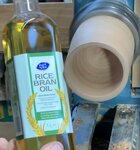
and at about 9:15 he shows a bottle of rice bran oil (he states in the comments it is Aldi Australia supplied) he is going to use, without explanation, as a substitute to his normal unnamed boiled linseed oil. Screenshot from the video-
I wonder to myself- but does it cure (polymerize)? Searching here on this board brought up a thread from a year ago where @Mick Fagan used it, based on watching Raffan use it. This was the only thread I found referring to rice bran oil.
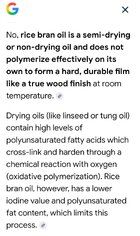
In the discussion, the answer to the question from @Sarah S Elkind about the ability of rice bran oil to fully polymerize into a hard cured finish remained unclear (and even I looked right past the use of this oil when I was part of that thread), so I did what any curious person would do nowadays, I asked Goo-Guhl, "Does rice bran oil polymerize as a wood finish?" Since the art. intel. answer can't seem to be linked directly for posting here, here is a screenshot giving the gist of the answer. If you want to see more, including the AI search result source, search that same question, but the point is made here. Reading further at the source, rice bran oil needs high temperatures, near its smoke temp of about 450°F, to polymerize into a hard, cured film. But, it seems this oil, and this high temp quality, make it ideal for seasoning cast iron and carbon steel cook pans. A silver lining.
Would I use rice bran oil as a wood finish? No. Hopefully, as Mick explained, linseed is once again available in Australia at this time.
 As Paul Harvey always used to tell us, "Now you know... the rest of the story."
and at about 9:15 he shows a bottle of rice bran oil (he states in the comments it is Aldi Australia supplied) he is going to use, without explanation, as a substitute to his normal unnamed boiled linseed oil. Screenshot from the video-
I wonder to myself- but does it cure (polymerize)? Searching here on this board brought up a thread from a year ago where @Mick Fagan used it, based on watching Raffan use it. This was the only thread I found referring to rice bran oil.

Hi Mick,
I'm unfamiliar with rice bran oil as a bowl finish. Does it polymerize? Are there particular kinds of pieces you like using it on? Lovely little bowl, by the way. Thanks!
I'm unfamiliar with rice bran oil as a bowl finish. Does it polymerize? Are there particular kinds of pieces you like using it on? Lovely little bowl, by the way. Thanks!
I quickly turned this reasonably small bowl a couple of weeks ago from some scrap wood laying around. ... Finish is rice bran oil
In the discussion, the answer to the question from @Sarah S Elkind about the ability of rice bran oil to fully polymerize into a hard cured finish remained unclear (and even I looked right past the use of this oil when I was part of that thread), so I did what any curious person would do nowadays, I asked Goo-Guhl, "Does rice bran oil polymerize as a wood finish?" Since the art. intel. answer can't seem to be linked directly for posting here, here is a screenshot giving the gist of the answer. If you want to see more, including the AI search result source, search that same question, but the point is made here. Reading further at the source, rice bran oil needs high temperatures, near its smoke temp of about 450°F, to polymerize into a hard, cured film. But, it seems this oil, and this high temp quality, make it ideal for seasoning cast iron and carbon steel cook pans. A silver lining.
Would I use rice bran oil as a wood finish? No. Hopefully, as Mick explained, linseed is once again available in Australia at this time.
As Paul Harvey always used to tell us, "Now you know... the rest of the story."