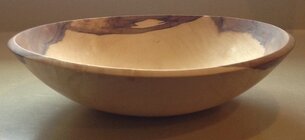
I have used a variety of finishes on large artistic bowls that may or may not be used for a salad. This bowl is white ash with striking figure entering in from the sides. I always use a light coat of Zinnser sanding sealer first to avoid blotches and unwanted darkening especially where I want contrast between figure and light background. Then I smooth it with an oil rag with fine pumice. Then General Finishes has a salad bowl finish I'm not wedded to. Liberon (UK) has a fine tung-bean based Finishing Oil. Volatile organics do go off in the drying process and it leaves a hard penetrating finishing with some darkening. I do not like direct oil finishes for the reasons I mentioned. Of course, larger pore size of ash would suck up oil as in fact does walnut. But do any of you have favorite finishes I should consider? Thx. Brad Whitman

-
It's time to cast your vote in the March 2026 Turning Challenge. (click here for details) -
Congratulations to Chris Lawrence for "Dragon's Grip" being selected as Turning of the Week for March 30, 2026 (click here for details) -
Welcome new registering member. Your username must be your real First and Last name (for example: John Doe). "Screen names" and "handles" are not allowed and your registration will be deleted if you don't use your real name. Also, do not use all caps nor all lower case.
You are using an out of date browser. It may not display this or other websites correctly.
You should upgrade or use an alternative browser.
You should upgrade or use an alternative browser.
Salad Bowl Finish
- Thread starter Bradford Whitman
- Start date
I use Sutherland Welles polymerized tung oil for anything food contact. Can't say if it's right or wrong, but it's the best I've come up with doing research on this. The Tried and True finishes work nice too, but they take a longer time to cure than polymerized tung oil.
Last edited:
My go to finish also.I use Sutherland Welles polymerized tung oil
That does it!
I use Sutherland Welles polymerized tung oil for anything food contact
Looking at the Sutherland Welles web site, I see:
- Interior Polymerized Tung Oil
- Exterior Polymerized Tung Oil
- Murdoch's Polymerized Tung Oil
- Botanical Polymerized Tung Oil
- and Wiping Varnish, apparently a polymerized tung oil fortified with resin
Could spend a fortune and get all of them and experiment a lot, I guess.
Or get recommendations from someone with experience. Specific suggestions and why? Always use the sealer?
JKJ
SW online says 4 oz samples available
I will try a few
But their checkout gives full price each
I'll get to the bottom of that
I will try a few
But their checkout gives full price each
I'll get to the bottom of that
I buy the original interior high luster finish. When I use it I start with a 50/50 mixture thinned with food grade di-citrosol solvent. I usually apply three to four coats or more depending on how the wood absorbs it. First coat I flood it until it won't accept any more finish. Second coat is thinned three parts tung and one part solvent, third coat and more are thinned four parts tung and one part solvent. I allow three to 5 days between coats (when you can no longer smell the di-citrosol), Sutherland says it's food safe after three weeks of cure. If I want to speed up the cure I set the object on top of my water heater, this gives just enough extra heat to allow recoat in two days. This method gives me a satin to semi gloss finish. I don't like full gloss wood items generally. I buy the high luster because I can thin it to whatever gloss I want. Another product they make is Millies which is good for bowls. It is tung with beeswax. If you check out their website they have videos on how to apply their finishes. You can also call them and tell them what you are doing and they will guide you on what to buy for your project. Very helpful and nice people. As Bradford said they sell sample kits. I have been buying it in quart size and put into a stop loss bag and it keeps for the 6 months that it takes me to use it. I would like to buy a gallon if I can find a buddy to share it with to get a better deal. Again, call them if you have technical questions, they are helpful.
Nice info - thank you.I buy the original interior high luster finish. When I use it I start with a 50/50 mixture thinned with food grade di-citrosol solvent. I usually apply three to four coats or more depending on how the wood absorbs it. First coat I flood it until it won't accept any more finish. Second coat is thinned three parts tung and one part solvent, third coat and more are thinned four parts tung and one part solvent. I allow three to 5 days between coats
I too (usually) prefer a satin or less glossy finish - I think it feels better and I like the way it brings out the form over the finish. I've been told glossy sells but I turn to suit me, not to sell.This method gives me a satin to semi gloss finish. I don't like full gloss wood items generally. I buy the high luster because I can thin it to whatever gloss I want.
JKJ
I have been using the walnut oil from The Doctor's Woodshop. He is a chemist. Maybe 20 years, can't remember. It is intended for wood bowls and treen ware/anything wood.
robo hippy
robo hippy

How fast does it cure?I use Sutherland Welles polymerized tung oil for anything food contact. Can't say if it's right or wrong, but it's the best I've come up with doing research on this. The Tried and True finishes work nice too, but they take a longer time to cure than polymerized tung oil.
That's been my 'go to' for years now though I've recently become concerned over the fact that it's a 'tree nut'. I've been meaning to reach out to him just haven't done so as of yet.I have been using the walnut oil from The Doctor's Woodshop. He is a chemist. Maybe 20 years, can't remember. It is intended for wood bowls and treen ware/anything wood.
robo hippy
The Tung Oil takes a couple days to cure enough to apply a second coat and a couple or three days between further coats. If you don't let it cure some between coats you get a gummy mess. Full cure is about three weeks. Tried and true I do the same between coats and they say it cures in about three to four weeks for full cure. Last year I did a gunstock with Tried and True varnish oil and it took six months to fully cure.How fast does it cure?
Both the Dr's and Mike Mahoney's oils are "heat treated", which is a process where the oil is heated to a point where the proteins that cause nut allergy reactions are broken down. I think some of the grocery store walnut oils are the same.
I don't know if the Osmo, Rubio monocote, are "food safe" or not. They do not have any VOC vapors, so you can use them inside without needing a respirator. Side note, a peanut is not a nut, but a legume. I don't turn Mimosa/Silk tree any more because it makes me sneeze and itch, like walnut wood does. The Mimosa does have long seed pods with seeds, so they may be legume or at least legume like. No problem with black locust or honey locust.
robo hippy
I don't know if the Osmo, Rubio monocote, are "food safe" or not. They do not have any VOC vapors, so you can use them inside without needing a respirator. Side note, a peanut is not a nut, but a legume. I don't turn Mimosa/Silk tree any more because it makes me sneeze and itch, like walnut wood does. The Mimosa does have long seed pods with seeds, so they may be legume or at least legume like. No problem with black locust or honey locust.
robo hippy
I use a variation on Vincent's approach and find it to be a highly reliable and flexible finishing strategy for bowls, if you have the time to wait between coats. I always have a can of the sealer and the high lustre, and use or blend them according to the wood and desired sheen. I use the Sutherland Welles line when I can get them, but when I can't I get the Lee Valley polymerized tung oil, which is the identical Sutherland Welles product under a Lee Valley label (the Lee Valley instructions for this line give the ratios of sealer-to-high lustre for the various sheens.)Or get recommendations from someone with experience. Specific suggestions and why? Always use the sealer?
I always start with a coat (or two) of the sealer, then go on to further coats, blended for the sheen I am aiming for. Often I find myself going straight from the sealer to straight high lustre (which is actually 50% tung oil and 50% solvent) and then cut back the sheen with steel wool (or Mirlon or Scotch-Brite) if necessary.
If you don't have the time for all of that, and agree (as I do) that cured poly is safe as a salad bowl finish, then as Richard says, you can't beat Minwax Quick Dry Poly, the poly that seems to always steal the show in tests and trials. Buff up or cut back the sheen as desired.
At the risk of compounding the options, an in-between finish that I love is Sutherland Welles Wiping Varnish, which is their polymerized tung oil blended with some varnish. This is another one that takes time between coats (a day or so) but you get a beautiful oil finish with the added protection that comes with the poly in it. It has the same sealer+lustre choices as their straight polymerized tung oil line; I just get the high lustre and mix it with the sealer to suit. I can get anything from a full-on gloss (with enough coats) to a gentle sheen.