Does anyone have a source for good quality affordable sandpaper? I have been using Finkat from Craft Supplies, as well as wet dry paper from the auto parts store.
Don't keep up with affordable but do with functional.
After trying many I now use two types of sandpaper.
1) I use
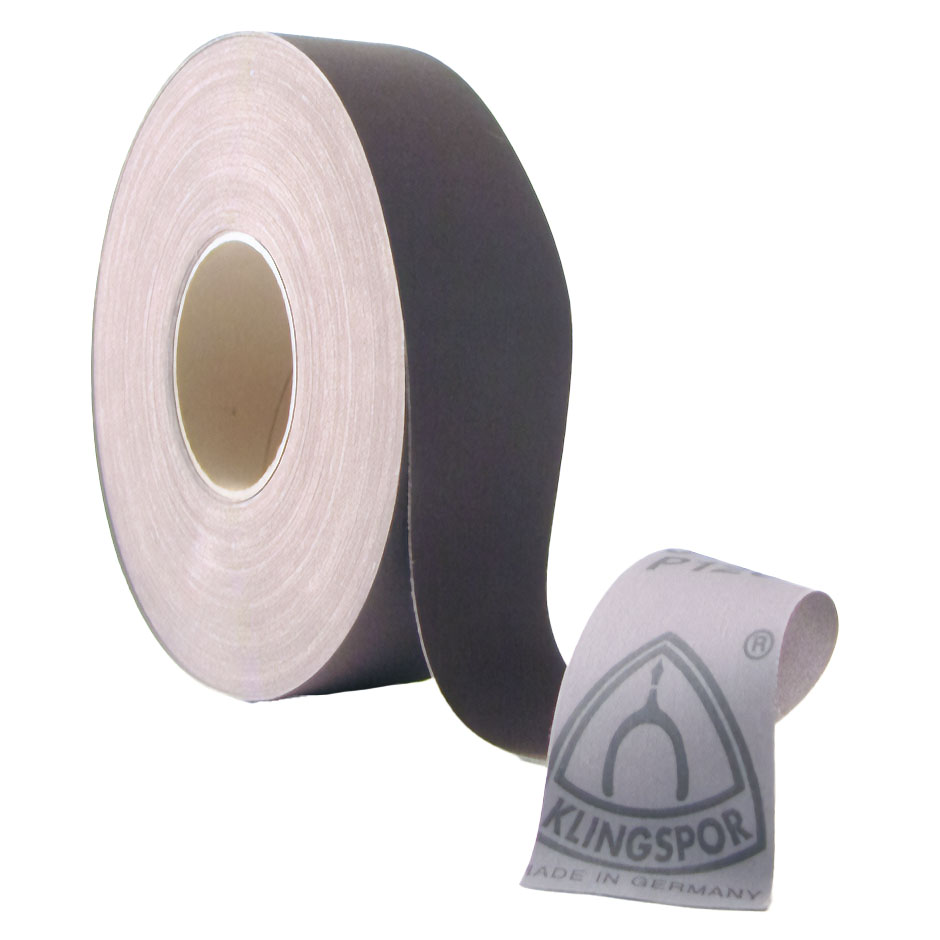
Klingspor Gold in rolls. These have excellent grit bonded to a very tough, flexible cloth backing. I get 1" and 2" rolls from 400grit down to coarse. Don't need the coarse much. I reserve the 80 grit for brake drums and such. Mostly start with 220 or 320. I put the rolls in a dispenser I made to hang on the wall behind the lathe - tear of a piece as needed. Write the grit on the back with a sharpie since sandpaper makers never got the memo to print the grit ever couple of inches.
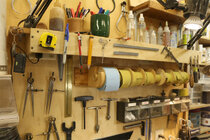
2) Under the sandpaper roll dispenser are some little plastic bins with finer grits. The only fine grit sandpaper I use is
Indasia Redline Rhynowet. It comes in 9x11 sheets. After trying some I bought a lifetime supply. I cut it into pieces maybe 1"x3". I use 600 grit the most, often 800, sometimes 1000,1200,1500 for special cases such as when sanding and polishing acrylic.
Long time ago I bought some wet and dry paper at an auto parts store. This stuff had a layer of black grit on the paper. Might be great for auto bodies but it's wasn't flexible. If folded, the grit would crack and some would even break loose. Never again. The Rhynowet is the opposite. The paper is extremely good and will take tight folds without any problem, very flexible. I also like that when it gets clogged with fine sawdust I can clean it with a swipe against my jeans pant leg.
Note that for several reasons I
never power sand with rotating disks on a drill. I turn dry wood. My method for bowls, platters and such is to make clean cuts, remove tool marks with negative rake scrapers of my own design, remove NRS marks with hand scrapers, then sand by hand. After scraping I usually need only 400 grit then 600 grit paper. Occasionally a little coarser if there are problem spots. I back up the sandpaper with a Magic Rub eraser, my "soft sanding block". On occasion I might use a pneumatic ROS running at a very low speed with 600 or finer paper. I use a Grex pistol grip air-operated ROS and a palm ROS from Woodturners Wonders - nice because it has a valve to cut the air way down.
When I started using the hand scrapers everything got so much easier. I grind various shapes, sharpen them like a cabinet scraper, and burnish a burr on both sides. (I start with good quality cabinet scrapers, the thicker the better, and shape the profile to suit with a 1" belt sander with coarse grit. Then sharpen on a 600 grit CBN wheel and fine diamond hones.)
I sometimes use one of the Stew-Mac scrapers marketed to people who make violins and guitars. Two Stew-Mac scrapers are shown on the left below along with some of the cabinet scraper shapes I like for bowls and shallow platters.
Using these quickly banishes any surface ripples and the little divot or hump we often see in the center of turnings. I've been preaching hand scrapers for years and now know some who use them.
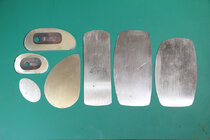
Hand scrapers can remove a lot of wood quickly and leave a very smooth surface.
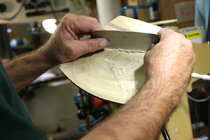
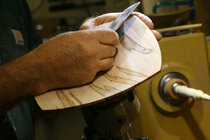
Smoothing with hand scrapers can eliminate a LOT of sanding. Sometimes I get lucky. I have one piece I take to show at some demos - the only sandpaper that ever touched it was 600 grit.
For spindles, I'll use the Klingspor Gold as needed, first with the lathe turning slowly with the paper constantly moving, then sanding by hand with the lathe off, being sure to sand in two directions, first around the circumference then along the grain before I got to finer paper.
When sanding tight coves on thin spindles I first sand slowly with the lathe turning, then turn off the lathe and sand diagonally with a piece of sandpaper curled into a kind of a tube. Sometimes I wrap the sandpaper around the non-working end of a fine sharpie pen for a curved sanding block.
I know this is more than you asked for but once I get started I don't know how to quit.
JKJ




 www.redlabelabrasives.com