• December 2025 Turning Challenge: Single Tree! (click here for details)
  • Congratulations to Bob Henrickson, People's Choice in the November 2025 Turning Challenge (click here for details)
  • Congratulations to Steven Gordon for "Dropped Ice Cream Cone" being selected as Turning of the Week for December 8, 2025 (click here for details)
  • Welcome new registering member. Your username must be your real First and Last name (for example: John Doe). "Screen names" and "handles" are not allowed and your registration will be deleted if you don't use your real name. Also, do not use all caps nor all lower case.

sandpaper sources

Joined
Mar 23, 2009
Messages
37
Likes
4
Location
Lisle, IL
Website
www.alancarterstudio.com
Can anyone tell me the best sources to get clothbacked sandpaper in superfine grits like 1000 and up? I've found a few places online, but don't know how well they work.
Thanks for any help you can give me.
 
1000 grit

you might want to try turningwood.com

he sells a 1000 grit ABRALON® Micro Fine Polishing Foam Discs are made from silicon carbide mesh laminated to 1/4" thick foam, hook & loop discs.

he also has a 1200 grit, not sure what kind of backing but i use it on poly finishes with a good result

http://turningwood.com/
 
Welcome!
Since this is your first post, I thought it might be appropriate to point out to you that Steve owns/runs the "Turningwood.com" Charlie referred to as a good source of sandpaper.
Steve's prices are as good as any and he is an experienced turner, so he'll understand what you are asking about.

Disclaimer - Yada, yada...just a happy customer.
 
You might try an auto body supply store - paint store. If you can find Eagle brand sandpaper (made in Japan) it is pretty good stuff. Then there is Abralon abrasives. Good also.
Hugh
 
What are trying to sand? I can make some suggestions based on usage.

Well, I'm giong to piggy back on this thread and ask my own questions about sanding.....

My usual sanding routine is to sand through to 600---white rhino industrial abrasives al/ox stearated paper-h&L back. I make sure I'm not burnishing with the fine paper, get it as good as I can w/ 600, then use grey ultra fine 3M scotchbrite, and super fine white 3M to really get the last scratches out. If I really work to get a totally scratch free surface before applying varnish, the finishing is so much easier. Sometimes though, I create more scratches than I remove with the grey 3M scotchbrite, but its somewhat inconsistent in regard to wood used, pressure, kind of mandrel backing, etc. Its all from the same box, so I know its the same grit, but sometimes I get scratches and sometimes I don't. Its not from stray grit getting into the pad either; I try to blow off pieces in between grits. Anyway, I'm thinking about changing up the last part of it to get a better finish.The grey pads are great for cutting down rough varnish spots between coats, but before the finish is applied it seems to gouge a bit. Is the abralon system worthwhile in the very high grits if you're trying to do things on a larger scale? I'm thinking of the reusable mesh ones, but I'm open to suggestions. I'm just looking for something to get out the last scratches before the white buffing scotchbrite, which really seems to work well if you don't use much pressure, which causes it to burnish the wood and clog up. Thanks in advance.
 
My recommendation, would be to sand to about 400 at most, if you are going to use a film finish that builds up. The reason for that is the finish can have adhesion issues if the teeth it needs to grip to are too small. Teeth in this case are the scratches left behind by the last grit.
Because it is a building finish, multiple coats will fill in the scratches left behind even with surface tension. If you are trying to achieve a level finish, no pores or grain showing, it is just more coats. If you are seeing scratches through the finish, they are most likely left from the dry sanding process, not spending enough time on a lower grit, or getting some gunk in the paper that tears up the surface.
You scuff between coats to clean up nibs and dust, but also to increase adhesion of coats as well as lower the peaks left by surface tension of the finish.

That said, Abralon (or SIA Air or any higher grit product system), work well for taking a finish or wood to the next level of smooth. With a sprayed or film finish that has nibs and orange peel, you would start out (always wet on a finish, but not always in wet wood) sanding with 1000, then 2000 and 4000 then maybe buffing and polishing compounds or a white diamond and wax regime.
Abralon works well because it is foam backed so it holds water and acts as a soft interface pad. But I have used wet and dry paper from 3M and others, you just have to presoak them so they are softer and then use a sanding block. Sanding with your hand may leave ridges because of different amounts of pressure with different parts of the hand.
 
Last edited:
Hi Nate,

I can't exactly remember where I heard it, but before you first use sand paper, run it over the edge of a metal edge, like a metal ruler. Since the manufacturing process is not perfect, even for the most expensive of sandpapers, occasional larger grit pieces get stuck on to finer grit sand paper. Just running once across the edge is enough to knock off the oversized grit.

Cheers,
 
Hi Nate,

I can't exactly remember where I heard it, but before you first use sand paper, run it over the edge of a metal edge, like a metal ruler. Since the manufacturing process is not perfect, even for the most expensive of sandpapers, occasional larger grit pieces get stuck on to finer grit sand paper. Just running once across the edge is enough to knock off the oversized grit.

Cheers,

There is some truth to that, as an 80 grit may have say 70-90 grit attached, but at the same time sandpaper isn't really made to be friable like a grinding wheel is. The grit doesn't really fracture off to make a fresh surface, it has a finite effective working lifespan and gets clogged or dull and can't be resharpened.

However as far as I know, all of the higher quality manufacturers can keep a pretty tight tolerance on the grit size..
 
Thanks to all who have replied. Since I'm really new to turning all your advice is very helpful. I'm doing small turnings right now with some fairly involved shapes (nothing like jumping into the deep end of the shark pool) and delicate finials along the lines of Cindy Drozda. Lots of nooks and crannies to sand and I'm looking for a really silky finish, hence the cloth backed high grit paper- I think.
Once I learn to stop breaking the things when I sand, I'll post some pics so you all can see what I'm talking about.
Thanks again.
 
For Nate Hawkes - Rhyno Grip sandpaper issues

Hi Nate

I was a former Ryhno-Grip Indasa sandpaper user (1 meter x 1 yard sheets) and found the sandpaper and my sanding job to be inconsistent, at best.

After about 2 years of struggling with poorly sanded finishes (here's everything that I tried - scratches after the finish went on, used mineral spirits to simulate finish to find scratches, took bowls -- after a coat of finish -- back down to original grit and resanded, hand sanded, power sanded, random orbital air sanders -- I was spending 3-5 times longer to sand a piece than it took to turn it - I tried it all) I picked up a sample of discs from another sandpaper vendor, Vince Welch, of Vince's WoodenWonders. That made all the difference in the world. In my opinion, the Rhyno Grip paper was simply too aggressive for me. Since I switched to a different type of sandpaper, I'm a woodturner again, not a 'wood sander'. Simply put, not all sandpaper is alike.

Here's another problem I ran into with the AO stearate paper - on darker woods, like walnut, a white film residue started to show up after a few weeks. I was told (by a turner whose opinion I highly respectd) that the white film was likely the glue or adhesives that were used to adhere the particles to the surface.

Steve Worcester, of this forum sells similar high quality paper, too. If you discover that you're still finding scratches in your finish, try starting with a different type of sandpaper altogether, Vince's or Steve's.

 
Here are lots of choices.

You might also want to try Bruce Hoover's website, thesandingglove.com.
He is a turner, and a great guy. His product selection is really outstanding, and the prices are good. If you speak with him, I am sure that he will give you a lot of good advice.

Matt
 
Alan,

I have a question? Why do you want cloth backed material for higher grits? The reason I ask is because of the woven backing with cloth back material you do not get a "smooth even" surface as you would with paper or film. That is why you generally cannot find cloth back in higher grits. I do have samples available for you or anyone who like to try a new product line I have coming available. Just contact me at www.VincesWoodNWonders.com.

Vince
 
I guess the sandpaper doesn't have to be cloth backed. I'm just looking for something really flexible that won't crease and will get into tiny nooks and crannies. I think the responses I've gotten here will help me find what I need.
Thanks.
 
The plastic film backed abrasives like Vinces and the 3M ceramic are far superior to paper or cloth backed abrasives as far as I am concerned. I believe the particles are electrostatically stuck to the film, and you get a much better/even/consistant grit on the discs. You can not tear them, even me with my 'when all else fails, it is nice to be able to rely on brute strength' attitude. It is flexable and strong. For getting into nooks and crannies, an old credit card adds some rigidity, or other shaped things that come close to matching the form you are sanding help.
robo hippy
 
You get it from Vince. The only other one out there is ceramic abrasive from 3M, which is only available in PSA (sticky back stuff) and is available through the Sanding Glove. Haven't tried it yet. Expensive, but supposed to really last a long time. I think Packard has a green ceramic disc as well, but to me, best value is from Vince. They really do last longer.
robo hippy
 
Seems the Cubitrons are on J weight cloth robo hippy. See the Sanding Glove catalogue p 11

Can anyone post a source of Astra dot discs?
 
I think Woodchuckers out of Canada had the Astra Dot stuff. I tried it and wasn't impressed. Great for open coat, but not good durability.

robo hippy
 
paper

You might look into the Hermes line of abrasives. Sorry, I don't have the link available at the moment but, it might just be the best and longest lasting paper available. Of course, all paper is going to "load up" when you're working the real oily stuff..Cocobolo, Lignum Vitae etc. but, overall, for me the Hermes is about the best. It's not cheap by a long stretch but, for me it's worth it. I also use the colour coded backed cloth stuff which is also excellent paper. Except for the real coarse stuff (80 or 100), all of my paper comes from over-seas.
I'm sure you can google Hermes.
J
 
paper

Alan,

I have a question? Why do you want cloth backed material for higher grits? The reason I ask is because of the woven backing with cloth back material you do not get a "smooth even" surface as you would with paper or film. That is why you generally cannot find cloth back in higher grits. I do have samples available for you or anyone who like to try a new product line I have coming available. Just contact me at www.VincesWoodNWonders.com.

Vince

Sorry Vince. The idea and/or statement that cloth backed paper does not give a smooth and even surface is utter nonsense. Guess that statement is ok for you because you're trying to sell something. However, it is completely without substance or merit, and simply not factual or accurate.
J
 
Seems the Cubitrons are on J weight cloth robo hippy. See the Sanding Glove catalogue p 11

Can anyone post a source of Astra dot discs?

The only North America source for Astra Dot is Woodchuckers in Canada.
My understanding is they get it from a source in New Zealand, so you may want to look "locally", since you are in AU.

I know a few people who really like it, and initially I tried it and talked to the manufacturer (Noritake Abrasives) about importing it into the US. But there are so many products out there, that in my opinion, perform better, I kind of dropped that line of thinking. That and the initial investment was too high to make it worth while.
 
I think some of the advances in manufacturing abrasive materials in the last 10 years will erase some of the old 'truths' about abrasives. The consistancy of the grit is much better than it used to be. I don't know if it is because the grit is applied electrostatically, or screening is better so it is more consistant, or if the backing materials are better than they used to be, even paper and cloth, or whatever. There is a Norton abrasive (Dry Ice) that is on fiber reinforced paper. Who knows what the future holds.

What the turning world needs is for the manufacturers or sellers of the abrasives to do is a DVD, book, article for the magazines, and lecture series on abrasives and their use as pertaining to woodturning. This is probably the most misunderstood part of woodturning there is. In part because it is our least favorite thing to do. Steve? Vince? Bruce? ...........

robo hippy
 
I think some of the advances in manufacturing abrasive materials in the last 10 years will erase some of the old 'truths' about abrasives. The consistancy of the grit is much better than it used to be. I don't know if it is because the grit is applied electrostatically, or screening is better so it is more consistant, or if the backing materials are better than they used to be, even paper and cloth, or whatever. There is a Norton abrasive (Dry Ice) that is on fiber reinforced paper. Who knows what the future holds.

Consistency in grit size isn't the only answer. Manufacturing standards allow a percentage larger than advertised mesh, as well as a percentage smaller. It's equally as important, if not more, that the adhesive provide a firm grip to what's spread on it. Prevents a rogue chunk from shaking loose, being caught, climbing above the average surface and dragging a nice divot before it gets pressed back or released to the helpful grip of gravity to get out of the way.

Better to keep that light touch which keeps down the heat, the hard/soft encounter deviation and the rogue grit from interfering too much.
 
This is an informative thread, thanks everyone. The only thing I've been told is you should stay with one source.....after you find a good one that works for you. Grits are not all equal from each supplier and a 220 grit from one might be a 200? or even 320? from another source.

Is that right, Steve? (since you are my "one source")

Ruth
 
Thanks all for the useful posts.

I've been using mostly SIA and Hermes velcro stuff, cutting my own discs, but both are prone to clogging. Astra single dot was better in this respect.

The Sanding Glove catalog makes very interesting reading ... who thought abrasives could be exciting?:D

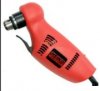
Has anyone used the angle-head sander listed there? Looks like a copy of a Milwaukee but much cheaper. Pic attached.

Steve, I've sent you an email about whether you can ship to Australia.
 

Attachments

  • Neiko from Bruce.jpg
    Neiko from Bruce.jpg
    15 KB · Views: 26
I do prefer the angle drills to the right angle drills. I have 4 of the Sioux/Milwaukee drills. They have all been rebuilt a number of times, from bearings to brushes, to the plastic housings on the drills do wear out as well. Average life before needing at least bearings is around 450 bowls, of all sizes (4 to 18 inch diameter). This is up from around 350 when I used to run at full speed. I now keep a piece of 1/4 inch cork under the trigger to keep the speed down. It really does work better. I have 3 inch discs on them 99% of the time. I did try one of the 'clones'. The plastic casing on it failed (where it holds the bearings) in less than a month, which was maybe 50 bowls. I knew others who tried the same one as well, and a couple of them had trigger issues and were sent back for replacements, which did work a bit better. This was a $30 drill. There are others around $80, but I haven't tried one yet. I do tend to abuse my tools, but I do blow them out several times a day if I am doing a lot of sanding. I did have a friend who works at a bearing place talk to an engineer about bearings, and he recomended some fancy ones that were not much more expensive than the stock ones, and they may last a bit longer, but not much. These drills are not made for grinding/sanding like we do.

robo hippy
 
Thanks for that extended answer RH!

Yes, I've seen Richard Raffan use the Makita right-angle sander but it seems to me it would be limited in deeper/steeper bowls, and they're darn expensive Down under.

The Milkwaukee 55 degree unit doesn't seem to be stocked here but it is in the UK so there must be a 240v version.
 
Sorry Vince. The idea and/or statement that cloth backed paper does not give a smooth and even surface is utter nonsense. Guess that statement is ok for you because you're trying to sell something. However, it is completely without substance or merit, and simply not factual or accurate.
J
Jay, Perhaps I did not word my statement correctly and the statement regarding the fact the I sell something has nothing to do with the point of this topic!
What I said was "a woven backing with cloth back material you do not get a "smooth even" surface as you would with paper or film". Perhaps I should have elaborated a bit more by saying cloth material generally will go to 600 grit. 600 grit is not a very high sanding grit in many applications as you can find paper backed and film backed abrasives that will range to 2000 and higher. 600 to 2000 is a big difference regarding finishing.
Jay, please do not misquote me! I never said "cloth backed paper" as you have written in your statement. Moreover, the idea that my statement is "is completely without substance or merit, and simply not factual or accurate" is a bit extreme in my view and this sounds a bit more personal then anything else. Feel free to contact me if you have any questions concerning any of my statements. This is a respected forum and should not be wasted on back and forth dribble.
Vince
 
Who thought that talking about sandpaper would generate so much friction? I guess the bottom line is what abrasives do the best job, regardless of their composition, backing, etc. My skills have improved somewhat since I first aked about sandpaper back in March and have found that the right amount of pressure is as important as the paper itself. Also power sanding and sanding off the lathe have solved a lot of problems. Experience wins out in the long run, right?

It's also a question of what abrasives work best on different finishes. I use mainly spray lacquer as a finish and have had some success with sanding pads up to 320, finishing off with auto polishing compound. Any comments on that without getting overly excited?

Thanks.
 
Alan I also use spray lacquer. I did a test a few years ago where I sanded some boards of different species to 2000 grit. I sanded them in 3" sections starting at 120. I don't remember the species for sure but I know I had cherry, tiger maple walnut and a few others that I use often. I used an oil finish on half and my spray lacquer on the others. I passed the around at the club meeting. On all the boards except 1 you could not see a difference in finish after 400 grit. I thought for sure the oil based finish would show a difference.
These were flat boards and sometime when I have time I'm going to do the same test on a turning with end grain showing. I have done that to a lesser degree when turning a production run of wine stoppers but not where I could have the same species sitting side by side for other to check. I now sand my work to either 400 or 600 and stop there. If I can't tell the difference I'm sure my clients can't.
Now sanding finish is another matter. If you want that glass look you've got to go all the way. I sand to 1500 and then go to polishing compounds.
 
Who thought that talking about sandpaper would generate so much friction?

Good pun even if not intended

It's also a question of what abrasives work best on different finishes. I use mainly spray lacquer as a finish and have had some success with sanding pads up to 320, finishing off with auto polishing compound. Any comments on that without getting overly excited?

Thanks.

Since this is a whole 'nother topic, I have copied this message to the main forum with a "Finishing for Lacquer" title
 
And of course oils ain't oils as the man said.

The proprietary DO I use provides a little fill and covers hairline scratches, and it's not one of the high gloss high resin content formulations.
 
Hey Steve,
I did a bowl turning demo in Portland last night, and when abrasives came up, some one mentioned that Mirka has a ceramic abrasive now. Know anything about it?

robo hippy
 
Back
Top