I recently reread the recent thread on negative rake scrapers, https://www.aawforum.org/community/threads/negative-rake-scraping.25073/#post-284343
There was only one comment by Dave Landers on the forces that are at play with straight (standard) scrapers and negative rake scrapers (NRS). For the record I use NRS almost exclusively. They are easily controlled and almost never catch on wood. (If you want a catch with a NRS, use it on a PVC plumbing fixture at high speed. It is soft enough that it will catch.) We all understand that straight scrapers can easily catch. I have heard several respected demonstrators say that tilting a straight scraper down to a NRS angle makes it perform just like a NRS scraper. This is not my experience.
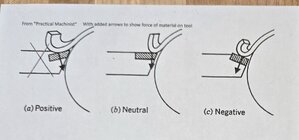
My question is has anyone figured why straight scrapers tend to self feed and NRS don't? Can anyone generate a force diagram for these? If I can understand the forces behind the scrapers I might be able to set up straight scrapers to be as safe and easy to use as a NRS.
Cheers,
There was only one comment by Dave Landers on the forces that are at play with straight (standard) scrapers and negative rake scrapers (NRS). For the record I use NRS almost exclusively. They are easily controlled and almost never catch on wood. (If you want a catch with a NRS, use it on a PVC plumbing fixture at high speed. It is soft enough that it will catch.) We all understand that straight scrapers can easily catch. I have heard several respected demonstrators say that tilting a straight scraper down to a NRS angle makes it perform just like a NRS scraper. This is not my experience.
My question is has anyone figured why straight scrapers tend to self feed and NRS don't? Can anyone generate a force diagram for these? If I can understand the forces behind the scrapers I might be able to set up straight scrapers to be as safe and easy to use as a NRS.
Cheers,