• The forum upgrades have been completed. These were moderate security fixes from our software vendor and it looks like everything is working well. If you see any problems please post in the Forum Technical Support forum or email us at forum_moderator (at) aawforum.org. Thank you
  • February 2026 Turning Challenge: Cookie Jar! (click here for details)
  • Congratulations to Matt Carvalho for "Red Mallee Folded Form" being selected as Turning of the Week for February 9, 2026 (click here for details)
  • AAW Symposium demonstrators announced - If the 2026 AAW International Woodturning Symposium is not on your calendar, now is the time to register. And there are discounts available if you sign up early, by Feb. 28. Early Bird pricing gives you the best rate for our 40th Anniversary Symposium in Raleigh, North Carolina, June 4–7, 2026. (There are discounts for AAW chapter members too) For more information vist the discussion thread here or the AAW registration page
  • Welcome new registering member. Your username must be your real First and Last name (for example: John Doe). "Screen names" and "handles" are not allowed and your registration will be deleted if you don't use your real name. Also, do not use all caps nor all lower case.

Sealing ends with paint?

Joined
Jan 24, 2010
Messages
3,188
Likes
969
Location
Cleveland, Tennessee
I have been sealing with Anchorseal but wondered if plain latex paint might be useful. Sometimes Lowe's has paint returned for whatever reason. Cheaper than Anchorseal. Your thoughts or experience?

 
Yup I do that on occaision with left over paint, it works and at times an old spray pack of varnish works just as well. I find to great way to get rid of the remnants of painting, instead having those old tins with too much to throw away in :)
 
Not in my tests. I did what I call long term tests. I seatled pieces with a variety of things from roofing tar and house paint to parrafin wax, anchorseal, stretch wrap, plastic and anything else I had. That was before people started using wood glue so that wasn't included. Anyway I watched all of these pieces for a tear or more. Anchorseal,parrafin wax and roofing tar won although the tar was simply too messy. Stretch wrap started breaking down after 6 months or so. The wood under the house paint ( i used 3 coats of latex exterior paint) was starting to crack. Plastic garbage bags deteriorated and caused lots of mold. Very good for short term storage. I use these when cutting cherry because it will start to crack within 5 minutes of being cut. The garbage bags give me enough time to take my time sealing them properly.
These were all logs cut in half through the pith abd stored in a building on shelves.
 
I was fairly pleased with an experiment using a thick coat of white glue and then sticking gloss paper from women’s clothing catalogs to the glue. But I did not expose the blocks to the weather. A flat roof paint that has a flexible additive would be a better product than just latex paint.
 
I haven’t tried white glue, but I’ve known some folks who use old wood glue just slightly watered down as a sealer with pretty good results. Worth a shot if you, like me, bought the big bottle, but can’t seem to use it fast enough before it starts to get a little lumpy.
 
I had a bunch of half rounds and used glue thinned with a little water to coat the ends until I could rough them out. After roughing out, I used Anchorseal on the entire blank.

I prefer the Anchorseal. Both worked but the glue made any splintered wood sharp needles. It also took a lot longer to dry. I could put a wet Anchorseal blank with it touching another blank and they wouldn’t be glue together. I can’t imagine coating the entire blank with glue.

My opinion, if I had just one blank, either is fine. For several, Anchorseal wins hands down. And cleanup is easier. YMMV.
 
I didn’t do a controlled experiment, but concur with others comments about latex not doing well.

~15yrs ago I sealed up a bunch of walnut with latex paint (2coats). Lots of cracking by the time I was sealing up some more walnut logs a year or so later, I used AnchorSeal the next time and didn’t have nearly as much cracking. That was the original AnchorSeal, before they changed the formulation. After AnchorSeal changed I read many comments about it not working as well, but I’ve been generally happy with it UNTIL some ~4”x4”x24” white oak blanks I coated last fall - just noticed major cracking :(
 
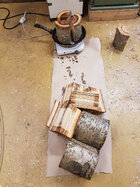
My tests were the same as Johns. The best was paraffin, second was white glue, third was anchor seal. Latex paint would have been in 10th place. I know I put two coats on but I don't think I tried 3 but who wants to do the same task three times. Paraffin is by far the easiest to do with pieces that you can pick up. An electric skillet and you are dipping in 5 min.

 
My tests were the same as Johns. The best was paraffin, second was white glue, third was anchor seal. Latex paint would have been in 10th place. I know I put two coats on but I don't think I tried 3 but who wants to do the same task three times. Paraffin is by far the easiest to do with pieces that you can pick up. An electric skillet and you are dipping in 5 min.

Unless the wood is bigger than the skillet. Good idea, though.
 
A nice feature of Anchorseal is that I can use the same bristle brush over and over, leaving it out between uses. Not so with glue.

My son buys Anchorseal in 50 gallon drums for his timberfaming business so my cost is low. Clubs can buy in bulk too and share the wealth.
 
John, since, like me, you're a charter member of the Cheapskates Club, a gallon jug of Elmer's white glue from Wally World is cheaper than a gallon jug of Anchorseal. However, if you get together with a group, and you're east of the Missisippi, a drum of Anchorseal is cheaper yet, per gallon.
 
I also didn't have luck with latex paint. I even tried a heavy coat of PVA drywall primer from a leftover basement finish, and had the same poor results as the latex paint.
I had somewhat better results with glue from wally world (the "washable" kind sold in gallons for making slime, normally $20/gal, but on clearance for $4.)
Anchorseal is the direction I've decided to go moving forward.
 
Well, long ago I heard that latex paint works if you slop a bunch of it on and then slap some plastic or newspaper onto the still wet paint.... All by itself, pretty much worthless. I get 10 foot long logs usually, and I keep them covered under tarps both top and bottom, and under a big western red cedar tree. I get minimal checking that way. Some times I have to cut off 2 or so inches, but results are pretty good.

robo hippy
 
A vote for Anchorseal or paraffin. Isn't AS paraffin based?

Latex paint has long been discouraged - water goes through it too fast. Maybe work better with multiple coats?

Oil-based paint is reported to be better. Aluminum paint is also reported to be very good. I don't use any kind of paint.

UC Coatings told me Anchorseal is a paraffin/water emulsion with a surfactant. (Surfactant lowers the surface tension. We use surfactant on the farm when applying liquid weed killer to fields - allows the liquid to coat and stick on the leaves rather than run off.)

I stick with Anchorseal and have great success. HOWEVER, Anchorseal, as it comes, is not useful in my opinion for woodturning blanks - it's too thin. I believe one reason it's thin so it can be applied to log ends at sawmills by spraying. (I used to do that)

I've described before what I always do to make Anchorseal useful to me for preparing and drying wood blanks of all sizes.
- I pour an inch or two in a plastic coffee can
- Leave the lid off for perhaps several days so some of the water evaporates.
- Mix it occasionally to judge the thickness. When "right", put the lid on the can.
- Apply the thickened Anchorseal with a cheap brush. Leave the brush in the can, close the lid till next time.
When a can starts to get low, I sometimes start drying more in 2nd plastic can so it will be ready if I use up the first.

Years ago I bought a 55-gal drum of Anchorseal (about 6$/gal then). It's about time to buy some more, I'm thinking 5 gal this time. I hate to pay the per-gallon retail prices.

For wood with a bad reputation I have used plastic wrap over the wet Anchorseal, but rarely.

JKJ
 
Back
Top