I just recently purchased a CBN wheel and wolverine sharpening jig for my tools. I was getting a lot of snags after sharpening my gouges. I consulted with a season turning veteran and my wings were not straight but rounded. What am I doing wrong and is there a way to set up the wolverine properly?

-
March 2026 Turning Challenge: Olla! (click here for details) -
Congratulations to David Wyke, People's Choice in the February 2026 Turning Challenge (click here for details) -
Congratulations to Tim Connell for "Black Locust Basket Illusion Series #4" being selected as Turning of the Week for March 16, 2026 (click here for details) -
Welcome new registering member. Your username must be your real First and Last name (for example: John Doe). "Screen names" and "handles" are not allowed and your registration will be deleted if you don't use your real name. Also, do not use all caps nor all lower case.
You are using an out of date browser. It may not display this or other websites correctly.
You should upgrade or use an alternative browser.
You should upgrade or use an alternative browser.
Sharpening with Wolverine jig
- Thread starter Richard Sondelski
- Start date
Yes, there’s a specific setup. Why not have the veteran or another club member help you?
View: https://www.youtube.com/watch?v=UBR0yTl8A1k&t=338
Thank you!Yes, there’s a specific setup. Why not have the veteran or another club member help you?
View: https://www.youtube.com/watch?v=UBR0yTl8A1k&t=338

Odie
Panning for Montana gold, with Betsy, the mule!
I just recently purchased a CBN wheel and wolverine sharpening jig for my tools. I was getting a lot of snags after sharpening my gouges. I consulted with a season turning veteran and my wings were not straight but rounded. What am I doing wrong and is there a way to set up the wolverine properly?
Sharpening on the Wolverine jig takes a little time to manage your gouge wings properly.
I suspect you are using a little too much pressure, but with a little practice, you can solve this issue very easily.
In my opinion, it's not about getting instruction from others, but to just get more time doing it!

=o=

The jig sets your angles but you govern the shape of the tip and wings by the amount of time and pressure you use on the various parts of the profile. The flute shape has an influence as well. It's easy to get a "birdsmouth" with a little hook between nose and wings when grinding a v-shaped gouge with a quick transition from the bottom radius to the straight sides of the flute.
Get with your seasoned veteran and look carefully from the side at his gouge's profile. Then turn over your gouge, resting the top of the flutes against the grinder platform and shape it symmetrically to the same profile. Put it in the Wolverine jig at the recommended settings and grind back to the new profile until you have a sharp edge. Try it out and see if it works for you. Remember, "Practice makes permanent" so develop a method that works for you and be consistent.
I usually use an "Ellsworth" grind with swept back, slightly convex wings because it is a versatile shape, but many shapes will work as long as there is a smooth curve with no concave sections. If you are in a club ask other members if you can try out their gouges to see what you prefer.
Here's Doug Thompson shaping a gouge, although he does it freehand, at about 14:00. Thompson
Get with your seasoned veteran and look carefully from the side at his gouge's profile. Then turn over your gouge, resting the top of the flutes against the grinder platform and shape it symmetrically to the same profile. Put it in the Wolverine jig at the recommended settings and grind back to the new profile until you have a sharp edge. Try it out and see if it works for you. Remember, "Practice makes permanent" so develop a method that works for you and be consistent.
I usually use an "Ellsworth" grind with swept back, slightly convex wings because it is a versatile shape, but many shapes will work as long as there is a smooth curve with no concave sections. If you are in a club ask other members if you can try out their gouges to see what you prefer.
Here's Doug Thompson shaping a gouge, although he does it freehand, at about 14:00. Thompson
The jig setup is just part of the equation. Even with everything set up just right, over time you can change the profile by grinding too much (or not enough) in places, and end up with a sharp gouge that's catchy. I think a slight convex "hump" is OK, but if you have tall rounded wings, you need to grind more on the sides. If you have a concave dip in the wings that creates a pointy beak of a point, you need to lighten up on the sides and grind more off the point.
Thank you for the advice. I got several old gouges that I've been practicing on so I don't grind away my new, good ones. I go to my friend to get the good ones sharpened until I learn how to do it.Sharpening on the Wolverine jig takes a little time to manage your gouge wings properly.
I suspect you are using a little too much pressure, but with a little practice, you can solve this issue very easily.
In my opinion, it's not about getting instruction from others, but to just get more time doing it!
=o=
Central Wisconsin Woodturners are not to far away in Wisconsin Rapids. I'm sure someone there would be willing to help if you asked. Sometimes another set of eyes sees things we miss.
I just recently purchased a CBN wheel and wolverine sharpening jig for my tools. I was getting a lot of snags after sharpening my gouges. I consulted with a season turning veteran and my wings were not straight but rounded. What am I doing wrong and is there a way to set up the wolverine properly?
It's very difficult to know what you are doing "wrong" without seeing what you are doing. The wolverine is versatile but there are some things I think are better done in ways they don't describe.
When I first started turning I paid a guy at Woodcraft to sharpen my gouges at $6 each (not $60 - typo!) After a short time I realized I could do a better job.
I agree strongly - get someone with experience to give some help - all respectable woodturners are willing to spend time teaching sharpening. I've had many people come to my shop just for sharpening instruction. I have them bring all their tools so I can judge there level of sharpening experience and decide what to do differently. I should have taken before and after pictures of some. It was amazing that some were able to turn anything.
I first show them how I would sharpen that tool then let them sharpen, with me watching and gently advising. "NO, don't ever do THAT!"
With the Wolverine, I sharpen almost all tools free-hand with the platform: skews, NRS, spindle roughing gouges, parting tools, my special wiicked point tool, more. I use only CBN wheels on that grinder - an 80 grit for shaping tools and a 600 grit for sharpening.
I far prefer the "mini" platform over the big one that comes with the wolverine, especially with older tools that have been shortened by sharpening for years.

I use their gouge jig only for bowl gouges.
I NEVER use the long arm attachment. With improper use it's just begging trouble. I also never use the skew attachment for the long arm. There is no need.
I make plastic angle templates for my favorite tools. I made this one to set the platform specifically to sharpen hand scrapers.


I make others as needed for skews, NRS, etc. (In this photo I've not yet painted the backs white for visibility.)

JKJ
Last edited:

I like the wings rounded a little. Everybody I know sharpens like that.
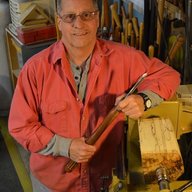
john lucas
AAW Forum Expert
Here is my sharpening problems video. Should help.
View: https://www.youtube.com/watch?v=_b73Br6xFc4
Hello Richard, a few weeks late, but...I just recently purchased a CBN wheel and wolverine sharpening jig for my tools. I was getting a lot of snags after sharpening my gouges. I consulted with a season turning veteran and my wings were not straight but rounded. What am I doing wrong and is there a way to set up the wolverine properly?
Rounded wings- I'll use the side wing edges of any gouge as long as the edge is straight to lightly convex in shape, but never concave at the edge. But concave can happen, especially coming off the nose around to the wing edge. That can be problematic.
I just wanted to verify/clarify the "rounded" part of your request. I hope you've gained a resolution!
Thank you John!Here is my sharpening problems video. Should help. Sorry dont know how to attach the link. Go to YouTube abd type in
Johnlucaswoodturner/sharpening problems
Hello John, in your video:Here is my sharpening problems video. Should help.
View: https://www.youtube.com/watch?v=_b73Br6xFc4
, at 5:02 you show a setting jig for the angle. Let's say you have a gouge that needs to be redone or has no edge. How do you determine the correct angle of the tool so you can make the jigs? (I have some gouges that I want to set the proper angle and make jigs for repeatability.) Thank you.

@Manny Yabar I do the same as @John K Jordan , ie use ~0.08” thick plastic to make angle setters. You will need an angle gauge. For gouges I like this one:

 generaltools.com
Trial and error - Grab a tool and initially guess (possibly use another tool measured with the protractor to help ) the platform angle. Grind enough of the edge to measure, then just keep adjusting the platform until you get the desired angle. How close you get to the desired angle depends on how OCD you are (for some +\- 5, me ~+\- 1, I am making a measuring device). What is important is that it returns the platform to the same angle each time.
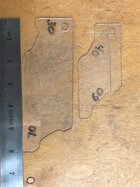
Photo of a couple of mine. I’ll cut a bit of the corner of with a saw, then just feed it into the grinding wheel. Remove the side flashing with a razor knife. I then use a drill mounted burr to remove the center of the arc, leaving a pad at each end of the arc. I then use an engraver to label the angle and go over that with a sharpie (the sharpie ink will wear off over time).
ANGLE-IZER® Square Head Stainless Steel Angle Protractor, 0 to 180 Degrees, 6-Inch Arm
ANGLE-IZER® Square Head Protractor is an essential tool for students, machinists, carpenters and woodworking hobbyists. Constructed of durable stainless steel, the protractor with its 6" adjustable arm is ideal for setting bevels, taking measurem
generaltools.com
Trial and error - Grab a tool and initially guess (possibly use another tool measured with the protractor to help ) the platform angle. Grind enough of the edge to measure, then just keep adjusting the platform until you get the desired angle. How close you get to the desired angle depends on how OCD you are (for some +\- 5, me ~+\- 1, I am making a measuring device). What is important is that it returns the platform to the same angle each time.
Photo of a couple of mine. I’ll cut a bit of the corner of with a saw, then just feed it into the grinding wheel. Remove the side flashing with a razor knife. I then use a drill mounted burr to remove the center of the arc, leaving a pad at each end of the arc. I then use an engraver to label the angle and go over that with a sharpie (the sharpie ink will wear off over time).
john lucas
AAW Forum Expert
I bought a cheap General angle gauge at Lowes. That let's me accurately measure the nose angle. However the exact angle does not matter. Anywhere from about 40 degrees to 60 works. You determine the correct angle for you by what shapes you turn. Deep narrow bowls need an angle like 55 or 60. Wide shallow bowls a 40 degree works. The more acute angles cut cleaner but on many of the bowls I do I simply cant ride tge bevel through the whole curve.Hello John, in your video:View: https://www.youtube.com/watch?v=GXetyA6-0b4
, at 5:02 you show a setting jig for the angle. Let's say you have a gouge that needs to be redone or has no edge. How do you determine the correct angle of the tool so you can make the jigs? (I have some gouges that I want to set the proper angle and make jigs for repeatability.) Thank you.
Hello John, in your video:View: https://www.youtube.com/watch?v=GXetyA6-0b4
, at 5:02 you show a setting jig for the angle. Let's say you have a gouge that needs to be redone or has no edge. How do you determine the correct angle of the tool so you can make the jigs? (I have some gouges that I want to set the proper angle and make jigs for repeatability.) Thank you.
The original question lacked specifics. Some thoughts:I bought a cheap General angle gauge at Lowes. That let's me accurately measure the nose angle. However the exact angle does not matter. Anywhere from about 40 degrees to 60 works. You determine the correct angle for you by what shapes you turn. Deep narrow bowls need an angle like 55 or 60. Wide shallow bowls a 40 degree works. The more acute angles cut cleaner but on many of the bowls I do I simply cant ride tge bevel through the whole curve.
1. The tool types weren't specified. All but the swept-back bowl gouge are best ground using a tilting-platform jig.
2. If you're using a swept-back bowl gouge, you probably have a lathe which doesn't have an outboard facility.
3. Most sharpening advice since 1957 promotes sharpening/bevel angles which are 15 to 20 degrees larger than optimum.
4. Sharpening is very quick and simple once you understand it. Much of the advice generously given is suboptimal.
5. I suggest Richard that some serious research would go a long way to solving your sharpening problems.
Best wishes, Mike Darlow
Hello, what brand /specs is the cbn wheel on your grinder, I am looking for one.. yours look very well madeIt's very difficult to know what you are doing "wrong" without seeing what you are doing. The wolverine is versatile but there are some things I think are better done in ways they don't describe.
When I first started turning I paid a guy at Woodcraft to sharpen my gouges at $6 each (not $60 - typo!) After a short time I realized I could do a better job.
I agree strongly - get someone with experience to give some help - all respectable woodturners are willing to spend time teaching sharpening. I've had many people come to my shop just for sharpening instruction. I have them bring all their tools so I can judge there level of sharpening experience and decide what to do differently. I should have taken before and after pictures of some. It was amazing that some were able to turn anything.
I first show them how I would sharpen that tool then let them sharpen, with me watching and gently advising. "NO, don't ever do THAT!"
With the Wolverine, I sharpen almost all tools free-hand with the platform: skews, NRS, spindle roughing gouges, parting tools, my special wiicked point tool, more. I use only CBN wheels on that grinder - an 80 grit for shaping tools and a 600 grit for sharpening.
I far prefer the "mini" platform over the big one that comes with the wolverine, especially with older tools that have been shortened by sharpening for years.
View attachment 85894
I use their gouge jig only for bowl gouges.
I NEVER use the long arm attachment. With improper use it's just begging trouble. I also never use the skew attachment for the long arm. There is no need.
I make plastic angle templates for my favorite tools. I made this one to set the platform specifically to sharpen hand scrapers.
View attachment 85897 View attachment 85900
I make others as needed for skews, NRS, etc. (In this photo I've not yet painted the backs white for visibility.)
View attachment 85901
JKJ
thanks
Doug when you contact the plastic to the grinding wheel does it clog the grit?@Manny Yabar I do the same as @John K Jordan , ie use ~0.08” thick plastic to make angle setters. You will need an angle gauge. For gouges I like this one:
ANGLE-IZER® Square Head Stainless Steel Angle Protractor, 0 to 180 Degrees, 6-Inch Arm
ANGLE-IZER® Square Head Protractor is an essential tool for students, machinists, carpenters and woodworking hobbyists. Constructed of durable stainless steel, the protractor with its 6" adjustable arm is ideal for setting bevels, taking measurem
Trial and error - Grab a tool and initially guess (possibly use another tool measured with the protractor to help ) the platform angle. Grind enough of the edge to measure, then just keep adjusting the platform until you get the desired angle. How close you get to the desired angle depends on how OCD you are (for some +\- 5, me ~+\- 1, I am making a measuring device). What is important is that it returns the platform to the same angle each time.
Photo of a couple of mine. I’ll cut a bit of the corner of with a saw, then just feed it into the grinding wheel. Remove the side flashing with a razor knife. I then use a drill mounted burr to remove the center of the arc, leaving a pad at each end of the arc. I then use an engraver to label the angle and go over that with a sharpie (the sharpie ink will wear off over time).
View attachment 86346
I've had a pile of CBN wheels of different grits. After experimenting and using all of them I've narrowed my wheels down to three. They do everything I need for the lathe. I buy all wheels from Ken Rizza at Woodturners Wonders.Hello, what brand /specs is the cbn wheel on your grinder, I am looking for one.. yours look very well made
thanks
The one in the photo in message #9 is an 8" wheel, 600 grit CBN, wide, square corners, 1" of grit down the size. I think Ken calls them "Mega-square". My most used wheel. I use it to sharpen all skews, bowl gouges, NRS and other scrapers, parting tools, my Wicked Point tool, hand scrapers, and others.
BTW, unless you have a special need, don't bother with the CBN wheels with radiused "corners". The radius reduces the useful width of the wheel, and eliminates the ability to grind and sharpen inside corners on certain custom-made tools. I bought one to try and gave it to a kids turning program.
I also have an identical wheel, except 60 grit CBN. I use it for shaping tools that requiring a significant removal of metal. I used to shape with an 80 grit wheel but the 60 is quicker.
A slow speed Tormek has a similar but 10" wheel with 1200 grit CBN. I use it almost exclusively to sharpen my spindle gouges. Sharpening at 1200 grit can be slow but it gives a great edge on the spindle gouges. (I'm real particular about them!)
Note that after sharpening skews, bowl gouges, NRS, and spindle gouges, I use the leather stropping wheel on the Tormek to remove any grinding burr. I also remove the grinding burr on scrapers and NRS then burnish a burr with an Arno burnish, IMO the best in the world!
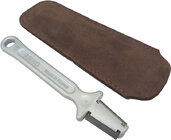
For hand scrapers, I grind on the 600 grit with the platform at 90 degrees, use a red extra-fine diamond hone to remove any grinding burr, then add a burnished burr with the Arno. For me, the hand scrapers are the key to smoothing bowls and platters and such and eliminate much sanding. I do NO power sanding with rotating disk. After the hand scraping, that would be a step backwards.
There, as usual, I wrote too much. I can't stop myself.
If I may be so bold to answer that, no, the plastic doesn't clog the grit, at least not the way I make them. I first set the grind a tool to the desired angle on the Wolverine platform then make a gauge to match.Doug when you contact the plastic to the grinding wheel does it clog the grit?
Mark the curvature of the gauge on the plastic by holding on the rest and against the side of the wheel. Cut the radius on the plastic on the bandsaw then cut a relief in the middle since the gauge doesn't need to contact the middle. Then first hold the I gauge against the 80 grit wheel to refine the radius and against the 600 grit wheel to smooth it.. After that, setting the platform to precisely the right angle is a 5-second process. Haven't had any plastic clog the grit, but I don't press very hard. If it DID clog, sharping a scraper or two should clean up the wheel.
Here's one I use for my curved negative rake scrapers. (spray painting the back of the plastic makes the gauges easier to read.
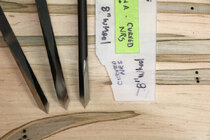
Here are some others before adding the white paint. (Also shown in msg #9) All of mine have the paint now.
The bottom one has two different angles, one on each end. BTW, the 60-deg skew is the first tool I put in a beginner's hand. (60=deg is far more "forgiving" and makes the skew easier to learn, building confidence quickly. Doesn't necessarily cut as cleanly and as effortlessly as a skew with a smaller included angle but that doesn't matter for the first lathe lesson.)
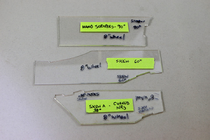
Can't remember when I started making these but it's been a while. SO useful. Note that some pro woodturers who do the circuit and symposiums sell similar angle-setting gauges- one I saw had four angles on one square gauge. These are so quick to make I never felt the need to pay someone to do it. Besides, they don't always have the exact angles I want.
JKJ
It can if you push too hard, but a light touch with a dressing tool clears it. I still use stone wheels. For cbn perhaps a touch with a brass brush or sharpen a scraper cleans it? Those with cbn will have to comment.Doug when you contact the plastic to the grinding wheel does it clog the grit?