what dust collection system works best in a 2 car garage + 200 sf room?

-
April 2026 Turning Challenge: Salad Bowl! (click here for details) -
Congratulations to David Bartell, People's Choice in the March 2026 Turning Challenge (click here for details) -
Congratulations to Ted Pelfrey for "Cherry Blossoms on Cherry" being selected as Turning of the Week for April 27, 2026 (click here for details) -
Welcome new registering member. Your username must be your real First and Last name (for example: John Doe). "Screen names" and "handles" are not allowed and your registration will be deleted if you don't use your real name. Also, do not use all caps nor all lower case.
You are using an out of date browser. It may not display this or other websites correctly.
You should upgrade or use an alternative browser.
You should upgrade or use an alternative browser.
shop dust collection
- Thread starter Ed Jarvis
- Start date
Best can be big $$$. I'd settle for effective and reliable. I believe I have effective and it has been very reliable, but...
This is a timely question, because I'm considering, due to general service life, upgrading from my 20-some year old 650cfm 2-bag Jet dust collector with then-upgraded felt bags. Doubling the CFM would be a good starting point for my thinking. I don't care about chips- things that drop to the floor are easy, it's the stuff that hangs in the air that I want to control and capture. My Raffan-inspired dust hoods (seach me for that over the past year of so) have been working wonderfully, but my current collector won't live forever, that's why it is on my mind.
I used to use a metal trash can and separator lid to pre-filter the air stream of heavies. I took it out- I wasn't sending much heavy stuff to it, it added greatly to the noise in the shop, and after removal I noticed the suction went up. And I saved a few square feet of floor space.
Here's a link from a recent discussion mentioning a couple custom fabric bag companies. I want fabric, not pleated filters. I feel high quality top and bottom fabric filter bags will provide more filter surface and less suction drop than a single pleated filter and plastic lower bag.
Post in thread 'Cleaning DC filter' https://www.aawforum.org/community/threads/cleaning-dc-filter.24755/post-278901
This is a timely question, because I'm considering, due to general service life, upgrading from my 20-some year old 650cfm 2-bag Jet dust collector with then-upgraded felt bags. Doubling the CFM would be a good starting point for my thinking. I don't care about chips- things that drop to the floor are easy, it's the stuff that hangs in the air that I want to control and capture. My Raffan-inspired dust hoods (seach me for that over the past year of so) have been working wonderfully, but my current collector won't live forever, that's why it is on my mind.
I used to use a metal trash can and separator lid to pre-filter the air stream of heavies. I took it out- I wasn't sending much heavy stuff to it, it added greatly to the noise in the shop, and after removal I noticed the suction went up. And I saved a few square feet of floor space.
Here's a link from a recent discussion mentioning a couple custom fabric bag companies. I want fabric, not pleated filters. I feel high quality top and bottom fabric filter bags will provide more filter surface and less suction drop than a single pleated filter and plastic lower bag.
Post in thread 'Cleaning DC filter' https://www.aawforum.org/community/threads/cleaning-dc-filter.24755/post-278901
Last edited:
To add...
-Avoid flexible plastic duct. Use 26ga. (not lighter 28ga.) smooth sheet metal duct and elbows for as much of the system as possible, should be available from your local big box stores. Use 3 equally spaced sheet metal screws per joint to hold them together. Support the duct along its length with plumbing J-hooks or metal strapping.
-I avoid height changes in the duct runs. I have my ducts running along the walls at the similar height of the source of the dust. Why fight gravity if you don't have to?
-In the direction of air flow, the crimped end of the duct goes into the uncrimped end of the next downstream duct section. This lessens air leakage at joints, and less clogging of debris.
-Seal all duct joints, at connections and along the length, with UL181 labeled metal foil tape or paint-on duct mastic (messy). Even tape the joints of elbows. Sealing prevents air leakage and suction drops at the points of use.
-2 elbows forming a long-sweep bend may(?) be more efficient than a single elbow making a short-sweep bend. 90° elbows restrict air as much as 5' of straight pipe. Plan your layout carefully.
-Blast gates leak air. Cheap gates leak more air. Buy good blast gates. Good ones are expensive. Or, turn tapered wood plugs to jam into the ends of branch openings when a branch is not in use, think a cork in a bottle. They won't leak any more air than blast gates, and maybe less if you build them well. And they cost almost nothing.
-Keep branches as short as possible to maintain suction efficiency. Consider where the collector and machines are located relative to each other.
The thread of my dust hoods at each lathe. They have proven to be very effective at grabbing airborne dust before it can leave the area of the lathe. Just today, on my long bed lathe, I was sanding spindles 24" away (down the bed) from the duct inlet, and dust was still being pulled into my hood enclosure. More about them in this thread-
There are probably other things I'm not thinking of, but these points, building a good duct system, will go far to make any collector as efficient and effective as possible.
-Avoid flexible plastic duct. Use 26ga. (not lighter 28ga.) smooth sheet metal duct and elbows for as much of the system as possible, should be available from your local big box stores. Use 3 equally spaced sheet metal screws per joint to hold them together. Support the duct along its length with plumbing J-hooks or metal strapping.
-I avoid height changes in the duct runs. I have my ducts running along the walls at the similar height of the source of the dust. Why fight gravity if you don't have to?
-In the direction of air flow, the crimped end of the duct goes into the uncrimped end of the next downstream duct section. This lessens air leakage at joints, and less clogging of debris.
-Seal all duct joints, at connections and along the length, with UL181 labeled metal foil tape or paint-on duct mastic (messy). Even tape the joints of elbows. Sealing prevents air leakage and suction drops at the points of use.
-2 elbows forming a long-sweep bend may(?) be more efficient than a single elbow making a short-sweep bend. 90° elbows restrict air as much as 5' of straight pipe. Plan your layout carefully.
-Blast gates leak air. Cheap gates leak more air. Buy good blast gates. Good ones are expensive. Or, turn tapered wood plugs to jam into the ends of branch openings when a branch is not in use, think a cork in a bottle. They won't leak any more air than blast gates, and maybe less if you build them well. And they cost almost nothing.
-Keep branches as short as possible to maintain suction efficiency. Consider where the collector and machines are located relative to each other.
The thread of my dust hoods at each lathe. They have proven to be very effective at grabbing airborne dust before it can leave the area of the lathe. Just today, on my long bed lathe, I was sanding spindles 24" away (down the bed) from the duct inlet, and dust was still being pulled into my hood enclosure. More about them in this thread-
As I started in this thread (with 2 videos) https://www.aawforum.org/community/...dest-shop-with-dust-collection-details.23325/ which wandered and meandered with a lot of good information, here is the final result of my version of the Richard Raffan-inspired dust hood I built for my Oneway 1224.
Raffan, nor Tomislav Tomasic in his video, had no plans to build it. It's easy to see that their setups are pretty casual in design, as is mine. Will my plastic bowl collect more effectively than Raffan's angle cut pipe? I don't know, but my bowl hood was my...
Raffan, nor Tomislav Tomasic in his video, had no plans to build it. It's easy to see that their setups are pretty casual in design, as is mine. Will my plastic bowl collect more effectively than Raffan's angle cut pipe? I don't know, but my bowl hood was my...
- Steve Tiedman
- Replies: 23
- Forum: Woodturning Discussion Forum

There are probably other things I'm not thinking of, but these points, building a good duct system, will go far to make any collector as efficient and effective as possible.
Last edited:
Oneida dust collectors work better than just about anything out there, and they have very small footprints. Depends on how packed your shop is. For pulling the fine stuff out of the air, you can get away with a box fan and a HEPA fliter. Depends on your budget.
robo hippy
robo hippy

The best system is one that picks up dust at the source and leaves the air clean enough to breathe without making you sick, all at an affordable cost. Not a simple question.what dust collection system works best in a 2 car garage + 200 sf room?
In a small space with few machines you can get by with a mobile dust collector and a single flex hose, but it sounds like you need a fixed duct system. Start with a floor plan showing your machine locations and use the planning guide found at airhandler.com. With that you can decide how powerful a blower you need. Look for a manufacturer that supplies fan curve data, because without that it is just marketing bafflegab. Oneida and Clearvue are a couple of reliable sources, and they want to sell you cyclone separators and filters as well
If you live in the sticks in a favorable climate you can blow everything out into the bush or an enclosed trailer. A proper tall cyclone will separate out the big chips from the fine dust and drop it into a sealed container. If you need to conserve heat now you are looking at a return air system and you need reliable filters to keep that fine stuff out of your lungs, whether cartridge or bag filters, with enough area for the air volume passing through.
Without getting into the weeds you should probably be looking at a system that will support a minimum 6" duct at the lathe, with an adjustable intake to pick up dust as close as possible to the work.
For reference I have an 1100 sq ft shop with 10 drops serviced by a 3 hp Oneida cyclone and about 150 sq ft of tube filters. I also have an ambient air filter with a 1/3 hp squirrel cage fan to catch what the central system misses.
I've used a 2hp DC from Harbor Freight for years - Not a fan of a lot of their power tools, but it's the best electric tool I've ever found there...change the bags for a nano cartridge filter from Wynn Environmental and add a cyclone and it's a great, affordable system that's served me well for nearly two decades. My shop is a little under 900 sq. feet; the DC is used for all power tools with a permanent drop for the table saw and movable flexible drop shared by lathe and all other tools as needed.
Cartridge filters are great until they get clogged, and they will. Rule of thumb is 10 sq ft of filter area for each 100 cfm actual air flow. I had one industrial designer comment that he doubled that for systems using cartridges rather than bag filters. A cheap "dust collector" with undersized coarse filter bags is in effect a combined chip collector and dust pump.
Keeper info, thanks.Cartridge filters are great until they get clogged, and they will. Rule of thumb is 10 sq ft of filter area for each 100 cfm actual air flow. I had one industrial designer comment that he doubled that for systems using cartridges rather than bag filters. A cheap "dust collector" with undersized coarse filter bags is in effect a combined chip collector and dust pump.
If I do an upsized collector with custom bags (sources you ref. in another thread back on Oct 23, '25), I'd spec the top bag to be extra tall by 2-4 feet, or more if possible, and support it from the ceiling, to provide extra filter bag surface.
I have clogged my filters up many times. They get clogged up when I am not paying attention to the level in the chip barrel. Many systems do have lights that come on to let you know when that level is reached. I take my cartridge outside and hose off the inside with a low pressure hose. No problems thus far, and once you turn the dust collector back on, it is dry in seconds.
robo hippy
robo hippy
I think a clear answer to your question would depend on how many machines you want to connect.
To fine tune that, it's not how many machines you want to connect, it's how many machines need suction simultaneously. I'm guessing in a one-person home shop, it is likely never more than one machine needing dust collection at any given moment. Good quality blast gates can provide the service of isolating machines from the greater system. With good blast gates controlling each branch, you could effectively have as many branches as you need.I think a clear answer to your question would depend on how many machines you want to connect.
If a home shop has two machine operators in the shop at the same time, both operating a machine that requires dust removal, now the dust collector machine specs become very important. A small collector (the typical "1-hp 650cfm" collectors) are probably going to have a hard time providing effective collection to two machines simultaneously.
I’ve read the goal is 1200 to 1500 CFM at each tool. That much air movement seems to require about a 2 1/2 to 3 hp machine.what dust collection system works best in a 2 car garage + 200 sf room?
I have a 3 hp Oneida system for my shop, which is over 2000 sq. ft. Lathe room is almost 900 sq. ft. It was more than enough for my old 860 sq. foot old shop, and I could run 2 machines at once. With my new shop, I can do the same since the DC is in the middle of the shop. For 200 sq. ft. a 1 1.5 hp Oneida system you could probably run 2 machines at once, but it would be more than enough for a shop that size.
robo hippy
robo hippy

On fine dust extraction systems, I only take notice of the experience/advice from someone who can also give me the PM2.5 readings in their workshop with their DE running and dust making equipment in use. In the case of woodturning, that will be taken while sanding the largest diameter piece they turn. Here is the typical PM2.5 reading in my workshop with effective DE running while sanding a larger platter...
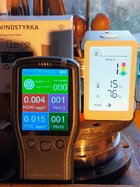
My readings sit around that level for hour after hour. Those are economy particle counters that are adequate for the purpose of 'knowing' that your DE system is effective. The one on the right is from IKEA... https://www.ikea.com/au/en/p/vindstyrka-air-quality-sensor-smart-60498233/ ...that price is currently discounted 50%, but also in A$, so a pittance in US$s for a little reassurance that you are making good decisions about your health.
Here is a review of that particle counter...
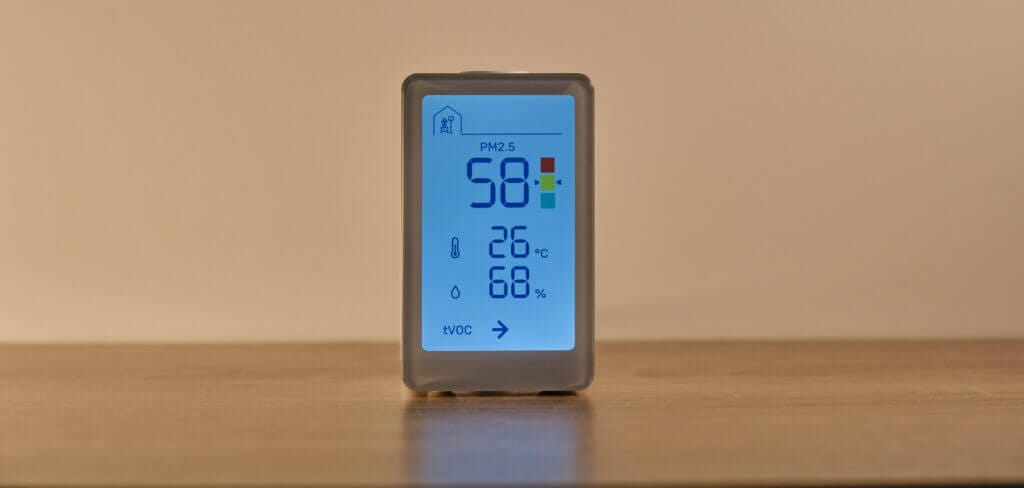
 breathesafeair.com
I look forward to seeing your PM2.5 readings from whatever sensor you use along with your experience/advice on how effective your fine DE system is in your workshop.
My readings sit around that level for hour after hour. Those are economy particle counters that are adequate for the purpose of 'knowing' that your DE system is effective. The one on the right is from IKEA... https://www.ikea.com/au/en/p/vindstyrka-air-quality-sensor-smart-60498233/ ...that price is currently discounted 50%, but also in A$, so a pittance in US$s for a little reassurance that you are making good decisions about your health.
Here is a review of that particle counter...
IKEA Vindstyrka Indoor Air Quality Monitor Review
IKEA has recently launched two inpexensive air quality monitors, the Vindstyrka and Vindriktning. However, how do they hold up compared to other options?
breathesafeair.com
I look forward to seeing your PM2.5 readings from whatever sensor you use along with your experience/advice on how effective your fine DE system is in your workshop.

Cartridge filters are great until they get clogged, and they will. Rule of thumb is 10 sq ft of filter area for each 100 cfm actual air flow. I had one industrial designer comment that he doubled that for systems using cartridges rather than bag filters. A cheap "dust collector" with undersized coarse filter bags is in effect a combined chip collector and dust pump.
I regularly blow out my cartridge filter; amazing how much I can see falling into the bag. Hopefully this will prolong the life of it.
Cartridge filters are great until they get clogged, and they will. Rule of thumb is 10 sq ft of filter area for each 100 cfm actual air flow. I had one industrial designer comment that he doubled that for systems using cartridges rather than bag filters. A cheap "dust collector" with undersized coarse filter bags is in effect a combined chip collector and dust pump.
I might be doing something wrong. In maybe 10 years of use my filters have never clogged. It's not from lack of use - I've emptied the collection bin many times.
I have a 5hp ClearVue cyclone with a stack of two Wynn filters with a small cleanout box below. Maybe it's because the cyclone appears to work so well it puts almost everything, even powder-fine dust, into the 30-gal trashcan bin. Yes the bin gets quite heavy with tightly packed fine dust.
The suction is so strong the 1st time I turned it on it collapsed the steel trashcan I used - had to get a stronger one.
The closet is small so I can't get easily get a full picture. Closet is insulated for sound and houses the air compressor too.
This is the top of the cyclone and shows part of the upper filter.
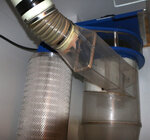
The bottom filter and the collection bin, a peek at the cleanout box, and some junk.
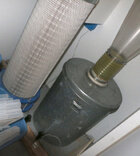
Almost no dust makes it to the little cleanout box.
I return the air from the closet to the shop through another filter. My Dylos monitor shows very little gets back into the shop.
I check the bin often and drag it out to empty when it gets over 1/2 full. I use a hand truck gets it outside and down to where I dump it in the wood. Make a big pile then spread it out with the tractor after it rots somewhat. If I had to bag up and haul off the dust I'm not sure what I'd do.
I thing the key here is the tall cyclone and the 5hp motor. This is a ClearVue, a Bill Pentz design.
Based on my limited experience, if I had to replace it I'd go with the tallest cyclone and a large motor I could get.
ClearVue is apparently back in operation. Unfortunately, the cost of the cyclone is quite a bit higher now. (No surprise.)
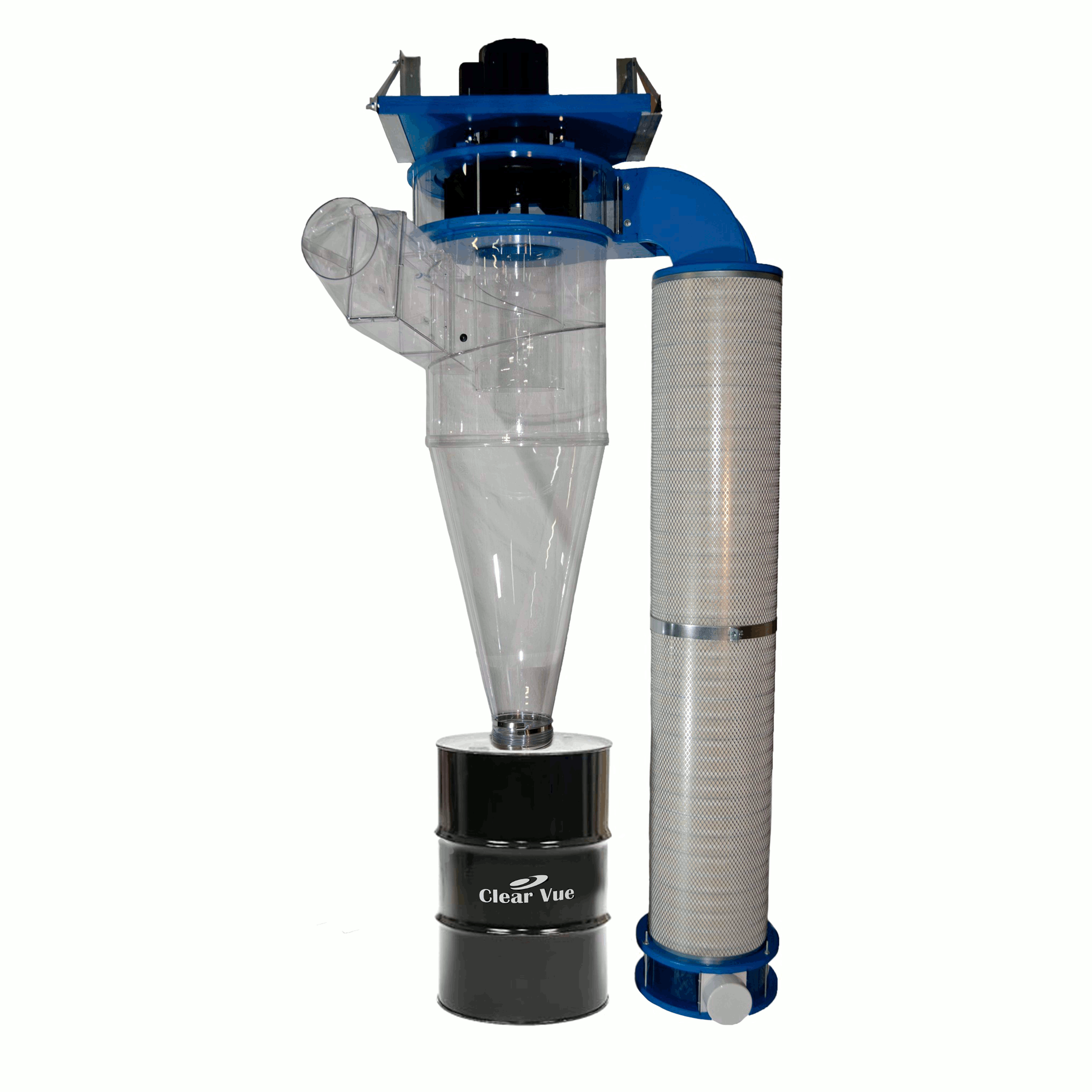
Clear Vue Cyclones CV1700 - Dust Collector 5HP Single Phase NANO - Clear Vue Cyclones
Ideal for woodworkers, small businesses or other entities needing fine dust collection. This system delivers suction sufficient for most midsize shops.
 www.clearvuecyclones.com
JKJ
A week later... (Sorry, this runs long, but includes websites.)
I have been looking for information backed by regulatory agency standards and requirements for air quality measurement devices. Amazon is not the source for this kind of information.
What I found is that, in the United States anyway, "low cost" air quality sensors or complete devices are not necessarily tested and listed to meet some defined criteria, rather they may be submitted for real world comparison to third parties to judge how they compare to the types of instruments governmental health agencies and similar, which do meet standards. But, the US Environmental Protection Agency still (yes, I said still, in these turbulent political times) has an FAQ site about air sensors in general, and this may be a good starting point to become knowledgable about what can be expected- benefits and limitations. But, the EPA does not test the consumer devices and does not give recommendations.

 www.epa.gov
One such third party researching air quality devices is South Coast AQMD, and their Air Quality Sensor Performance Evaluation Center, based in California. I'll take at face value their legitimacy, once I perused their About Us page and scrolled down the list of Ph.D. engineers that operate the organization. In short, they compare devices from anyone looking to evaluate their products against known, high-level scientific instrumentation used by government health agencies, university researchers, and similar high-accuracy users.
I'll admit, as I went through many of the product evaluations for what they'll refer to as "low cost" air quality sensors, most of their reports over the past 10 years are frankly over my head of understanding, not without first taking a short course to learn how to interpret their testing and findings. That said, some of their recent tests are reported in much more "common-person user-friendly" formats that allowed me to get an idea of what they were reporting. Within this list of evaluated devices linked here, the first half dozen or so have pretty friendly evaluation reports to read, but after that the product reports are shown in very "scientific" formats that may not have much meaning without really taking the time to learn about how to interpret the results. (Best to read these on a computer screen, not a phone screen.)
Luckily, the Ikea device that has been mentioned on this board was recently tested (Dec 2025), and today appears on top of their list (a chronologic list, it seems). The opening paragraphs of this link (below) summarize what and how is being tested, and against what standard of reference. Keep in mind, these "low cost" devices are pretty much consumer grade; high level accuracy may be advertised, but is not being delivered. That's the difference between a $30-200 device from Amazon or the local home center, and a $20,000+ reference device from the scientific community. Please visit their FAQ page, some of the questions may provide context for you in your research and decision making.
Regarding the Ikea and the Dylos devices that have been mentioned in message threads on this board, both of these brands appear on the product list pages (3 pages long). Dylos is shown in the older report style from a few years ago.
Here is another site that reviews air quality devices. It is a site than earns affiliate commisions on products, so keep that in perspective. Here he happens to review the Ikea device. Lots of info, but some may leave you wonder about his thoughts and conclusions.
breathesafeair.com
After learning the above information, I am still weighing my decision to buy a device, and which one. How much do I want to spend? Will I use it constantly in my shop, or will I use it as a diagnostic tool to see if my dust collection/extraction habits and equipment are sound and reliable, or will it lead me to modifying usage and equipment to assure they are delivering as I hoped?
I should do something, "dust on my eyeglasses" really isn't a reliable test, I suppose. (I'll say that when turning with dust collection, little to anything unusual compared to daily wearing accumulates on my glasses, but I can't visibly see what these sensors can. But, without dust collection, my glasses quickly dust over, with that same stuff going into my lungs.)
I have been looking for information backed by regulatory agency standards and requirements for air quality measurement devices. Amazon is not the source for this kind of information.
What I found is that, in the United States anyway, "low cost" air quality sensors or complete devices are not necessarily tested and listed to meet some defined criteria, rather they may be submitted for real world comparison to third parties to judge how they compare to the types of instruments governmental health agencies and similar, which do meet standards. But, the US Environmental Protection Agency still (yes, I said still, in these turbulent political times) has an FAQ site about air sensors in general, and this may be a good starting point to become knowledgable about what can be expected- benefits and limitations. But, the EPA does not test the consumer devices and does not give recommendations.
Frequent Questions About Air Sensors | US EPA
This page provides answers to common questions about the use of air sensor technology to measure air quality conditions.
www.epa.gov
One such third party researching air quality devices is South Coast AQMD, and their Air Quality Sensor Performance Evaluation Center, based in California. I'll take at face value their legitimacy, once I perused their About Us page and scrolled down the list of Ph.D. engineers that operate the organization. In short, they compare devices from anyone looking to evaluate their products against known, high-level scientific instrumentation used by government health agencies, university researchers, and similar high-accuracy users.
I'll admit, as I went through many of the product evaluations for what they'll refer to as "low cost" air quality sensors, most of their reports over the past 10 years are frankly over my head of understanding, not without first taking a short course to learn how to interpret their testing and findings. That said, some of their recent tests are reported in much more "common-person user-friendly" formats that allowed me to get an idea of what they were reporting. Within this list of evaluated devices linked here, the first half dozen or so have pretty friendly evaluation reports to read, but after that the product reports are shown in very "scientific" formats that may not have much meaning without really taking the time to learn about how to interpret the results. (Best to read these on a computer screen, not a phone screen.)
Luckily, the Ikea device that has been mentioned on this board was recently tested (Dec 2025), and today appears on top of their list (a chronologic list, it seems). The opening paragraphs of this link (below) summarize what and how is being tested, and against what standard of reference. Keep in mind, these "low cost" devices are pretty much consumer grade; high level accuracy may be advertised, but is not being delivered. That's the difference between a $30-200 device from Amazon or the local home center, and a $20,000+ reference device from the scientific community. Please visit their FAQ page, some of the questions may provide context for you in your research and decision making.
air quality sensors field evaluation
This page houses the AQ-SPEC field evaluations report on air quality sensors.
www.aqmd.gov
Regarding the Ikea and the Dylos devices that have been mentioned in message threads on this board, both of these brands appear on the product list pages (3 pages long). Dylos is shown in the older report style from a few years ago.
Here is another site that reviews air quality devices. It is a site than earns affiliate commisions on products, so keep that in perspective. Here he happens to review the Ikea device. Lots of info, but some may leave you wonder about his thoughts and conclusions.
IKEA Vindstyrka Indoor Air Quality Monitor Review
IKEA has recently launched two inpexensive air quality monitors, the Vindstyrka and Vindriktning. However, how do they hold up compared to other options?
breathesafeair.com
After learning the above information, I am still weighing my decision to buy a device, and which one. How much do I want to spend? Will I use it constantly in my shop, or will I use it as a diagnostic tool to see if my dust collection/extraction habits and equipment are sound and reliable, or will it lead me to modifying usage and equipment to assure they are delivering as I hoped?
I should do something, "dust on my eyeglasses" really isn't a reliable test, I suppose. (I'll say that when turning with dust collection, little to anything unusual compared to daily wearing accumulates on my glasses, but I can't visibly see what these sensors can. But, without dust collection, my glasses quickly dust over, with that same stuff going into my lungs.)
I'm using a 2HP Griz with canister filter in a small separate inclosure. The return air to my shop has a high efficiency furnace filter. I just got an air quality monitor from Amazon. Reliable accuracy?? I second turned a small 6" walnut bowl that didn't move the readings. Sanding also didn't register anything. Since the monitor was showing the Temp in my shop rising I knew it was working. I moved on to cutting a few pieces of plywood on my table saw a few feet behind my lathe. I was astounded to see the 1.0, 2.5 as well as the 10.0 reading jump from 2 or 3 to 8 or 9. I can only imagine what a few hours of work might have achieved. I'm not going to rely on this unit to yield high accuracy, but I hope to get a better relative idea of how my dust protection is working.
Ha, I'll have to remember that!I should do something, "dust on my eyeglasses" really isn't a reliable test, I suppose.
Will I use it constantly in my shop, or will I use it as a diagnostic tool to see if my dust collection/extraction habits and equipment are sound and reliable, or will it lead me to modifying usage and equipment to assure they are delivering as I hoped?
I have had they Dylos since 2012. I don't care if it's calibrated and as accurate at a laboratory standard. I think it, and others are valuable for comparison.
Take a reading in a clean environment and when setting up the shop or when it is undisturbed for some time, without and with the DC on. Compare those to a reading when turning/sanding/sawing and see the difference. Write everything down. When adding a new tool or working differently take more readings and compare. Should give a pretty good idea of what needs to be changed.
I compared readings with the cyclone running (which returned air to the shop) and found no significant difference.
Also might want to take a reading before, during, and after sharpening tools - that is known to put a lot of extremely fine dust into the air where it can float a surprising distance across the shop.
I did that when I set up a drum and a belt/disk sander. I already had a cyclone drop in place and tested the air before hand - the sanders again added no significant particulates to the air.
It's also informative to do some sanding or turning without the DC on and look at the readings.
Be sure to maintain the meter as instructed, including gently blowing out the top vents.
I also bought one of the tiny very cheap monitors and although it uses a different scale it's also useful for relative comparisons.
JKJ
Are these "filter bags" HEPA rated? If not it wouldn't really matter too much how much surface area is available for fitering. The finest, most harmful, dust would just end up floating around in your shop to later settle on top of any surface that will hold it. I have been working with wood in my home shop for 40+ years and there are 2 things I've learned. The highest quality dust collection and hearing protection are at least as important as the tools you buy to work with wood. So my sollutions for dust collection have always included HEPA filters (once they became readily available) and sufficient suction to make sure the finest dust gets removed from my shop's air. Right now I have a cyclone with a HEPA filter and an air cleaner which attempts to filter the dust that escapes from the dust collector, and I almost always wear a powered helmet with a HEPA filter. Possibly this is overkill and was certainly expensive, but I feel every penny was well spent to protect my lungs. When I became a turner about 7 years ago, I installed a line from my dust collector to the lathe area. This won't pick up large shavings but it does get the dust from turning and sanding. What the collector doesn't (and there is some) the air cleaner gets, along with my helmet. I just feel you can't be too careful with your lungs.Best can be big $$$. I'd settle for effective and reliable. I believe I have effective and it has been very reliable, but...
This is a timely question, because I'm considering, due to general service life, upgrading from my 20-some year old 650cfm 2-bag Jet dust collector with then-upgraded felt bags. Doubling the CFM would be a good starting point for my thinking. I don't care about chips- things that drop to the floor are easy, it's the stuff that hangs in the air that I want to control and capture. My Raffan-inspired dust hoods (seach me for that over the past year of so) have been working wonderfully, but my current collector won't live forever, that's why it is on my mind.
I used to use a metal trash can and separator lid to pre-filter the air stream of heavies. I took it out- I wasn't sending much heavy stuff to it, it added greatly to the noise in the shop, and after removal I noticed the suction went up. And I saved a few square feet of floor space.
Here's a link from a recent discussion mentioning a couple custom fabric bag companies. I want fabric, not pleated filters. I feel high quality top and bottom fabric filter bags will provide more filter surface and less suction drop than a single pleated filter and plastic lower bag.
Post in thread 'Cleaning DC filter' https://www.aawforum.org/community/threads/cleaning-dc-filter.24755/post-278901
Are you asking for 'dust collection' or for 'air filtration'?what dust collection system works best in a 2 car garage + 200 sf room?
Hello @Randy Heinemann, no, the 5-micron felt bags on my Jet 650cfm collector are not HEPA rated. That said, I did empty and gently clean the bags this past summer of bulk buildup, but I did not attempt to remove any caked dust on the interior surface of the felt. Those experts in the know claim the caking contributes to more effective filtration, and when caking is thick enough, it sheds off under weight and drops to the bottom collector bag. I'll take that at face value.
-----------
Today I braved a trip to the MN Ikea store, next to the Mall of America. (I work hard to avoid both places- yikes!) I bought their soon to be discontinued air particle monitor, on sale for $41. (Same device that @Neil S referenced in an earlier message above.) No longer available online, only through stores that still have inventory. Dunno if a store will ship to you. Amazon sells a lot of different devices, none of which I can speak to.

 www.ikea.com
The meter is tiny, and runs continuously on a USB charger plug. No internal battery. Before I left their parking lot, I plugged it in to my phone charger for the 15 mile drive home. Vents open, and even with the windows open, the device was measuring 15-20 particles per cubic meter on the freeway and city streets, within the "good air" zone of the gauge. (I found actual particle thresholds somewhere, but can't find them. EPA, maybe?) This reading represents average number of particulates from .1 micron to 2.5 microns in size per cubic meter, quite breathable. Color chart pointing at green, good air.

Below, set up in the workshop, cleaner than outside. After taking this pic, I turned the dust collector on and left the shop for an hour. The number actually dropped a bit, telling me that my dust collector is not blowing dust out of the filter bags and back into my shop.
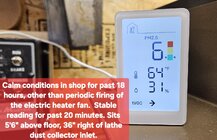
Image below, just while cutting the piece of maple (no sanding yet) air was getting visibly bad without dust collection (60+ on meter), yellow zone on meter chart. I didn't want to breathe it. In 30 years of turning, I've never turned without some sort of collection/filtration set up behind the lathe, even if just a box fan and pleated furnace filter back in my early days. Some woods, like green wood, I've left the dust collection off while cutting, but not anymore after today's experiment.
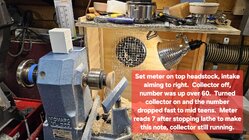
Meter reading (below) while sanding this piece of dry maple, 3, cleanest air I've seen today.
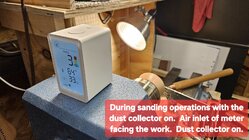
How accurate is this meter? Not very, gotta take its results with a grain of salt. Reading the graphs on pages 2-3 of this 3rd party device testing,
the meter's results can average up to 60% off from actual pollutant levels, but that's on par for similar "low cost" meters per the website I referenced in an earlier thread. But, if my device is showing me single digit particulates less than 12" from the spinning wood, even corrected for that 60% error, I'm in good shape.
Summary for my shop-
- my shop habits are giving me cleaner air inside my shop than the air out in my yard. (And today, our local world has calm winds, 12" of snow on everything, and if pavement isn't snow/ice covered, it is saturated wet. No road salt dust clouds blowing about on the highways as will happen mid-winter at single-digit temps and colder.)
- keep using dust collection at the bandsaw, even if not a perfect configuration from the saw mfr.
- if a power tool of any kind has a dust port (circ. saws, sanders, chop saw, etc.), hook up a shop vac or dust collector to it, every time.
- if the lathe is spinning, the dust collector is running.
- use the best aftermarket dust collector/extractor filters you can for your machine, even if the machine is a puny 650cfm 1hp rated collector like mine.
- a Raffan-esque dust collector hood/box capture and containment setup immediately behind the lathe is by far the superior method of grabbing dust coming off the wood, period. I've proven that to myself today. See my message #3 above for info on my dust hood/box. (Photo above shows a piece of 1/2" screen mesh loosely hanging over the dust inlet to keep shaving from going into the filters. [I do like the design of the hood I built for my Oneway 1224 better, almost no shavings find that dust inlet, but room constraints didn't allow it at the Vic.] I can't breathe shavings. I remove the screen and clean off the shavings before I start sanding.)
Thanks, Neil, for convincing me to go down this rabbit hole. If anyone feels I'm overlooking something, please let me know.
-----------
Today I braved a trip to the MN Ikea store, next to the Mall of America. (I work hard to avoid both places- yikes!) I bought their soon to be discontinued air particle monitor, on sale for $41. (Same device that @Neil S referenced in an earlier message above.) No longer available online, only through stores that still have inventory. Dunno if a store will ship to you. Amazon sells a lot of different devices, none of which I can speak to.
VINDSTYRKA air quality sensor, smart - IKEA
VINDSTYRKA air quality sensor, smart Want to know more about the air you breathe at home? This easy-to-use air quality sensor gives you all the information you need. You can also make it a part of your smart home for more great functions.
www.ikea.com
The meter is tiny, and runs continuously on a USB charger plug. No internal battery. Before I left their parking lot, I plugged it in to my phone charger for the 15 mile drive home. Vents open, and even with the windows open, the device was measuring 15-20 particles per cubic meter on the freeway and city streets, within the "good air" zone of the gauge. (I found actual particle thresholds somewhere, but can't find them. EPA, maybe?) This reading represents average number of particulates from .1 micron to 2.5 microns in size per cubic meter, quite breathable. Color chart pointing at green, good air.
Below, set up in the workshop, cleaner than outside. After taking this pic, I turned the dust collector on and left the shop for an hour. The number actually dropped a bit, telling me that my dust collector is not blowing dust out of the filter bags and back into my shop.
Image below, just while cutting the piece of maple (no sanding yet) air was getting visibly bad without dust collection (60+ on meter), yellow zone on meter chart. I didn't want to breathe it. In 30 years of turning, I've never turned without some sort of collection/filtration set up behind the lathe, even if just a box fan and pleated furnace filter back in my early days. Some woods, like green wood, I've left the dust collection off while cutting, but not anymore after today's experiment.
Meter reading (below) while sanding this piece of dry maple, 3, cleanest air I've seen today.
How accurate is this meter? Not very, gotta take its results with a grain of salt. Reading the graphs on pages 2-3 of this 3rd party device testing,
the meter's results can average up to 60% off from actual pollutant levels, but that's on par for similar "low cost" meters per the website I referenced in an earlier thread. But, if my device is showing me single digit particulates less than 12" from the spinning wood, even corrected for that 60% error, I'm in good shape.
Summary for my shop-
- my shop habits are giving me cleaner air inside my shop than the air out in my yard. (And today, our local world has calm winds, 12" of snow on everything, and if pavement isn't snow/ice covered, it is saturated wet. No road salt dust clouds blowing about on the highways as will happen mid-winter at single-digit temps and colder.)
- keep using dust collection at the bandsaw, even if not a perfect configuration from the saw mfr.
- if a power tool of any kind has a dust port (circ. saws, sanders, chop saw, etc.), hook up a shop vac or dust collector to it, every time.
- if the lathe is spinning, the dust collector is running.
- use the best aftermarket dust collector/extractor filters you can for your machine, even if the machine is a puny 650cfm 1hp rated collector like mine.
- a Raffan-esque dust collector hood/box capture and containment setup immediately behind the lathe is by far the superior method of grabbing dust coming off the wood, period. I've proven that to myself today. See my message #3 above for info on my dust hood/box. (Photo above shows a piece of 1/2" screen mesh loosely hanging over the dust inlet to keep shaving from going into the filters. [I do like the design of the hood I built for my Oneway 1224 better, almost no shavings find that dust inlet, but room constraints didn't allow it at the Vic.] I can't breathe shavings. I remove the screen and clean off the shavings before I start sanding.)
Thanks, Neil, for convincing me to go down this rabbit hole. If anyone feels I'm overlooking something, please let me know.
Last edited:

Good question, and one that is just about always asked in these discussions. Based on the context, I'll say we are talking about this:Are you asking for 'dust collection' or for 'air filtration'?
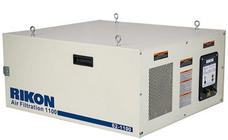
rather than this:
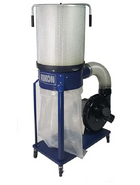
Speaking of Rikon bagged/cartridge point-of-use dust collectors, what is their reputation for service, longevity, use, etc? Any negatives? I have experience only with my old Jet 2-bagger. Generally speaking, I'd have no issue buying another Jet, but I'd go with aftermarket sintered felt bags rather than a cartridge.
I also have a Jet ambient filter hanging from the ceiling, but admittedly rarely run it because it's just adding to the noise level in my small shop. (Yep, poor excuse.)
I also have a Jet ambient filter hanging from the ceiling, but admittedly rarely run it because it's just adding to the noise level in my small shop. (Yep, poor excuse.)
The thing about the old cloth bags is I don't think any of them filtered less than 5 microns, but I heard/read that once they get some fine dust inside them, the rating would/could go down to 1 micron. Maybe newer ones go down to 1 micron. The thing/advantage with the pleated paper filters is that they give you several times the surface area to vent through, and they go much finer than 1 micron. If you can, get one!
robo hippy
robo hippy
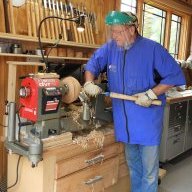
I will relate one experience I had. My shop is about the same size (576 sqf with 9ft ceiling). I have pvc ducting (4 stations with blast gates) going up through the attic then down to the DC which sits in a dedicated closet outside the shop in a carport. Orginally I had a delta canister type like the rickon pictured above in Kents picture. About 6 years ago I replace the Delta with a Laguna cyclone type. Both were 1.5hp but the cyclone type was near double the suction of the cannister type. I was amazed at the difference.what dust collection system works best in a 2 car garage + 200 sf room?
This thread got me motivated to go to Amazon for an air monitor. My shop is a little less than 200 sq ft addition to my garage. My 2hp Griz canister dust collector sits in a very small room in my garage. Return air to my shop is through a high efficient furnace filter. With just a few small projects I barely nudge the particle readings (1, 2.5, and 10 microns/ m). When I cut a couple small pieces of plywood 8' across the shop, the readings quickly jumped to 10-11. I just did a little sanding at the lathe with the monitor sitting on the headstock. Again, the readings didn't budge.? Obviously a less the $100 unit will not be precise, but it should give some useful information.
Attachments
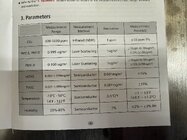
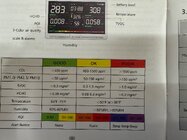
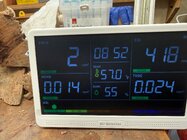
@Steve Tiedman "the 5-micron felt bags on my Jet 650cfm collector are not HEPA rated. That said, I did empty and gently clean the bags this past summer of bulk buildup, but I did not attempt to remove any caked dust on the interior surface of the felt. Those experts in the know claim the caking contributes to more effective filtration, and when caking is thick enough, it sheds off under weight and drops to the bottom collector bag. I'll take that at face value."
Steve, They aren't wrong about leaving the caked on dust on the inside. However, based on my knowledge and experience, I'd say there are 2 remaining issues with that concept.
1. I believe that leaving all that dust on the inside forces the motor to work harder. This may not be a huge problem, but I suspect how much extra wear and tear depends on how much the dust collector is used.
2. Nothing replaces a HEPA filter regardless of how much dust is caked up inside the bag filter of a collector. There just isn't anything available which filters dust particles as small as a HEPA filter given that the original development and use for HEPA filters was to protect workers on the Manhattan project from atomic energy particles.
All I can do is relate the difference between surface dust in my shop between when my cyclone had a filter which was simlar to yours and now with a HEPA filter. It's significant in my my shop and hence, in my lungs.
Steve, They aren't wrong about leaving the caked on dust on the inside. However, based on my knowledge and experience, I'd say there are 2 remaining issues with that concept.
1. I believe that leaving all that dust on the inside forces the motor to work harder. This may not be a huge problem, but I suspect how much extra wear and tear depends on how much the dust collector is used.
2. Nothing replaces a HEPA filter regardless of how much dust is caked up inside the bag filter of a collector. There just isn't anything available which filters dust particles as small as a HEPA filter given that the original development and use for HEPA filters was to protect workers on the Manhattan project from atomic energy particles.
All I can do is relate the difference between surface dust in my shop between when my cyclone had a filter which was simlar to yours and now with a HEPA filter. It's significant in my my shop and hence, in my lungs.
All I can do is relate the difference between surface dust in my shop between when my cyclone had a filter which was simlar to yours and now with a HEPA filter. It's significant in my my shop and hence, in my lungs.
Same here. I found a huge increase in air flow and a very large decrease in fine particles after upgrading from the cloth bags to a HEPA filter.
Bob
Good to know, and I won't disagree with what @Randy Heinemann and @Bob Hall have to share. And not to be contrary, but my cheapie particle meter showed that I'm likely breathing cleaner air inside my workshop than I am in my yard on a winter day. Something to keep in perspective, creating a nearly cleanroom environment in the workshop only to leave it and enter a dirty world afterward.
[Edit- no, my garage workshop is not a cleanroom. I see actual cleanrooms being built often enough, and nobody at their home is making that clean of a space.]
[Edit- no, my garage workshop is not a cleanroom. I see actual cleanrooms being built often enough, and nobody at their home is making that clean of a space.]
Last edited:
Tomislav just did a video about a system he uses, a big gulp type hood and it is on a dowel so he can move it in and out and gravity holds it in place. It works well. I might have to expand on it some....
View: https://www.youtube.com/watch?v=RrK8kQMINuY
robo hippy
robo hippy
I use the same hood but I have it attached to a piece of T-track so I can slide it the length of the lathe.
Bob
Bob
Today I braved a trip to the MN Ikea store, next to the Mall of America. (I work hard to avoid both places- yikes!) I bought their soon to be discontinued air particle monitor, on sale for $41. (Same device that @Neil S referenced in an earlier message above.) No longer available online, only through stores that still have inventory. Dunno if a store will ship to you. Amazon sells a lot of different devices, none of which I can speak to.
VINDSTYRKA air quality sensor, smart - IKEA
VINDSTYRKA air quality sensor, smart Want to know more about the air you breathe at home? This easy-to-use air quality sensor gives you all the information you need. You can also make it a part of your smart home for more great functions.
How accurate is this meter? Not very, gotta take its results with a grain of salt. Reading the graphs on pages 2-3 of this 3rd party device testing,
the meter's results can average up to 60% off from actual pollutant levels, but that's on par for similar "low cost" meters per the website I referenced in an earlier thread. But, if my device is showing me single digit particulates less than 12" from the spinning wood, even corrected for that 60% error, I'm in good shape.
Summary for my shop-
- my shop habits are giving me cleaner air inside my shop than the air out in my yard. (And today, our local world has calm winds, 12" of snow on everything, and if pavement isn't snow/ice covered, it is saturated wet. No road salt dust clouds blowing about on the highways as will happen mid-winter at single-digit temps and colder.)
- keep using dust collection at the bandsaw, even if not a perfect configuration from the saw mfr.
- if a power tool of any kind has a dust port (circ. saws, sanders, chop saw, etc.), hook up a shop vac or dust collector to it, every time.
- if the lathe is spinning, the dust collector is running.
- use the best aftermarket dust collector/extractor filters you can for your machine, even if the machine is a puny 650cfm 1hp rated collector like mine.
- a Raffan-esque dust collector hood/box capture and containment setup immediately behind the lathe is by far the superior method of grabbing dust coming off the wood, period. I've proven that to myself today. See my message #3 above for info on my dust hood/box. (Photo above shows a piece of 1/2" screen mesh loosely hanging over the dust inlet to keep shaving from going into the filters. [I do like the design of the hood I built for my Oneway 1224 better, almost no shavings find that dust inlet, but room constraints didn't allow it at the Vic.] I can't breathe shavings. I remove the screen and clean off the shavings before I start sanding.)
Thanks, Neil, for convincing me to go down this rabbit hole. If anyone feels I'm overlooking something, please let me know.
Your welcome, Steve, and thankyou for sharing your findings... excellent report!
On the accuracy of these consumer-level meters, I think you have summarised the key point to be made about them when you say, "the meter's results can average up to 60% off from actual pollutant levels... <snip> But, if my device is showing me single digit particulates less than 12" from the spinning wood, even corrected for that 60% error, I'm in good shape."
We have down here a member of a dust extraction forum who was responsible for setting up and monitoring the cleanroom labs at the university where he worked and he has used and tested some of these consumer-level meters along side a high-end professional particle counter that he has/had available to him and he reports a similar level of accuracy, which, if that is understood, is more than adequate for our purposes.
I look forward to reading many more reports from other forum members, like the one from you and @Mike Zip Hamilton, giving the readings they are getting from their DE setups.
Although he built it some clever operational features, and Bob built a method for it to move parallel to the lathe, that hood, at its perimeter edge, is still one-dimensional and allowing air to be drawn in from the top and sides nowhere near as close to the dust source as his previous Raffan-style hood system. Yes, being telescopic helps, but it could be better. This big gulp hood would be far more effective if it had a roof and sidewalls that came forward toward the lathe and the wood, forcing the majority draw of the air to come right past the spinning wood and drawing the dust into the hood. As it is, that hood will draw some of its air from around the rear of the lathe area instead of pulling most of the air from in front of the lathe where it can capture and contain, practically speaking, nearly every bit of dust instead of giving some dust the opportunity to be thrown away from the suction stream by way of the spinning wood and tooling.Tomislav just did a video about a system he uses, a big gulp type hood and it is on a dowel so he can move it in and out and gravity holds it in place. It works well. I might have to expand on it some....
View: https://www.youtube.com/watch?v=RrK8kQMINuY
robo hippy
This could be achieved simply by securing strips of cardboard a few inches wide to the perimeter edge of the hood, aiming them forward toward the dust source. This will force the draw of air to come closer to the dust source, making the overall system that much more effective.
That's a good idea, can it move up and down and fore and aft too?I use the same hood but I have it attached to a piece of T-track so I can slide it the length of the lathe.
Bob
Although he built it some clever operational features, and Bob built a method for it to move parallel to the lathe, that hood, at its perimeter edge, is still one-dimensional and allowing air to be drawn in from the top and sides nowhere near as close to the dust source as his previous Raffan-style hood system. Yes, being telescopic helps, but it could be better. This big gulp hood would be far more effective if it had a roof and sidewalls that came forward toward the lathe and the wood, forcing the majority draw of the air to come right past the spinning wood and drawing the dust into the hood. As it is, that hood will draw some of its air from around the rear of the lathe area instead of pulling most of the air from in front of the lathe where it can capture and contain, practically speaking, nearly every bit of dust instead of giving some dust the opportunity to be thrown away from the suction stream by way of the spinning wood and tooling.
This could be achieved simply by securing strips of cardboard a few inches wide to the perimeter edge of the hood, aiming them forward toward the dust source. This will force the draw of air to come closer to the dust source, making the overall system that much more effective.
Is it worth doing that, why not continue to use the Raffan style collector? Tomasic doesn't mention if his latest hood is more efficient
At the 10:50 mark, he stated he wanted/needed the smaller footprint, and that it allows for more storage behind the lathe. I respect that.Is it worth doing that, why not continue to use the Raffan style collector? Tomasic doesn't mention if his latest hood is more efficient
I've rewatched the video and I still stand by what I stated above, that with a bit more easy effort it could be better, but he does show how well it captures when he has it as close as possible, and he also shows how clearly ineffective it is in comparison when the hood is at a distance (10:43 mark). That last part, everyone who has a simple suction tube, or a tube with some small inlet hood (most of which are at best 1/4 to 1/3 the size of what Tomi shows) attached to it and has it located anywhere other than right behind the spinning wood, needs to see how much dust is escaping the suction draw (watch the power sanding) when he has that very large hood only 10"-12" behind the dust source. A 4"-6" tube with a bell mouth fitting (velocity stack) located a similar distance away (10-12") is not going to be anywhere near as effective as Tomi's (or Raffan's) hood placed right behind the dust source, and photos similar to this description are seen on this board.
Another thought- it's not the size and power of the dust extraction machine you use, it is how effective you are at putting its capability directly at, and surrounding, the source of the dust. Between this examination, and the numeric readout of my little Ikea dust meter, I'd say that my simple 20+ y.o. 1hp 650cfm collector with felt bags is doing a remarkable job. (Heck, my shop air is shown to be cleaner than the winter air in my suburban back yard.)
Last edited:
I needed to clean my shop today. I swept the floor collecting about 1/2 cubic ft of shavings from several second turned projects. After 15 min, my readings were 60-50-35. (10-2.5-1.0) In 5min, readings dropped to 30-10-4. In another 5 min, all readings bounced between 5 and 2. Original specs would give me about 1 air change/min from my DC. 10 year old performance ? I'm headed to Florida next week. I'll continue monitoring in April.Your welcome, Steve, and thankyou for sharing your findings... excellent report!
On the accuracy of these consumer-level meters, I think you have summarised the key point to be made about them when you say, "the meter's results can average up to 60% off from actual pollutant levels... <snip> But, if my device is showing me single digit particulates less than 12" from the spinning wood, even corrected for that 60% error, I'm in good shape."
We have down here a member of a dust extraction forum who was responsible for setting up and monitoring the cleanroom labs at the university where he worked and he has used and tested some of these consumer-level meters along side a high-end professional particle counter that he has/had available to him and he reports a similar level of accuracy, which, if that is understood, is more than adequate for our purposes.
I look forward to reading many more reports from other forum members, like the one from you and @Mike Zip Hamilton, giving the readings they are getting from their DE setups.
That's a good idea, can it move up and down and fore and aft too?
It’s just left to right. The height is right where I need it. It is just a very basic setup using bolt heads in a piece of T-track.
Bob