• It's time to cast your vote in the January 2026 Turning Challenge. (click here for details)
  • Congratulations to Ric Taylor for "Black Ash Burl" being selected as Turning of the Week for January 26, 2026 (click here for details)
  • Welcome new registering member. Your username must be your real First and Last name (for example: John Doe). "Screen names" and "handles" are not allowed and your registration will be deleted if you don't use your real name. Also, do not use all caps nor all lower case.

Size of bowl blanks?

Joined
Jan 24, 2010
Messages
3,147
Likes
956
Location
Cleveland, Tennessee
I have a lot of logs that have dried for centuries, begging to be turned into bowl. Bear with me as I'm new to bowl turning. My lathe has a 12 inch swing. Diameters of logs can run up to eight inches. What would be the maximum length of a small log for turning to a bowl? 8x8? Larger logs would be cut and rounded on the bandsaw. Hope I'm making sense. Thanks.
 
In turning terms...a 12" swing would be the distance between spindle center point and the bed center. This could allow you turn a piece up to 24" in diameter. The way you described your machine however, reads more like you have a 6" swing which would result in a 12" bowl.

Your length would be the length of the bed ways...or more specifically, the distance between the motor spindle and your tailstock. Turners don't frequently speak in terms of 'length' when turning a bowl...I think perhaps you mean 'height' of the piece.

Whether your 8"x8" blank will turn on your machine that would be relative to whether or not the blank's corners would hit...hence the need for a bandsaw. That said...knocking the corners off of an 8" blank will get you to a piece you can successfully turn.

Hope this helps in some small way. Feel free to ask away as the community is a wonderful resource for help and suggestions.

cheers...j
 
I have a lot of logs that have dried for centuries, begging to be turned into bowl. Bear with me as I'm new to bowl turning. My lathe has a 12 inch swing. Diameters of logs can run up to eight inches. What would be the maximum length of a small log for turning to a bowl? 8x8? Larger logs would be cut and rounded on the bandsaw. Hope I'm making sense. Thanks.

I don't consider myself a "bowl turner" although I've turned a bunch of bowls, dry and green. What kind of bowl?

How long is a "century"? And kind of wood? Have the logs been kept off the ground out of the sun to prevent rot? Those sitting on the ground may be decayed - cut through one to inspect. Or if lucky, spalted! If unlucky, maybe firewood.

Could turn an 8" diameter end grain bowl, the length you cut and the depth is up to you. Could leave the bark on the rim or make a smooth, turned rim.

Could cut down the pith with a bandsaw or chainsaw then you'd have about 8" across to work with, so if centered about an 8" length would work. Turning with the pith at the bottom or the pith at the top makes a difference in both size and the shape of the rings inside - they might be distinctive for some species. Turned with the pith down would made a smaller diameter bowl, depending on the depth.

Some people turn a bowl and leave the pith in it somewhere. This, depending on the wood, can be great or cause a bunch of cracking.

With plenty of small logs and new to bowl turning, you have the perfect opportunity to experiment with all different ways! There are plenty of books likely youtube videos that could help. Or someone in a local club (Chatanooga?) might be thrilled to provide ideas and even mentorship.

But you said ""logs that have dried for centuries." Should stay away from cracks on the end grain. If you see cracks one thing to do is to cut back with the chainsaw until you see no cracks, then cut a thin slice (maybe 1/4" thick" and bend it. This will expose hidden cracks. If any, repeat until the thin slice is solid.

If you see cracks down the side, you can cut off say a 10" length in away from the ends and see if you can make another cut down the crack, giving you two solid halves. If there is more than one deep crack on the outside, it may be too late.

If you need wood for bowls, take a drive up 75. I have walnut, cherry, ERC, and more on the ground and some dry bowl blanks. A dry piece of mahogany, walnut, or cherry about 2" thick can make nice shallow bowl. The design is up to your imagination. If looking for ideas, there are books and an internet full of those!

This is one of my very early bowls made from dry 2" thick cedar. Thicker wood not needed for a small, shallow bowl!!
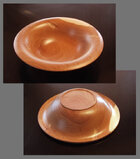
1769801540708.jpeg

I think this one was from 3" thick cedar:
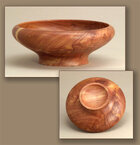
1769801642019.jpeg

And this was my very first real bowl, after practicing on a piece of red oak. Cherry, about 2" thick.
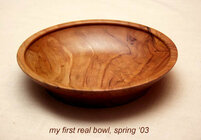
1769801714069.jpeg

With a few exceptions, most of my bowls are from dry wood.
That said, I'd rather turn spindles!

An 8" diameter log cut down the middle can make some VERY nice spindle turning blanks!

 
John, thanks for the reply. From the center of the drive spur to the bed is six inches. Twelve inches diameter would be the maximum. Some wood I would venture were dry before I got them. Logs have been in the dry for years. Good idea to cut and check the cookie for cracks by bending it. I don't store wood on the ground. Have some Bradford pear in the storage building, off the floor; cut this summer. Have watched several YT videos and took a class at Woodcraft, Chattanooga.
 
A circle jig for the Bandsaw will make quick work of making them round. Even a basic one like this will help make quick work of that job.

Bob


Its a bit like 'how long is a piece of string' Bowls come in many configurations shallow, fat, wide,closed, tall and skinny. Most of us have some preferred style, shape or form for our bowls so I would lean in that direction with a few variations along as you develop your bowl making, things will change. I started with open bowls, moved slowly to closed then they got taller- vases and now its pretty much complex embellished hollow vessels.
 
You need to research the different ways that bowl blanks are cut out of a log and like Hughie said the type of bowl you want to make. face grain, end grain or hollow form etc..
 
Last edited:
If your wood is 8" in diameter then I would cut a 9-10" piece of wood then cut it horizontally through the pith to make 2 bowl blanks (if you have a bandsaw jig/sled that is best with that size of wood to minimize waste, otherwise it can be done with chainsaw). With a 12" swing on your lathe you wouldn't even need to round it on the bandsaw but could just cut off the corners into a hexagonal shape but rounding on the bandsaw makes it a little easier when starting out. I would do side grain over end grain to start as that is more common/durable. I'd start with typical bowl orientation (bark side as the outside of the bowl and pith side as the inside) versus trying to start with a natural/live edge bowl. I'd focus on safe, smooth cuts in the proper grain direction (from base to rim on the outside and from rim to base on the inside) and on form - like a lot of turners, my first bowl was pretty straight sided (the so-called "dog food bowl") which is fine if that's what you are going for, but most people prefer continuous curves which is harder to obtain at first.

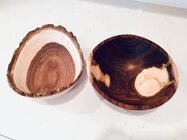
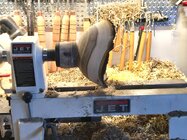
The best thing is to just start practicing. Here are some pictures of a couple of bowls that I made early on (maybe my 3rd and 4th bowls) from 2 sides of a black walnut log. They were both made on a jet 1014 and are about 9 inches in diameter (it just barely fit my lathe as you can see by the second picture). I didn't have a chuck then so I used a glue block, though now I always use chucks for convenience.
black walnut paired bowls.jpg live edge on lathe side view.jpg

Good luck and show us pictures. I've really enjoyed making bowls and am still trying to get better and faster. Hope you enjoy it.

Tom
 
Bradford pear does not like to sit around. Very good chance it is full of cracks. In fact if all you wood is log form like you say, all of it will be cracked to some extent. The outside of the log dries faster than the center and the ends dry faster than the center of the log, that is why it cracks. Being small logs adds another bad element to the equation. Small trunks and limbs crack even faster.
 
I have a lot of logs that have dried for centuries, begging to be turned into bowl. Bear with me as I'm new to bowl turning. My lathe has a 12 inch swing. Diameters of logs can run up to eight inches. What would be the maximum length of a small log for turning to a bowl? 8x8? Larger logs would be cut and rounded on the bandsaw. Hope I'm making sense. Thanks.
I had a 10 in swing lathe and was able, with considerable work, to turn a 9 inch bowl. The banjo would not slide under the piece, so I had to remove the bowl from the lathe to move the banjo.
 
Bradford pear does not like to sit around. Very good chance it is full of cracks. In fact if all you wood is log form like you say, all of it will be cracked to some extent. The outside of the log dries faster than the center and the ends dry faster than the center of the log, that is why it cracks. Being small logs adds another bad element to the equation. Small trunks and limbs crack even faster.
Will need to bring it inside. I did coat the ends with Anchorseal.
 
In turning terms...a 12" swing would be the distance between spindle center point and the bed center. This could allow you turn a piece up to 24" in diameter. The way you described your machine however, reads more like you have a 6" swing which would result in a 12" bowl.

cheers...j
“swing” is stated in Diameter, not radius. For instance, I have a 12” Rockwell and a 30” New Haven; they will handle 12” and 30” diameter work respectively.

Tim
 
Back
Top