• The forum upgrades have been completed. These were moderate security fixes from our software vendor and it looks like everything is working well. If you see any problems please post in the Forum Technical Support forum or email us at forum_moderator (at) aawforum.org. Thank you
  • Congratulations to David Bartell, People's Choice in the March 2026 Turning Challenge (click here for details)
  • Congratulations to Steve Gray for "White Oak Handled Bowl" being selected as Turning of the Week for April 6, 2026 (click here for details)
  • Welcome new registering member. Your username must be your real First and Last name (for example: John Doe). "Screen names" and "handles" are not allowed and your registration will be deleted if you don't use your real name. Also, do not use all caps nor all lower case.

Spinning Tops

Joined
Jan 10, 2024
Messages
1,077
Likes
600
Location
Bournemouth, UK
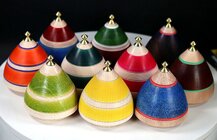
I’ve seen some nice looking spinning tops online made from three or four different woods, some with what look like a Ball Bearing at the bottom.
Do any of you know the best way to approach turning something like this? Concentricity is the key I think?
 
Pardon the pun but those were one of my top sellers at farmers markets... simple as chucking a 2" or so square block , round it, and the rest is just up to your imagination - key for tops I think is the mass better placed nearer to the apex of rotation (In other words, widest part closest to the bottom) they spin fine just making them entirely of wood they can be as simple or as complex as you please.. but yeah concentricity I'd say is key (Thouh if you turn like some partly spalted or punky wood, you can make a wobble top because heavier mass of solid wood on one side throws it out of a smooth rotation) the more balanced you can make the top the smoother it may spin , the more mass you can get into it, the LONGER it can spin - nothing wrong with experimenting to craft tops that spin certain ways or have certain characteristics.. and then there's those games (involving a box and mini rolling pins and tops configured to fit through slots in the inner walls of the box) - forget what they're called, known by several names..
 
Bill, do you have a link to what you saw? I don't have an answer, but you've made me curious.

Bought but not yet used, another spin top thread from a year or so ago lead me to obtain a small diameter brass rod. My intention was to drill a pilot hole into the "business end" of the top in the rough out stage and epoxy in a short length (1/4" or so) of the brass rod. After curing, I'd cut to expose just a very short contact point of brass, making sure it was rounded over and polished to prevent damaging the surface on which it spins.

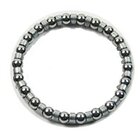
What you saw, is it using a singular metal ball in the same manner? If so, a cheap source for a small handful of those balls is a bicycle shop. (Or online. But support the local bike shop, they live a lean life.) Go in and ask for steering headset bearings, the "old-fashioned" ones that look like this below. They are a bit over an inch in diameter so the balls are quite small. Each caged bearing should only be a few bucks and will provide enough balls for a mess of tops. Drill a small recess, glue in a ball. Brilliant. Use a needle nose pliers to carefully bend the cage prong away from the balls. Keep an eye on those loose balls, they're wiley little fellas once out of their cage! And caution with small children- if the ball breaks off the top owned by a small child, that ball could find its way into their mouth. Maybe these should be "Age 6 and older" toys when they have a ball bearing in them.

1775820519605.jpeg
 
Brian that box with the pins to be knocked down with the spinning top I first ran into at the Boys Club in Erie PA 70 years ago. I have the plans to build one some where and I think you can buy them. I have put ball bearings in my tops but the regular tops are just easier and just as much fun. You can get 600 ball bearings in various sizes for $8 or $9 dollars on AmaZ.
 
A few years back I made some that had a launcher but instead of a steel tip I made the shaft out of American hornbeam so there was not much chance of damaging the spinning surface. The basic idea came from a early 1950.s Delta gram magazine.
101_1370.JPG
101_1371.JPG
I have more photos of the build process if you are interested and they were shown in an earlier post on this forum .
 
Here's a how-to video on turning a throw-top, made last year. The brass "Spin Top Tip" shown in the video can be purchased at YoYoSam.com. They may have a bearing axle version of the point in stock, but they're hard to find these days:
2026_001_010_tops.jpg
 
I’ve seen some nice looking spinning tops online made from three or four different woods, some with what look like a Ball Bearing at the bottom.
Do any of you know the best way to approach turning something like this? Concentricity is the key I think?
Ed Davidson/YoYoSpin is the authority. I'd look at his and maybe buy a few for a closer look.

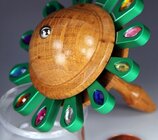
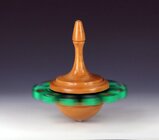
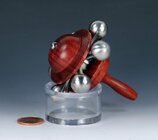
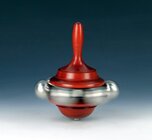
I've made many 100s of finger tops but I almost always use solid wood. I would send batches of 50 with a missionary friend to use at an orphanage in Romania to encourage participation by the kids.

I've heard various theories about the center of mass but found a wide variation in shape and mass distribution spin well. Unbalanced does not spin well, of course. The main part of the top does not have to be round - I've made them square. It's nice to make the tips of the "handle" so they spin nicely upside own - a good challenge for kids.

Even if you want to turn some from glued-up wood you might start by practicing with solid wood. I made this to show people the sequence of cuts. I turn, sand, and finish in sections since when thinning the handle the earlier parts can't be reliably touched. I know some people turn them the other way, with the handle first, bit for me this way allows better spinning.
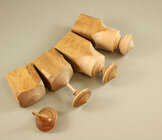
1775843033285.jpeg.

A few examples. You might notice I use friction burning a lot with a very thin wire. It's tricky to friction burn on a slope with a wire but I developed a way. On another forum someone said he could make just as clean burned line by holding a sliver of formica against the wood but after some back-and-forth I sent him a top to duplicate and he gave up.
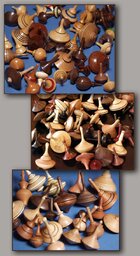
1775843204592.jpeg
When I started making these over two decades ago nearly all I saw were turned quickly, textured with a chatter tool, then colored with markers. I saw none on the forum that looked like these. Now I see many.

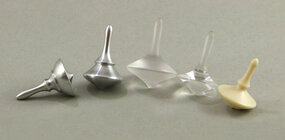
I've also made them from other materials such as acrylic and aluminum.
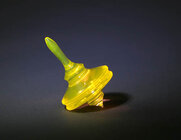
1775843508926.jpeg
1775843479904.jpeg

JKJ
 
Last edited:
Thanks Don, that would be good if it’s not too much trouble.
101_1360.JPG101_1359.JPG
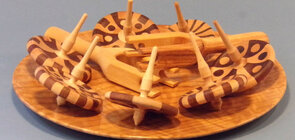
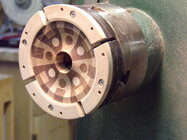
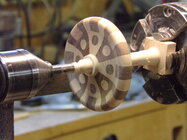
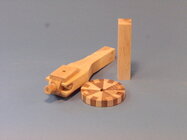
The blanks for the disk were cut from an 8 stave glue up of 4 walnut and 4 birch and while there were 8 flats I clamped it in the vice on my milling machine to make the 1/2" grooves for the contrastingstrips. The whole assembly was mounted on the wood lathe and turned to the diameter that would fit the collet like adapters on my chuck then cut into rough disks. The disc was then mounted in the chuck, flattened on both sides and a pencil line was made to establish the tangential center line and the radial center was eyeballed. The round pieces were turned to a reasonably accurate 1/2", cut into short pieces and driven into the round holes. The top and bottom faces were turned as shown and the hole in the center was trued up & tapered.
The stem blank was mounted as shown and male part was turned to fit the female taper. The disk outer diameter can then be rounded off as shown and the stem can be finished.
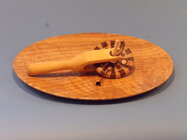
101_1383.JPG The launcher is cut out from a hard wood board and the handle end is turned using an adapter as shown driven by a collet chuck.
 
Quite a few years ago I've used small ball bearings, also tried using short brass escutcheon pins for tips. Decided all the drilling, hammering/installing, gluing (CA) was just too much effort ... although they worked pretty well. Now I just dribble some thin CA into the end grain where the tip will be before turning to strengthen the tip ... and sometimes add a little more before the final cut.
 
I wonder if you could just use a BB for the ones that have that steel ball stuck in the bottom.
The BBs I remember from several moons ago were not that round. They may still be that way for all I know. Awfully small to work with but probably manageable with care. I think a ball bearing larger than a BB would be much easier to manage though.
 
At Amazon, here is a package of 100 grade 304 1/4" stainless steel ball bearings for $6.20. No need for the somewhat more expensive and higher corrosion resistance 316 SS, you'd need your tops to be spinning in a pretty harsh environment to require 316.

Plain chrome plated steel bearings are even cheaper, but maybe that plating will wear off in time and start scratching surfaces. 304 ss seems to be the best choice.
 
Back
Top