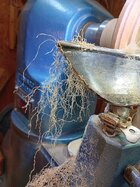
Once you find that "perfect cut" you'll see that it isn't dependent on faster rpms, but rather can be found along with the best vibration free rpm, in conjunction with sharpness and presentation......
The rules are different for cross-grain bowl turning than they are for spindle turning. If you can find the PC, you'll notice that you can turn the rpms way down, and still achieve it......as long as presentation and sharpness is maintained. The dynamics of a bowl shape will negatively react increasingly more to higher speeds the further from that point which is determined to be the best vibration free rpm. There is definitely a limit to how slow it can go, just as there are limits to how faster speeds will sometimes create conditions that result in a better cut. (IMO, newer turners will almost always resort to higher speeds mainly because they wait too long between sharpening intervals.....or, they just haven't developed their sharpening/honing skills to a fine degree.....yet!

Also, the established formulas for determining the best rpm are only a starting point. Each piece of wood will have its own unique best vibration free rpm, and there really isn't a set rule for finding it.
Using a "vibrometer" has been a significant help in my efforts to find the PC......but, it should be understood that this little device is not a "silver bullet"!......it is dependent on the refinement of other turning skills for it to work well, and is only a "piece of the puzzle" in finding the best rpm applicable to any one individual bowl.
=o=
My vibrometer is shown here. I've modified it slightly from the photo, but it's use is the same as the configuration in this photo:
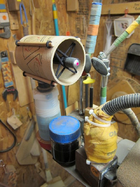
Here is a link to the discussion that led to the development of my first "vibrometer"...
I am looking for ideas for devices, or inventions for detecting minor vibrations on the lathe.
The purpose is to adjust the rpm to where the least possible vibrations are present.
Right now, I use my fingertips on the lathe bed, plus there is one long neck spot lamp that consistently gives me some good indications. Other lamps and fixtures on the headstock also help.
Assuming the best location would be connected to the headstock, but entertaining input, if any.
I have tried an antennae like affair that was not very successful.
I also have experimented with a jar of water, that was...