• It's time to cast your vote in the December 2025 Turning Challenge. (click here for details)
  • Congratulations to Pat White for "Sicilian Mosaic" being selected as Turning of the Week for December 29, 2025 (click here for details)
  • Welcome new registering member. Your username must be your real First and Last name (for example: John Doe). "Screen names" and "handles" are not allowed and your registration will be deleted if you don't use your real name. Also, do not use all caps nor all lower case.

Threaded waste block

Joined
Feb 25, 2025
Messages
547
Likes
673
Location
Jackson, MS
I saw a video where a waste block was threaded and screwed on the spindle so no chuck was used and the advantage stated was the turning could be taken off the lathe for fitting and returned to the lathe as many times as needed with it always running true before parting it off.

Sure seems like a good idea or is it just another way of doing something?

 
I use them all the time and probably have a dozen of them in different profiles for different things, like different jam chuck profiles for bowls of different sizes, hollow forms, boxes, double sided tape blocks for small items, etc , they work fantastic , once you make one glue a waste block on and then when the waste block gets used up you turn it off and add another , you can uses them over and over
 
Sure seems like a good idea or is it just another way of doing something?

It’s a holding option with pluses and minuses
Need a tap and time to make the them
Useful for items that will go on and off the lathe many times

Useful for making various jigs

I use a lot of wooden morse tapers to glue things on. And several are on cult chucks for ball turning.


Chucks in some uses and cup centers( oneway safe center) allow nearly recentering.

I have a couple of glue blocks on dedicated faceplates
 
I use them all the time for turning threaded boxes. The mini lathes are pretty much all 8 tpi, and 1 inch diameter. You can find boxes of the locking nuts at any big box hard ware store. I insert them into a wood block, about 2 inch diameter. I do epoxy them in. You can get thread cutters, maybe from Beal tools? You have to special order locking nuts 1 1/2 inch by 8 tpi. To me, this is easier than threading them, but that works too. As you part blanks off, I generally take the waste block, it eventually gets down to the nut. I just flatten the surface and glue another 3/4 inch or so piece of wood to the waste block.

robo hippy
 
I use them all the time for turning threaded boxes. The mini lathes are pretty much all 8 tpi, and 1 inch diameter. You can find boxes of the locking nuts at any big box hard ware store. I insert them into a wood block, about 2 inch diameter. I do epoxy them in. You can get thread cutters, maybe from Beal tools? You have to special order locking nuts 1 1/2 inch by 8 tpi. To me, this is easier than threading them, but that works too. As you part blanks off, I generally take the waste block, it eventually gets down to the nut. I just flatten the surface and glue another 3/4 inch or so piece of wood to the waste block.

robo hippy
Great idea. Thanks. And less expensive than a Beale tap.

Where did you order them from?
 
Last edited:
I used to glue nuts into a wooden faceplate. 1"x8 nuts are easy to find - maybe at big-box stores (home despot etc) or at farm stores. Did that back when my old lathe had a 1"x8 spindle. I still do this sometimes to make accessories for the tailstock-end (3/4"x10 nuts screw onto my live centers).
1-1/4"x8 is the common size for many full-size lathes but the more common nut/bolt size is 7TPI not 8, so they're harder (if even possible) to find at a physical store.
If you're just going to make one or a few faceplates and make them reusable like Bob suggested, then availability may not be a problem. You can google for "1.25"x8 UNR nut" - note that most of what comes up will be metric 1.25x8mm (not what you want). McMaster-Carr has them https://www.mcmaster.com/products/nuts/thread-size~1-1-4-8-1/
If you want the option to run to the store when you need another nut - one option would be to use 1"x8 nuts and get a spindle adapter. (Or else invest in a Beale tap - but the advantage of the nuts is they can be epoxied into wood that might not tap very well).
 
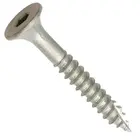
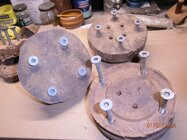
I have the tap for my head stock thread diameter. But generally screw a hardwood block on to my blanks. I have several different sizes hanging over the lathe, using hex bugle type screws to hold them, 2 to 3" in length depending on the blanks.
I use this method as a simple, effective way of adding a tenon. And with the hex drive with self drilling capability it will penetrate any hardwood, to date I have come across. I have this set up and the same screws for many years, ok, the tenon part gets a bit dog-eared after a while.
 

Attachments

  • class-bugle-batten-gal.webp
    class-bugle-batten-gal.webp
    12.4 KB · Views: 1
  • P1010032.JPG
    P1010032.JPG
    515.6 KB · Views: 1
Last edited:
I have a Beal 1-1/4x8 tap and used it to make friction chucks for finishing the bottom of pieces, but a few years ago I got a copy of Robust threaded live center with cones, and a Robust threaded drive center. 3/4x10 nuts to fit either center are easy to find, and I have a number of friction/jam chucks made up using the nuts - easier than threading wood.

For glue blocks, all of my chucks have a “locating mark” on them, and I mark glue blocks to match when I make them for the chuck/jaws. No problem getting them concentric when matched back to the jaws. It’s rare for me to use glue blocks anymore, I rarely have a blank so thin I cant fit a tenon on it.
 
Back
Top