• The forum upgrades have been completed. These were moderate security fixes from our software vendor and it looks like everything is working well. If you see any problems please post in the Forum Technical Support forum or email us at forum_moderator (at) aawforum.org. Thank you
  • February 2026 Turning Challenge: Cookie Jar! (click here for details)
  • Congratulations to Chad Eames for "Red Tines" being selected as Turning of the Week for February 23, 2026 (click here for details)
  • AAW Symposium demonstrators announced - If the 2026 AAW International Woodturning Symposium is not on your calendar, now is the time to register. And there are discounts available if you sign up early, by Feb. 28. Early Bird pricing gives you the best rate for our 40th Anniversary Symposium in Raleigh, North Carolina, June 4–7, 2026. (There are discounts for AAW chapter members too) For more information vist the discussion thread here or the AAW registration page
  • Welcome new registering member. Your username must be your real First and Last name (for example: John Doe). "Screen names" and "handles" are not allowed and your registration will be deleted if you don't use your real name. Also, do not use all caps nor all lower case.

Tobby Cook

Joined
Apr 5, 2020
Messages
2
Likes
0
Location
Vernonia, OR
Hello there,

I have no experience what so ever. I got into it because my son loves baseball and wants me to make him a wooden bat. So, the adventure starts here I guess.

Cheers.
 
You can purchase baseball bat wood blanks on Ebay depending on wood species and grade of wood blank you are looking for.
 
Find a mentor. And work your way up to a regulation size bat.
Turn a couple of carving mallets, then turn a couple of minutes bats about 12” long.
Once the mini bats begin to look like a real bats you are ready to go for a regulation size bat.
Some leagues don’t allow wooden bats

the first project I do in a beginning bowl class is a carving mallet.
Tools used are spindle roughing gouge, 1/2” spindle gouge
Can be done all between centers and saw off the ends with a small handsaw.
Or one end can be held in a chuck.

after roughing round I have my students use the area where the handle will be to practice a row of beads. Turn them off with the roughing gouge. If there is room practice more beads. Then shape the handle a bit with the roughing gouge getting it to a diameter that feels good in the turners hand. Turn the head profile with the spindle gouge. Turn a bead where the handle starts and shape the handle.

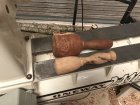
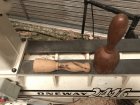
size from 3 to 5” diameter. The cherry one was parted off at an angle to make a concave face to stand on end, the hickory on is sawn off on the face and will stand on end too. The cherry one is over 20 years old and has been stipples with thousands of whacks on spur drives.
8C78A027-7334-4928-98BF-AF226D82F089.jpeg 1480C6ED-B8C0-4A56-84D3-7940CB8AF67F.jpeg
 
Last edited:
Welcome aboard Tobby. You'll find a ton of expertise here and plenty of people willing to share. You've already heard from some of the best (the folks above, not me :-).
 
Hello there,

I have no experience what so ever. I got into it because my son loves baseball and wants me to make him a wooden bat. So, the adventure starts here I guess.

Cheers.
Welcome to the forum and to the world of turning!
 
Back
Top