• The forum upgrades have been completed. These were moderate security fixes from our software vendor and it looks like everything is working well. If you see any problems please post in the Forum Technical Support forum or email us at forum_moderator (at) aawforum.org. Thank you
  • February 2026 Turning Challenge: Cookie Jar! (click here for details)
  • Congratulations to Chad Eames for "Red Tines" being selected as Turning of the Week for February 23, 2026 (click here for details)
  • Welcome new registering member. Your username must be your real First and Last name (for example: John Doe). "Screen names" and "handles" are not allowed and your registration will be deleted if you don't use your real name. Also, do not use all caps nor all lower case.

Tripoli on Wax Buff Wheel. How do I to fix

Joined
Mar 19, 2016
Messages
1,557
Likes
2,076
Location
Haubstadt, Indiana
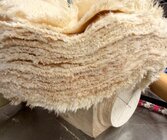
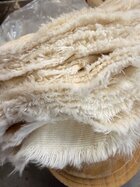
I bought a set of Beall buffing wheels used. Well the turner had loaded the wax wheel with Tripoli. Looking at the Tripoli wheel I’m guessing it was used for wax. With 80 grit sandpaper and got most all of the Tripoli removed. I also used sandpaper to clean the other two wheels. I am speculating the white diamond was not contaminated with any other compound, but the Tripoli wheel was likely used for wax. The picture below is the wax wheel after the sandpaper. cleaning. Still it has an indication it had Tripoli on it.

The question is this sufficient or do I need to go further with the cleaning. I’m guessing the wheels could be machined washed. Suggestion/comments?


IMG_5338.jpeg
 
I bought a new wax wheel because my older one had been worn down from 8” to ~6.5” over the years from normal use (still use it as well).

Maybe just stick the corner of a board into it while running at 1500-2000 for a while? I would think after you’ve worn away the outer ~1/4” or so you’d be past the contamination.

I wouldn’t trust it though until I inspected it well and put some wax on a scrape piece of light maple first…
 
I've removed Tripoli from Beall wheels by holding the teeth of a hacksaw or bandsaw blade against the spinning wheel. I removed a lot of fibers which was OK.

I have since quit using Tripoli completely. When I want a coarser polish grit I use Vonax in bar form; (Mark Sillay carries it)

I rarely use white diamond compound and never on dark wood since the pores can hold the white specs.

I do use the wax.

Anything I apply to beall buffing wheels is done VERY sparingly. With good sanding with fine paper very little is needed.

JKJ
 
@Jamie Straw the wheel was heavily loaded with Tripoli and used two sheets of 80 grit sandpaper. I removed about 90%, but not all. @Richard Coers is correct in the fact you cannot remove all the Tripoli mechanically. Using very warm water worked as the warm water softened the wax and the the Dawn and Tide aided in removal.

@John K Jordan It is my understanding (internet) that the Vonax is a replacement for the white diamond and not the Tripoli. Also I went to Mark’s site and there doesn’t appear to be any activity since 2020. Nothing was listed for sale. I could not find a US supplier for the Vonax compound. There two eBay listings to buy it from the UK. However shipping was very high. It would be nice to have it for woods like walnut where you can’t use white diamond because it will get in the pours of the wood.
 
@John K Jordan It is my understanding (internet) that the Vonax is a replacement for the white diamond and not the Tripoli. Also I went to Mark’s site and there doesn’t appear to be any activity since 2020. Nothing was listed for sale. I could not find a US supplier for the Vonax compound. There two eBay listings to buy it from the UK. However shipping was very high. It would be nice to have it for woods like walnut where you can’t use white diamond because it will get in the pours of the wood.

Vonax was recommended to me to use instead of the Tripoli.
At first I also found it offered only in the UK. The a kind gentleman on another forum sent me 1/2 a bar for free.

Don't know about white diamond vs tripoli vs Vonax. The all-knowing and sometimes confused internet suggested:
- white diamond was around 12,000 grit
- tripoli was between 400 and 1000 grit, depending on the formulation

I usually sand hard, fine-grained wood to 600, 800, or higher and use 0000 steel wool on some pieces. I don't buff to remove scratches, which some use Tripoli for), only for light polish on certain pieces. For my use Vonax has worked well on bowls, platters, and smaller things. I follow it with a light buffing with the carnauba wax.

The dates I see on Mark's website were for past demonstrations. Like many of us, perhaps he's slowed down a little and doesn't keep it updated.

I purchased various Vonax and other products from Mark in May 2025. Prompt delivery, good pricing. Maybe he imports it in quantity.

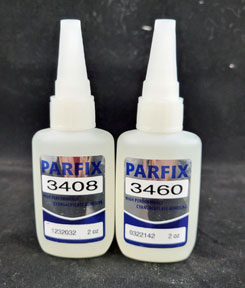
I also bought Parfix 3408 from him at the same time - an excellent CA glue I use in the shop and around the farm. It's a medical grade and useful to patch up certain cuts or abrasions on horses and peacocks. Creates no heat when curing. Has no offending order. Cures slowly.

Many people use it as a good one-step finish. I keep a large bottle in a fridge and pull out just a few ml at time in a plastic pipette. I use drops from the pipette for many weeks.

Maybe give Mark a call.

JKJ

 
I could not find a US supplier for the Vonax compound.
Kirk Kapp at kappskreations.com sells the Vonax compound. And also the Parfix 3408 CA glue John mentions. I bought both from him just this past December 2025. His prices per item include shipping. When I ordered tow items, he followed up with a refund of the excess shipping cost since both could be shipped in a single package. Scroll to the bottom of the page for the Vonax compound listing:

 
I forgot to mention, the Parfix 3408 will last longer if stored in the fridge and nearly forever if the air inside is first displaced with inert gas. I was told it was shipped from the factory this way. When I bought a quantity for our club directly from Parsons Adhesives each bottle came with a red cap pressed tightly into the top of the bottle, under the cap. Unfortunately, Parsons will only sell in quantity. One of our clubs buys a quantity and sells to members at cost. Other clubs might check into this.

It doesn't take more than a few molecules of water in the air to start the reaction that will set up the entire bottle. I have a bottle set up like this. I'm thinking of cutting off the plastic bottle and mount and turn the set up contents, just for fun.
 
Back
Top