• The forum upgrades have been completed. These were moderate security fixes from our software vendor and it looks like everything is working well. If you see any problems please post in the Forum Technical Support forum or email us at forum_moderator (at) aawforum.org. Thank you
  • March 2026 Turning Challenge: Olla! (click here for details)
  • Congratulations to David Wyke, People's Choice in the February 2026 Turning Challenge (click here for details)
  • Congratulations to Tim Connell for "Black Locust Basket Illusion Series #4" being selected as Turning of the Week for March 16, 2026 (click here for details)
  • Welcome new registering member. Your username must be your real First and Last name (for example: John Doe). "Screen names" and "handles" are not allowed and your registration will be deleted if you don't use your real name. Also, do not use all caps nor all lower case.

turning dowels

! need to turn several 2" diameter dowels. longest one is 36". Is there a simple jig I can make to be consistent?

Sorry, I can't answer you question about a jig. I've always just turned that size with a skew.
But even a 2" diameter can have vibration, especially when that long. The type of wood can make a difference as can the holding. I like to secure long spindles in a chuck on one end which helps.

Do they need to be perfectly cylindrical? Any detail or straight dowels with square ends? If so, I did a google search with 'wood dowel 2" x 36"' and saw them for sale from maple, ash, etc.

JKJ
 
There are all sorts of things on You Tube about making your own dowels. I would expect you might be able to do it that way. Some are even done with hand planes but that takes practice. Not sure if there is a pencil sharpener thing that could make for a 2 inch dowel. Not sure if any one makes a 2 inch diameter, well, not reamer, but outside reamer....

robo hippy
 
Dowels aren't usually made on lathes. You could do them on a metal lathe or pattern makers lathe with some sort of traveling steady rest to support the work piece at point of cutting to prevent deflection and vibration.

Commercially, dowels are made on special machines known as "dowel" machines. Square stock is fed into and through a rotating cutter head and supported in what is like the inside diameter of a ball bearing for complete support. Dowels can also be made on molding machines using 4 cutters, both sides and top, bottom. A molder is the same machine that produces common millwork patters,

However the dowels are made they must be made of straight grained stock.

Depending on how perfect they need to be you can do them on a router table from accurately sawn square stock. Use a 1" radius round-over bit. 4 passes total, one pass to do each corner. Spring type hold downs need to securely hold the stock down and against the fence.
 
Like John said, vibes may come in to play at 2" diameter x 36" long. It sure does at 1"x36"! Shy of a spindle steady rest, I think I'd attack them with very sharp tools (roughing gouge or skew), and maybe every 6"-8" along the length, use a parting tool to cut in depth indicator marks to your final diameter to help guide the overall depth. And by eyeballing, keep your toolrest dead parallel with the bed ways by sighting the rest to the bed at the bed gap. Again, this helps to guide your tooling operation to maintain consistent cutting and diameter.

Play with RPM speed. The faster it spins, the more the spindle will deflect off-center at the location of the cutter. You may find a lower-than-"normal" RPM and light cuts to be helpful to keep the spindle running true(er).

Depending on your wood species, maybe stop cutting a stroke or two before your final diameter and let sandpaper get you to that measurement.
 
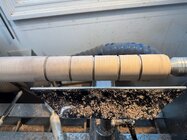
I've made 8 dowels of varying lengths out of walnut without noticeable vibration. I used an AB for the shorter ones and a jet 1642 for the 36" ones. Obviously, the AB performs better but i have a longer bed on the Jet which worked surprisingly well. I used a caliper every few inches (see photo) but being mostly a bowl turner, I struggled getting the diameter equal with a roughing gouge. Exact diameter is not critical but want to do better. I still need to make 2 more. I recall seeing a simple homemade wood duplicating system that could be used for this purpose and thought it may work.
 

Attachments

  • Walnut dowels.jpg
    Walnut dowels.jpg
    438.8 KB · Views: 5
Question... Has anyone here ever attempted to do a very long thin dowel shape with a "pull" from the tail stock instead of the usual "push" from the tailstock? I envision a chuck at the headstock and a small chuck or a screw chuck situation at the tailstock. Of course, this would mean a drawbar at the tailstock into the morse taper or a set screw something or other to keep the project from pulling out as it is stretched between "centers". Would this lessen the likelihood of the spindle whipping like is easy to do on long thin spindles under compression?
 
I use those for spindles for the Windsor chairs I make. I wouldn't use this approach for something 2" in diameter.
But, you could... 😉

In all seriousness, for your chair spindles, what is your acceptable tolerance of "round" off the shave horse? I've never done the process myself, with time and practice are you able to achive near-lathe-like roundness?
 
Last edited:
But, you could... 😉

In all seriousness, for your chair spindles, what is your acceptable tolerance of "round" off the shave horse? I've never done the process myself, with time and practice are you able to achive near-lathe-like roundness?
Perhaps one could, but I definitely wouldn't. Holding something 2" in diameter and 36" long is not something I'd want to try on a shavehorse. I did shave a continuous arm for a settee. That was 86" long (yes 86") but only 1" in diameter. That was interesting but went fairly quickly. That was after I had made a number of chairs whose arm piece was shorter.
You can get to smooth and round with a spokeshave, although a cross section might not be a lathe-like circle. Light sanding could then further regularize the smoothness/roundness. I don't aim for perfect smoothness or roundness -- small light facets from a spokeshave add a bit of visual interest, particularly if you paint one color over another and then rub it back. Likewise, on other parts which are not necessarily round but made with drawknife and spokeshave -- such as crests and many types of arms -- I leave light facets from the spokeshave. Many professional Windsor makers leave a little evidence of spokeshave use as they complete the chair.
 
Back
Top