• The forum upgrades have been completed. These were moderate security fixes from our software vendor and it looks like everything is working well. If you see any problems please post in the Forum Technical Support forum or email us at forum_moderator (at) aawforum.org. Thank you
  • It's time to cast your vote in the February 2026 Turning Challenge. (click here for details)
  • Congratulations to Gabriel Hoff for "Highly Figured Masur Birch Round Bottom Box" being selected as Turning of the Week for March 2, 2026 (click here for details)
  • Welcome new registering member. Your username must be your real First and Last name (for example: John Doe). "Screen names" and "handles" are not allowed and your registration will be deleted if you don't use your real name. Also, do not use all caps nor all lower case.

Turning end grain?

Joined
Jan 24, 2010
Messages
3,261
Likes
992
Location
Cleveland, Tennessee
Is there a rule of thumb for turning end grain? Have a piece of, I believe, cherry mounted on the lathe. Piece is 3-3/8 in diameter and 4-1/4 long. Started to hollow with a Forstner bit but wasn't comfortable with the "action" of the Jacobs chuck in the tailstock. Any and all suggestions are welcome.
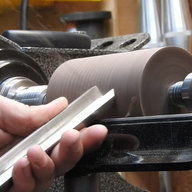
 
Well, there are many methods, but most turners including myself, hollow from the center out, using a spindle gouge or a Hunter hollowing tool. For your size piece of wood, these tools should be no problem.

I don't prefer a forstner bit because of the heat produced and the way it leaves a straight hole with a divet in the bottom.

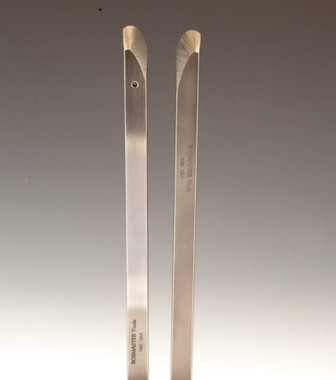
Also negative rake scrapers are a great choice, such as these from D-Way. If you are going to hollow a lot, these tools are an excellent investment and leave a very smooth surface. They also are excellent for blending the interior curve.

 
Started to hollow with a Forstner bit but wasn't comfortable with the "action" of the Jacobs chuck in the tailstock. Any and all suggestions are welcome.

Curious, what "action" of the jacob's chuck did you not like?

To remove a center core of wood to make hollowing something like a box quicker, I often drill with forstner bits in a jacob's chuck. But I do these things:
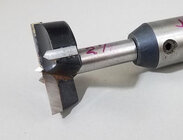
  • I use cheap carbide forstner bits (one shown below) rather than good quality bits. These don't cut as smooth a hole as the high end HSS bits but they cut faster and with less heat and stress. And they never get dull! The carbide bits have just two primary points that score the fibers at the circumference and two flat blades that then scoop out the scored fibers. This works especially well for drilling in side grain but also well for end grain.
  • I have one entire set of forstners that have hex shafts. These are easily held in a jacob's chuck without slipping. Woodcraft had a couple of sets for 90% off one day and I couldn't resist.
  • Forstners with a 3/8" round shaft get mounted in a precision 3/8" End Mill holder held securely with a hex set screw. These come in different styles - for at the lathe I chose one with a #2MT to fit into the tailstock. To keep the MT from spinning in the tailstock, I do the same as with taper shank bits: constrain it from spinning, either hold it with vise grips resting against the tool rest, or in this case by simply inserting a t-handle hex key in the set screw socket. Drilling this way doesn't create much force. If drilling from the headstock, just use a drawbar.
  • And the MOST important thing is something I tried one day after hit with a sudden Epiphany - I directed a constant strong stream of compressed air behind the forstner bit while drilling. Now I never use forstners without the compressed air. This does two things: it keeps the bit cooler (especially important for the smooth-cutting HSS bits), AND continuously blows out chips so they don't accumulate and jam, heat, and slow down the cut. It's amazing how much this improves the drilling, especially for deep holes.
Pic showing a carbide forstner bit held in an end mill holder. I got this one 2-1/8" and another 2-1/16" diameter just to drill recess holes in the top of a bowl blank for 50mm chuck jaws. (This was before I started using an entirely different method on the top and gave up the drilling completely.)
I liked the 2-1/16" better for 50mm jaws but a friend pointed out if the hole was 2-1/8 at the BOTTOM of a bowl the larger bit would leave just enough room between the jaws to insert the right caliper to check the thickness at the bottom.
1772933691238.jpeg
I mostly use forstner bits now while teaching to show one of several options to start a face turning (not every student owns every possible tool - gasp!)

When drilling a hole I want to enlarge and make a smooth bottom, say in the bottom of a box, I stop short so the point in the middle doesn't leave a mark. However, if the bit AND the wood is constrained on the lathe the point can be ground off since it won't be needed to keep the hole centered.

JKJ
 
Last edited:
For hollowing end grain bowls, not vases with narrow openings, I start with spindle gouge as Ron described. Then I switch to the ring tool and finish to final thickness at the rim, then go a little deeper maybe 2 cm to final thickness and so on, never go back to the rim later. For ring tool use I thoroughly recommend svarvulf, Instagram Svarvulf
 
JKJ, the bit kept grabbing some. Not sure if it's the wood which I thing is cherry.
Going to take inventory of my tools- have two spindle gouges, round nose gouge and a square nose gouge. Surely something will work.
 
Is there a rule of thumb for turning end grain? Have a piece of, I believe, cherry mounted on the lathe. Piece is 3-3/8 in diameter and 4-1/4 long. Started to hollow with a Forstner bit but wasn't comfortable with the "action" of the Jacobs chuck in the tailstock. Any and all suggestions are welcome.
What size bit were you using?
 
Well, first step for me is to take a drill bit, about 1/4 inch plus in a set of vice grips, and into a small cone already turned into the end grain, insert it for depth. A small O ring can serve as a depth guide. After that, I will use a spindle detail gouge to pull from the center to the top rim. Pull in an uphill/lower to higher position pattern. The NRS is a detail tool, not for heavy roughing cuts, so after all the hollowing is done, then use the NRS for clean up. When you learn how to use one well, then 400 grit will rough up the surface, not make it smoother. I never have figured out the Richard Raffan method of hollowing/back cut, but here is a link to that video. Tomislav also does one, but in this one, I think Richard does a slightly better job. The standard drill bit just works better for me than a forstner bit does. A spindle detail gouge also will drill down fairly well. Think of the old fashioned "spoon" bits if you ever watched Roy Underhill on PBS.

View: https://www.youtube.com/watch?v=_KdPGAqXOds


robo hippy
 
What Gabriel said. And Ron and Reed, too. This is where understanding grain orientation is crucial. It's not a bowl.

Forstner bits get dull and are hard for me to sharpen. I can hog out waste in end grain with back hollowing and/or a scraper just as fast, and resharpen the tool easily and often. YMMV.
 
What Gabriel said. And Ron and Reed, too. This is where understanding grain orientation is crucial. It's not a bowl.

Forstner bits get dull and are hard for me to sharpen. I can hog out waste in end grain with a scraper just as fast, and resharpen it easily and often. YMMV.
I can rough hollow a box with a tool faster then I can using a forstner bit! Yes, you are correct with orientation, drilling end grain is harder then side grain.
 
The cheap carbide forstners I mentioned haven't gotten dull with years of use, even in very hard wood.

Where a forstner bit shines is for deep holes such as when drilling deep to make salt and pepper mills. Shallow holes such as on a typical lidded box are not a problem with a gouge or even the right scraper.

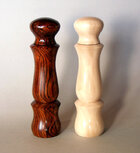
Cocobolo and dogwood.
1773010091270.jpeg
Been using this set daily or over 15 years.

JKJ
 
Last edited:
JKJ, the bit kept grabbing some. Not sure if it's the wood which I thing is cherry.
Going to take inventory of my tools- have two spindle gouges, round nose gouge and a square nose gouge. Surely something will work.

But what kind of bit was it? Was it a smooth-sided HSS forstner made to cut smooth holes? (I admit to adding a bit of Renaissance wax to the outside of such bits?

Was the hole deep. Could the grabbing have been caused by chips and sawdust accumulating at the bottom of the how where the teeth were cutting. If so, the compressed air may help.

Unless wildly burled Cherry should not have been the primary reason issue since it's a relatively easy wood to cut.

Oh to have a transportation booth so we could visit each other's shops in an instant!
 
Smooth side bit; hole was 1/16" deep.
Yikes, so shallow! Have no experience with the effect you mentioned. Assuming the bit is good quality, and was held firmly AND the lathe perfectly aligned (check the tailstock-to-headstock alignment?) and the hole was scored lightly at slow speed at first touch, that's a puzzle. Try varying the speed?

I might test that bit on the drill press on a piece of similar wood securely clamped to the table. But unless this was the first time using the bit, it's unlikely to be a defect in the bit.

Can you borrow and test one of the same size in the same situation and see if it's grabby?

JKJ
 
The cheap carbide forstners I mentioned haven't gotten dull with years of use, even in very hard wood.

Where a forstner bit shines is for deep holes such as when drilling deep to make salt and pepper mills. Shallow holes such as on a typical lidded box are not a problem with a gouge or even the right scraper.

Cocobolo and dogwood.
View attachment 85910
Been using this set daily or over 15 years.

JKJ
What "cheap" bits are you using?
 
Tried again with a 1/4 inch bit to start. Then went to a round nose scraper. Did fair but would take a lot to hollow this piece. Tried spindle gouge and got horrible catches. Contacting a turner for help this Saturday as he opens his shop to the club members.
 
Use a Hunter Viceroy. Faster than a scraper and easier to use.. I dont like drilling with firestner style bits on a lathe. It's very hard on the tailstock spindke threads.
 
Found sources. #1 or #3? Or do you sell them?
??????? What is this related to?
It would be helpful to click on the Reply (or Quote) button in the lower RH corner. This will show the post (as above this one to you) that you are responding to. Or, even by using the (@ so-and-so) would be helpful ... but not as much as the Reply button. Thanks.
 
??????? What is this related to?
It would be helpful to click on the Reply (or Quote) button in the lower RH corner. This will show the post (as above this one to you) that you are responding to. Or, even by using the (@ so-and-so) would be helpful ... but not as much as the Reply button. Thanks.
He means he found a Hunter tool dealer and would like to know what cutter size, #1 or #3.

Found sources. #1 or #3? Or do you sell them?
I would go with #3 for the size you pieces you work on. It will give you more mass. But, give Mike Hunter a call, he will be more then happy to talk to you and get you set up.

 
Back
Top