What would happen if one turned a piece of wet, green wood to its final shape, then left it to dry? Accepting the normal warpage as a desired effect, doing nothing more than sanding and applying finish? Is that an acceptable technique?

Cracking is what I thought might be a problem.the risk is that in addition to warping they might crack...badly

Sure. it is very often done regularly with "natural edge" bowls so that you have bark (or the surface that had bark on it) as the natural wavy rim - almost always turned green and allowed to warp - bottoms I'd suggest having a raised bead so once dry you can cut away parts of it to give it 3 "feet" to stand on and they are less likely to wobble... If you turn them thin enough they'll often warp without cracking (since the tinner wood will "bend" rather than "break" much like the difference between 1/8" plywood and 1/2" plywood, for example... )What would happen if one turned a piece of wet, green wood to its final shape, then left it to dry? Accepting the normal warpage as a desired effect, doing nothing more than sanding and applying finish? Is that an acceptable technique?


Absolutely! Couple of things to keep in mind if you decide to turn green:What would happen if one turned a piece of wet, green wood to its final shape, then left it to dry? Accepting the normal warpage as a desired effect, doing nothing more than sanding and applying finish? Is that an acceptable technique?
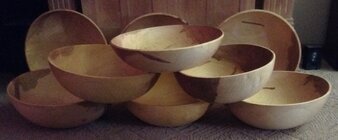
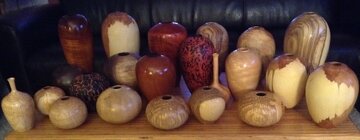
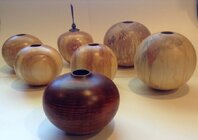
All of these were turned from a tree cut days before. Not a crack in the batch. In the 38 years of turning, the only time I have twice turned is some cremation urns so I could get a round hole for a threaded insert. ALL the other work is once turned green wood. You must consider species, drying techniques and even and identical wall and base thickness. The stack of salad bowls are 18” in diameter.the risk is that in addition to warping they might crack...badly

Please excuse me Monte but I can't resist commenting when someone says "be sure not to leave the pith in".Be sure not to leave the pith in the blank as that is where it will normally crack from when drying. I tend to dry these in a shop microwave to speed along the process.
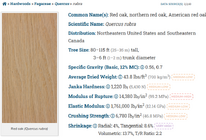
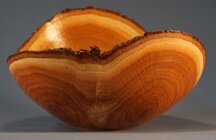 This is a northern red oak crotch bowl with 3 piths.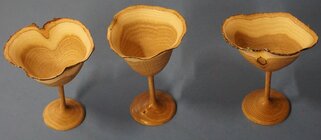
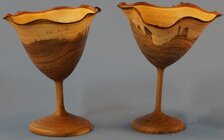
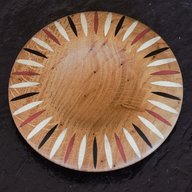
I just watched a couple of your YouTube videos. Glad to see you here! And thanks for the info.I once turn all of my bowls, plates and platters. I just love the warped shapes. I do use a recess on them. My favorite is Pacific Madrone because it warps in totally unpredictable ways. I have found that with it, I need spring harvested trees, which around here is March through May, but later than that, I get more cracking. I turn the walls to about 1/4 inch thick. I do round over the rims. I use the LDD soak, which is kind of messy, but it makes the bowls easier to sand out. LDD is liquid dish washing soap and water in equal parts, soak for 24 hours or more, rinse off, wrap stretch film around the rim (big box stores in "moving" supplies", and let it dry. Some do sand them wet, but it seems to take more time. They are dry in a week at most. I let them sit on the concrete floor of the shop for a day or 5, then up on wire racks to finish. It takes at most a week for it to finish moving and drying. It REALLY helps to have a lathe with 15 or ro rpm speed for sanding. Any faster and you can't keep the abrasives on the wood as it spins. I had my Robust slowed down to that speed range, my Vicmark 240 already goes that slow. Final wall thickness can vary a bit from wood to wood. Walnut and maple, mostly big leaf out here can be 3/8 inch thick. I would not leave them thicker. Oh, I power sand too, just more "efficient", and my "articulated arm for sanding", a video I did, is a must because the arm takes all the weight of the sander off so you can actually spin the piece by one hand and hold the drill on the sanding arm. You get a lot of comments about why is it so out of round and after you explain it, many go "oh, it so organic"!
robo hippy
I saw your video on using dish soap and how you wrap it in plastic.I once turn all of my bowls, plates and platters. I just love the warped shapes. I do use a recess on them. My favorite is Pacific Madrone because it warps in totally unpredictable ways. I have found that with it, I need spring harvested trees, which around here is March through May, but later than that, I get more cracking. I turn the walls to about 1/4 inch thick. I do round over the rims. I use the LDD soak, which is kind of messy, but it makes the bowls easier to sand out. LDD is liquid dish washing soap and water in equal parts, soak for 24 hours or more, rinse off, wrap stretch film around the rim (big box stores in "moving" supplies", and let it dry. Some do sand them wet, but it seems to take more time. They are dry in a week at most. I let them sit on the concrete floor of the shop for a day or 5, then up on wire racks to finish. It takes at most a week for it to finish moving and drying. It REALLY helps to have a lathe with 15 or ro rpm speed for sanding. Any faster and you can't keep the abrasives on the wood as it spins. I had my Robust slowed down to that speed range, my Vicmark 240 already goes that slow. Final wall thickness can vary a bit from wood to wood. Walnut and maple, mostly big leaf out here can be 3/8 inch thick. I would not leave them thicker. Oh, I power sand too, just more "efficient", and my "articulated arm for sanding", a video I did, is a must because the arm takes all the weight of the sander off so you can actually spin the piece by one hand and hold the drill on the sanding arm. You get a lot of comments about why is it so out of round and after you explain it, many go "oh, it so organic"!
robo hippy

I've found that Pecan is the most likely to warp, at least among the woods I most often turn while green. The Live Oak here in South Georgia hasn't moved at all after turning green. It's a completely different kind of grain than most other oaks.Absolutely! Couple of things to keep in mind if you decide to turn green:
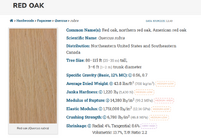
* Different woods will yield different results. Oak and fruit woods will see a lot of warping and distortion. Other woods will just go oblong on you. There are some good threads on the forum that offer more details about how different species behave as they dry.
* If you’re looking for interesting warping, thinner walls usually elicit a better result and are less likely to split (especially if they are a consistent thickness throughout)



Love the screen name. Nicely done D.I do it a lot. I like the character the warping and distortion adds. There have only been a couple of pieces that turned sort of oval in a way that I didn't like like.

Thank you.I have to guess here, but don't know for sure. I think that a lot of wood movement comes from how much water the tree is holding to begin with. Some will hold a LOT more water than others. Some of it could depend on what time of year you harvest, like spring sap trees will shrink a bit more than fall or winter harvested trees. So, sycamore tends to hold a lot of water and I would expect it to move more than other woods. Most of the time movement is predictable. There is very little movement length wise in the wood since it grows up and down, and is under compression for all of its growth cycle. The wood moves a lot during seasonal changes, mostly to the sides to accomodate the spring sap. This means the bowls go oval. I know mesquite is supposed to move hardly at all from wet to dry. I have found black walnut to move a little bit. I don't turn cottonwood since it always seems to stink badly, but I would expect it to warp a lot. With my once turned bowls, I have learned to cut close to branches because that wood will move differently. Madrone, well, it just moves however it wants to.... Some times, depending on how I cut the blank, it can move in ways that I can almost predict.
robo hippy