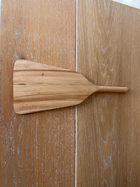
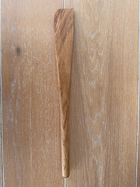
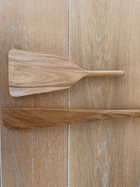
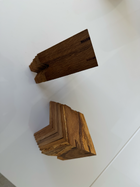
grill spatula. ...when I was trimming the handle, it snapped. So I had to make a second one. However, it went faster and turned out just as good.
You mentioned that you were teaching your friends' daughter how to use a skew chisel. Personally, I don’t really like that blade. A couple of years ago, I had a serious catch, and I don’t feel comfortable working with it anymore. It’s a bit of a fear. I made the spatula using a bowl gouge.
Tymur,
Thanks for the photos! I like the spatula - I saw the Raffan video but haven't made one myself. I have made many things that have "interrupted" cuts ("cutting air" on every rotation) and the most important thing I know as moving into the interrupted part imagine it as solid wood and move the tool firmly on the rest and into the interrupted part exactly as you would if the wood was solid.
Handle snapping sometimes comes from wood with defects or grain that is not straight with the rotational axis. Sometimes a catch.
I always start students with the skew chisel precisely because it ioftes n feared. It's frightening to get a catch with it and some people decide to never use it again! Once people learn it properly, EVERYTHING seems easier!
I've also given "remedial" skew lessons to some old, experienced turners. Absent from the club for several years while building my shop, on my first return an older may saw me and jumped up from the back and said "I want to shake your hand!" I forgot that I had given him my custom skew lesson a few years ago - he said now the skew was one of his favorite tools! Made me feel great.

I developed a way to teach the skew and spindle turning that so far has ALWAYS worked - I've introduced dozens of students to the skew this way and so far NOT ONE has gotten a catch. Knock on wood
(do you have that expression for good luck?)
If you are interested, I can provide details of my method of teaching the skew - the only thing needed is a skew, a rounded spindle blank, and a second person to assist at the beginning.
And if you haven't seen it, my document on turning thin spindles has a lot of info about turning spindles, skews, and other tools. It also covers holding methods (and those I like the best), and the most important thing, how to control vibration during the cut.
This document shows the tools and methods I use to hold, shape, and successfully finish a thin spindle. I wrote this update for a recent club demo.
As spindles get long and thin, there are challenges to turn them successfully. My demos use “magic” wands to show the techniques but they apply to many types of thin spindles. I always take some long examples, a couple of tapered shafts that go from about 1/2” diameter down to 1/16” diameter in more than 24” - one I turned from a piece of shelving pine board from Home Depot.
Some things covered here are about the wood itself and how to...
Some people use a steady rest to control vibration but I don't. Never have, I've never even had or used a steady rest!
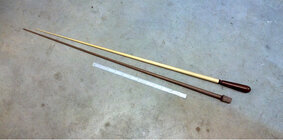
As an example of thin spindles that are almost impossible to turn without controlling vibration, I take these two to demos as examples. The are over 2' long, pine and walnut, and taper from about 1/2" down to about 1/16" in diameter. That is a 12" ruler in the photo. I turned a handle for one. The one from walnut has the holding method I like - a short #2 morse taper that fits snugly into the lathe headstock spindle. I had NO problems turning these with a skew with the methods I use.
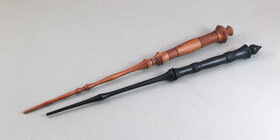
Other examples, "magic wands", conductor batons, and hair sticks (girls with long hair LOVE these!).
(Sorry if you've seen these here before.)
Cedar (with "distressed" texturing, and ebony (with carved stippled texture - one of my favorite texturing methods. (I posted a separate document on texturing.) I've made 100s of wands so far and often use them to teach thin spindle turning to students and at demonstrations and classes.
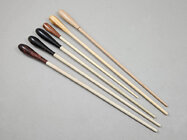
I started making conductors batons when a former kindergarten student asked me if I could make one she could give to her boyfriend for a graduation present, about to graduate as a band director. "Sure, no problem!" I didn't tell her I'd never made one before. She asked how much would it cost? I always tell people the same thing: "$60". But if the person comes to the shop, helps with the design and picking out the wood, and watch me make it, the cost is free! That gets people to come and experience the lathe, usually for the first time. Good fun!
I've since made more of these and some are in the hands of band, orchestra, and choir directors.
I made and took these hairsticks to a good friend in Italy. Seven or eight inches is a good length. A little texturing or "swelling" in the diameter helps to hold it in the hair. Many with long hair love them - and they use very little wood and are quick to make! Another friend wanted some a few blanks so she could make some so I took her a box with a few dozen blanks.
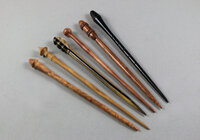
All of these things can be sold but I often give them away UNLESS someone really wants something I want to keep for a demoinstration/show piece.
One important thing about learning the skew and spindle turning. Various turning experts have said basically the same thing: "If you learn spindle turning it will teach you the fine took control needed to let you turn ANYTHING! The same is not always true for those to start with and stay with turning bowls. (I can provide references!)
John, I’ve noticed that in woodturning, there are many military people. It seems like military men have their own "caste" there.))) I think you are a happy man. You have your animals, and the way you talk about them shows me that you truly enjoy life. That is important for everyone.
There are many who used to be in the military, but also MANY who have never been! I haven't noticed any "caste" - those in or previously in the military are just normal people!
Some turners started when very young and have a lot of experience, some just recently and are beginners or intermediate. Our club usually has 30-40 people attending each month.
And yes, I am an extremely happy person - good family, good friends, great place to live, enough food to eat, access to good medical care! If you are interested I can send a few animal and farm pictures in another message.
Also, if you are interested and haven't seen it, attached is a video I made of using my bandsaw to cut up log sections into turning blanks. I cut these blanks, seal them, and let them dry before turning. It has a couple of pictures of outside and inside the shop. Good clean fun.
(I made the video for a club demo during the start of the Covid pandemic so it's kind of long. Includes all-important safety info. I made it in a hurry so there are lots of things I would change if I had time. Time is the most precious resource (and friends are the most precious part of life!)
View: https://youtu.be/4Rbdas-jtD0
And sorry I write so much! I get excited and can't stop.
Any questions at all, just ask. I, and many others here love to help!!
JKJ