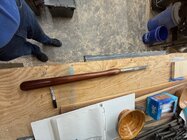
I'm looking at purchasing a Crown Tools 243PM 3/4 Inch PM Bowl Gouge. I have a Jet 1221 1-horsepower lathe. Will this gouge be too strong for turning green live-edge bowls?

Might depend on the sharpness, your skill, the speed/related torque, and how deep the cut is. Removing large amounts of wood at once with that gouge might be challenging.I'm looking at purchasing a Crown Tools 243PM 3/4 Inch PM Bowl Gouge. I have a Jet 1221 1-horsepower lathe. Will this gouge be too strong for turning green live-edge bowls?
Well, it will never be as affordable as it is today. Get it, and dream of those giant shavings yet to come. Fresh from the wheel, those Crown Pro PM tools can be wicked sharp, and very willing and able to strip the hide off any lump of wood.Thank you for the reply!!!!! Such a great organization to be a member of.
I've seen these used on larger/stronger lathes, and they worked wonderfully.
Wish I knew someone close by who turns to try (the nearest club, 90 mins one way), will have to go easy now on the 12-21, but I will have a use for it when I upgrade. (Cheaper now than later).
After reading many of the above opinions, I am reminded of a lighter I used to have that said "It isn't the size of the rod that matters, it's how you wiggle the worm") - technique and sharpness trump gouge size any day of the week. I can't imagine using a 3/4" gouge - I use a 5/8 sometimes but usually just for roughing , and I run a Jet 1642 lathe. Only reason you'd possibly want such a big gouge is when quickly roughing out a bowl to round - but if you're already round, you'll probably find a 3/4" gouge just entirely too big for finer and detailing work especially on a 12" or smaller bowl... I'd call it a waste of money, myself...I'm looking at purchasing a Crown Tools 243PM 3/4 Inch PM Bowl Gouge. I have a Jet 1221 1-horsepower lathe. Will this gouge be too strong for turning green live-edge bowls?
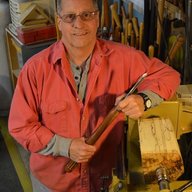
Wish I knew someone close by who turns to try (the nearest club, 90 mins one way),
Just completed one of those trips today -- 90 miles, 90 minutes each way -- to the Cincinnati meeting for a day of Helen Bailey demos. And I made the same trip last Saturday to teach a class in their learning center.Wish I knew someone close by who turns to try (the nearest club, 90 mins one way)



..... <---- Eyes bug out at the thought of a 3/4 inch flute....Clarification.... 3/4 bar stock with a 5/8 flute. (The descriptions on the websites don't always specify the actual flute size, which makes it confusing for newbs.)
I truly appreciate all the valuable input regarding the bowl gouge query.I'm looking at purchasing a Crown Tools 243PM 3/4 Inch PM Bowl Gouge. I have a Jet 1221 1-horsepower lathe. Will this gouge be too strong for turning green live-edge bowls?
Even as others have mentioned, it's often overkill for much larger lathes.
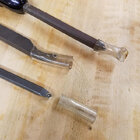
And you can take it from me that you won't find two finer gentlemen who are usually just a phone call away.
I had a 1-1/2 hp lathe for a while, and bogged it down just fine with a 1/2" bowl gouge....will have to go easy now on the 12-21, but I will have a use for it when I upgrade. (Cheaper now than later).
I was in the MN Woodturners Assoc. for a few years in the early 00's along with Mike when he was developing his carbide tools and learning how to implement them to the woodturning realm. If I recall, before he introduced his tools to us, he came from the carbide tooling industry for metal work. If there's anyone who has a deep understanding of carbide cutting tools, it's Mike Hunter.And as far as carbide I never got into that flat carbide scraper stuff and when I heard about Mike Hunter and learned about his history in carbide (as in the carbide I used at the Erie GE) I got interested.




Do you not like the bottom feeder grind?I just bought one. Mine is a 5/8” flute with 1” bar. It is a bottom feeder grind. I am going to regrind it to swept back.
I see many videos with a whole rack of turning tools. I'm not the brightest candle on the cake but I'm of the opinion that each one has a different diameter and different grind for specific uses.
I also have several Thompson 3/8" detail gouges a couple reasons. Like JKJ, it's handy to have several while you're in the middle of a session, as I was this afternoon (3+ hours of spindles for a single lattice). I also have these for student use in classes I teach (and several other types of tools as well). Students are welcome to use them, but not to sharpen them.Might be another reason for keeping several tools with identical grinds. For example, I keep six Thompson 3/8” spindle gouges with identical grinds. When one gets dull, I put it in the “to sharpen” pile and put a fresh one in the handle, and keep turning. When all are dull, I stop, set up the jig on the Tormek, and sharpen all six with a 1200 grit CBN wheel. This keeps from interrupting my train of thought at the lathe AND can save time since sitting up the jig can take more time than sharpening one. (And I’m real picky about my spindle gouges.) Of course, I keep the spare sharp gouges in a drawer, tool only/no handle, so they take up very little space.
I do the same for diamond parting tools, some skews, and some other tools, e.g., curved NRS.
JKJ
Students are welcome to use them, but not to sharpen them.
Yes that is one reason, I have 4 different grinds on 5/8” shaft bg’s, but then I also have multiples of the same grind on a few others so I can keep going with a project. For me 5/8” shaft bg cuts a whole lot more miles of wood than any other tool (all sizes and types of project).I see many videos with a whole rack of turning tools. I'm not the brightest candle on the cake but I'm of the opinion that each one has a different diameter and different grind for specific uses.