• The forum upgrades have been completed. These were moderate security fixes from our software vendor and it looks like everything is working well. If you see any problems please post in the Forum Technical Support forum or email us at forum_moderator (at) aawforum.org. Thank you
  • February 2026 Turning Challenge: Cookie Jar! (click here for details)
  • Congratulations to Matt Carvalho for "Red Mallee Folded Form" being selected as Turning of the Week for February 9, 2026 (click here for details)
  • AAW Symposium demonstrators announced - If the 2026 AAW International Woodturning Symposium is not on your calendar, now is the time to register. And there are discounts available if you sign up early, by Feb. 28. Early Bird pricing gives you the best rate for our 40th Anniversary Symposium in Raleigh, North Carolina, June 4–7, 2026. (There are discounts for AAW chapter members too) For more information vist the discussion thread here or the AAW registration page
  • Welcome new registering member. Your username must be your real First and Last name (for example: John Doe). "Screen names" and "handles" are not allowed and your registration will be deleted if you don't use your real name. Also, do not use all caps nor all lower case.

Using 3/4 bowl gouge - 5/8 flute - on a 1HP lathe?

Might be another reason for keeping several tools with identical grinds. For example, I keep six Thompson 3/8” spindle gouges with identical grinds. When one gets dull, I put it in the “to sharpen” pile and put a fresh one in the handle, and keep turning. When all are dull, I stop, set up the jig on the Tormek, and sharpen all six with a 1200 grit CBN wheel. This keeps from interrupting my train of thought at the lathe AND can save time since sitting up the jig can take more time than sharpening one. (And I’m real picky about my spindle gouges.) Of course, I keep the spare sharp gouges in a drawer, tool only/no handle, so they take up very little space.

I do the same for diamond parting tools, some skews, and some other tools, e.g., curved NRS.

JKJ
JKJ
This may be off topic,
I know it was in another thread somewhere, do you polish your tools after running them on the tormek? It would be interesting to know what angles you use for what, being new to this stuff im mostly just fooling with bowl turning, trying to get a grip on grinds and angles and technique for using the tools. Am guessing that spindle turning and detailed finials and such as ive seen in some of your work require much finer grinds than bowl gouges etc, as with anything i suppose theres also way more than one way to skin that cat
 
JKJ
This may be off topic,
I know it was in another thread somewhere, do you polish your tools after running them on the tormek? It would be interesting to know what angles you use for what, being new to this stuff im mostly just fooling with bowl turning, trying to get a grip on grinds and angles and technique for using the tools. Am guessing that spindle turning and detailed finials and such as ive seen in some of your work require much finer grinds than bowl gouges etc, as with anything i suppose theres also way more than one way to skin that cat

I always removed the grinder burr. Some leave and use but the grinder burr will be gone in an instant leaving a rough edge. (I keep a stereo microscope in the shop to look at edges, wood pores, and more)

I removed the grinder burr just after sharpening then use honing compound on the Tormek leather wheels, flat or profiled as appropriate, and gently polish the edge. Some people say the tool off the grinder works better for them but I think much depends on what and how you turn. I rarely turn green wood, seldom turn bowls, turn a lot detailed things. (No offense to the many bowl turners but I find bowls too easy and not much challenge, especially bowls turned from green wood.)

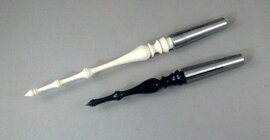
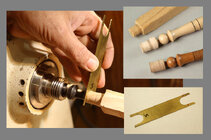
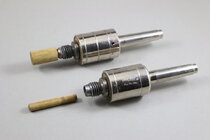
For detailed things I want a smooth polished edge for the finest cut right off the tool with minimal sanding. For example, I kept these and take to spindle demos.The finial from Holly is from polished spindle gouge and skew edges, right off the tools and with ZERO sanding. The other one, from Ebony, has only very light sanding with fine paper, prob 600 or 800, can't remember. (I held these tight in the headstock for turning with #2MT collets and a drawbar but that's just one way.)

1771274897600.jpeg

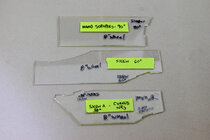
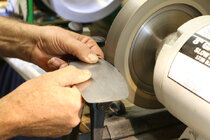
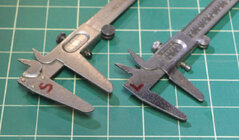
Depending on the use, I grind various angles on spindle gouges, detail gouges, skews, conventional scrapers, NRS, roughing gouges, and more. I'd have check. For various angles, I make small templates from plexiglas so I can set the wolverine platform repeatably in an instant. These are some. I make others as needed.

1771275098932.jpeg

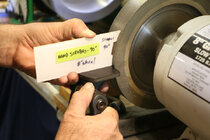
One in use at the grinder preparing to sharpen hand scrapers. (I started painting the back sides of the plastic white for visibility.)
BTW, I've switched to the Mini Wolverine platform for almost all tools. I sharpen all tools by hand except for spindle and bowl gouges.

1771275552807.jpeg 1771275573392.jpeg

Yes, there are lots of ways, almost as many ways to sharpen and turn as there are woodturners! And although everyone has opinions, none of the ways are wrong. (Except for grinds that don't provide sharp edges! A couple have come to my shop with turning problems and one look at their tools explained why!!)

As for turning bowls, platters, and other face turnings, I personally found that almost any tool grind would work (if sharp). Some are a little easier in places than others, for example in transition areas and undercuts inside and below the rim

Another option is to become acquainted with the Hunter Carbide tools - never need sharpening. Except in cases where they won't provide the fine datail, I find myself reaching more for a couple - my favorite is the small Hunter Hercules. Can be used as a spindle gouge, a bowl gouge, on platters, bottom transitions, as scrapers, and far more. The cutters are NOT the typical flat-topped carbide- they cut wonderfully and leave no tearout. I like them so much I've bought several for good friends. I have developed one design I call my Small Squarish Dished Platter that I probably do 90% of with the Hercules. That, a bit of negative rake scraping, and some hand scraping and I can often go directly to 600 grit sandpaper. (Sorry, no room in this message for more photos but I've put them in other messages.)

There's one bit of advice repeated over and over by REAL experts, aimed especially at those learning to turn or wanting to up their game: Even if the life goal is to turn bowls, bowls, and bigger bowls, learn spindle turning first. It will teach you the fine tool control that will let you turn ANYTHING you want. It doesn't always work in the other direction. I can provide references from books and from some pros and expert turners.

OK, back on topic: I have a at least two 3/4" bowl gouges I bought when I thought that was what I was supposed to do. Don't think I've used one for years. When I did they worked as well on a Jet mini as the PM3524b. Might take finesse instead of force. The Hunter Hercules will do a better job for me. AND, with dry wood, the bowl gouges funnel hot shavings right up the flute onto my hand. Ouch. The Hunter geometry throws the chips off to the side. I like that better.

JKJ

 
I always removed the grinder burr. Some leave and use but the grinder burr will be gone in an instant leaving a rough edge. (I keep a stereo microscope in the shop to look at edges, wood pores, and more)

I removed the grinder burr just after sharpening then use honing compound on the Tormek leather wheels, flat or profiled as appropriate, and gently polish the edge. Some people say the tool off the grinder works better for them but I think much depends on what and how you turn. I rarely turn green wood, seldom turn bowls, turn a lot detailed things. (No offense to the many bowl turners but I find bowls too easy and not much challenge, especially bowls turned from green wood.)

For detailed things I want a smooth polished edge for the finest cut right off the tool with minimal sanding. For example, I kept these and take to spindle demos.The finial from Holly is from polished spindle gouge and skew edges, right off the tools and with ZERO sanding. The other one, from Ebony, has only very light sanding with fine paper, prob 600 or 800, can't remember. (I held these tight in the headstock for turning with #2MT collets and a drawbar but that's just one way.)

View attachment 85284

Depending on the use, I grind various angles on spindle gouges, detail gouges, skews, conventional scrapers, NRS, roughing gouges, and more. I'd have check. For various angles, I make small templates from plexiglas so I can set the wolverine platform repeatably in an instant. These are some. I make others as needed.

View attachment 85285

One in use at the grinder preparing to sharpen hand scrapers. (I started painting the back sides of the plastic white for visibility.)
BTW, I've switched to the Mini Wolverine platform for almost all tools. I sharpen all tools by hand except for spindle and bowl gouges.

View attachment 85286 View attachment 85287

Yes, there are lots of ways, almost as many ways to sharpen and turn as there are woodturners! And although everyone has opinions, none of the ways are wrong. (Except for grinds that don't provide sharp edges! A couple have come to my shop with turning problems and one look at their tools explained why!!)

As for turning bowls, platters, and other face turnings, I personally found that almost any tool grind would work (if sharp). Some are a little easier in places than others, for example in transition areas and undercuts inside and below the rim

Another option is to become acquainted with the Hunter Carbide tools - never need sharpening. Except in cases where they won't provide the fine datail, I find myself reaching more for a couple - my favorite is the small Hunter Hercules. Can be used as a spindle gouge, a bowl gouge, on platters, bottom transitions, as scrapers, and far more. The cutters are NOT the typical flat-topped carbide- they cut wonderfully and leave no tearout. I like them so much I've bought several for good friends. I have developed one design I call my Small Squarish Dished Platter that I probably do 90% of with the Hercules. That, a bit of negative rake scraping, and some hand scraping and I can often go directly to 600 grit sandpaper. (Sorry, no room in this message for more photos but I've put them in other messages.)

There's one bit of advice repeated over and over by REAL experts, aimed especially at those learning to turn or wanting to up their game: Even if the life goal is to turn bowls, bowls, and bigger bowls, learn spindle turning first. It will teach you the fine tool control that will let you turn ANYTHING you want. It doesn't always work in the other direction. I can provide references from books and from some pros and expert turners.

OK, back on topic: I have a at least two 3/4" bowl gouges I bought when I thought that was what I was supposed to do. Don't think I've used one for years. When I did they worked as well on a Jet mini as the PM3524b. Might take finesse instead of force. The Hunter Hercules will do a better job for me. AND, with dry wood, the bowl gouges funnel hot shavings right up the flute onto my hand. Ouch. The Hunter geometry throws the chips off to the side. I like that better.

JKJ
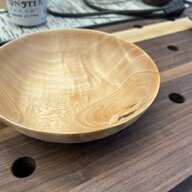
Great info bud, it's nice to be able to get input like this on technical stuff relating to turning, books, articles etc etc, too many out there, but i truly appreciate the input from guys like you who are doing this stuff and have been doing it.

I do like my Robust shanks, am getting the grinds dialed in, almost to a point where i will be able to concentrate on my turning and milling exclusively for a bit so getting lined up is helpful.

Those Hunter tools are kinda nice, will most likely give some of them a try, different tools for different tasks eh,

I did pick up a couple sets of simple wood turning tools a while back, full size and mid size sets, they are pretty simple and do work quite well, can lap the cutters too to tune them up a bit. Great for spindle turning.

Anywho, thank you for the input.
 
Back
Top