• December 2025 Turning Challenge: Single Tree! (click here for details)
  • Congratulations to Bob Henrickson, People's Choice in the November 2025 Turning Challenge (click here for details)
  • Congratulations to Guillaume Fontaine for "Old Tea Pot" being selected as Turning of the Week for December 15, 2025 (click here for details)
  • Welcome new registering member. Your username must be your real First and Last name (for example: John Doe). "Screen names" and "handles" are not allowed and your registration will be deleted if you don't use your real name. Also, do not use all caps nor all lower case.

Using paper with glue blocks

Using paper in a glue joint is a way to split the joint after you get a shape you want. Last time I did this, it was for quarter round pillars in a corner. Do not use a lot of glue. Just enough to hold the joint together.
 
I stumbled across this video about using paper between the glue block and the work piece.
The comments seem favorable about the method.
Does anyone here have any real world experience doing this?

Craig
Yes. I have used it in both ways that Conover demonstrated (and others). It works well and is convenient. I generally let the glue cure longer than the 2 hours he mentioned. David Springett,, who did many types of complex turnings, used this technique, although he used newspaper. I prefer brown paper (grocery bags).
 
I've been doing it occasionally for years. I gave up getting brown paper bags at the store and bought a roll of heavy brown paper at Lowes.

Another method I sometimes use. On the glue block I cut a 1/8" groove about 3/8" from the outside edge. This acts like a dam to stop the glue from spreading after it is applied only to the outside edge. I end up with a glued 3/8" ring holding the work to the glue block. This makes it very easy to part off and finish. Sometimes easier to do than the paper.
 
"Yep.. and if you happen to go down the "inside out turning" rabbit hole, you'll find them an absolute necessity..."

Don't tell me about any new "Rabbit Holes" yet.
I've found enough all ready with my new found wood turning hobby.

Although I did try reverse turning when I hollowed out that vase I made
 
Yes. I have used it in both ways that Conover demonstrated (and others). It works well and is convenient. I generally let the glue cure longer than the 2 hours he mentioned. David Springett,, who did many types of complex turnings, used this technique, although he used newspaper. I prefer brown paper (grocery bags).
I have made several of the shapes David Springett describes in his book Woodturning Full Circle. It works exactly as described. Obviously not the solution for all problems, but essential for the "turn it, split it apart, glue it back together in a different configuration" use case.
 
Great for inside out turnings and making split decorations for furniture. A good way to end up with a flying object in the shop if you try to use it for holding a bowl blank to a glue block as used to be recommended years ago. You don't want the joint between your blank and the block to be a weak point! Yes, I know this from personal experience.
 
Great for inside out turnings and making split decorations for furniture. A good way to end up with a flying object in the shop if you try to use it for holding a bowl blank to a glue block as used to be recommended years ago. You don't want the joint between your blank and the block to be a weak point! Yes, I know this from personal experience.
Never used it for bowls for that reason. In addition to split turnings, I've used it for lost wood turning.
 
The comments seem favorable about the method.
Does anyone here have any real world experience doing this?

For smaller bowls less than 10” diameter I have used thick CA glue with glue blocks quite a bit.
Faster than the paper when done a flat chisel fractures the glue. CA is one of the few glues that is not stronger than wood.
One advantage is that CA will bond to wet wood.

Note: the CA or paper glue joints with bowls will not hold up from the force of a catch. I’ve done the CA glue blocks a few times with students with pretty good success. As chucks became more ubiquitous I dropped this technique. And a few students worked too slowly and the CA would fail when the wet wood moved.

I’ve use paper joints with spindles quite a bit on various spindles. Great for gettin decorative 1/2 rounds or quarter rounds

A good technique for anyone turners repertoire
 
For smaller bowls less than 10” diameter I have used thick CA glue with glue blocks quite a bit.
Faster than the paper when done a flat chisel fractures the glue. CA is one of the few glues that is not stronger than wood.
One advantage is that CA will bond to wet wood.

Note: the CA or paper glue joints with bowls will not hold up from the force of a catch. I’ve done the CA glue blocks a few times with students with pretty good success. As chucks became more ubiquitous I dropped this technique. And a few students worked too slowly and the CA would fail when the wet wood moved.

I’ve use paper joints with spindles quite a bit on various spindles. Great for gettin decorative 1/2 rounds or quarter rounds

A good technique for anyone turners repertoire
What about Titebond instead of CA?
 
I appreciate all the feedback.

I did make a half dozen red oak glue blocks of various sizes a while back.
I glued them directly to whatever I was turning with Titebond 1 using the tailstock as a clamp, and had no unscheduled dis assemblies doing so.
Getting them off was another story, hence my curiosity about using paper.
Using a parting tool left some of the block resulting in prolonged sanding.
Using a sharp chisel with the flat against the work resulted in tear out on the piece.
I've never tried hot melt glue or CA glue to secure the blocks to the work.
I only ever had one sudden departure of work from my old lathe, but that was enough.
Thankfully it didn't hit the Harley or my reloading equipment.
It hit me, square in the chest.
It didn't hurt - much - :-)
 
I've never tried hot melt glue or CA glue to secure the blocks to the work.
I've used hot melt glue doing some large turnings (16" diameter, up to 4" thick) -- not attaching bowls to a waste block but gluing various pieces into a disk. It worked well, although a bit of clean up afterward. I don't use CA for anything, partially due to the fumes.
 
@Odie uses glue blocks. Wonder what he does.

l have used paper between the glue block joint in the past, but have settled on gluing the glue block directly to the bowl block.

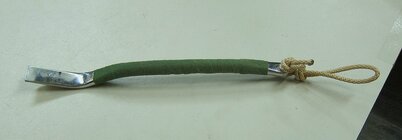
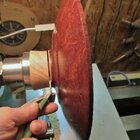
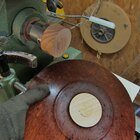
For removing the glue block, I use a parting tool to bring the union down to silver dollar size.....and then use a drum brake adjusting tool to break it loose.

=o=
IMG_1214.JPGIMG_1217.JPGIMG_1219.JPGIMG_1220.JPG
 
A friend learned to turn before chucks were common and everyone used face plates. To keep the screw holes out of his blank, he didn't use glue and paper but instead used double-sided tape to hold the blank to the faceplate. This holds incredibly well. Still uses this today, even for large bowls from solid blanks. Use one layer of tape on the face plate, one on the flattened bottom of the blank, burnished to hold tightly, remove baking and stick the layers together (tape running perpendicular). It can be a challenge to get apart - use thin wooden wedges and patience. I've used the tape method, not on the wood lathe but on the milling machine to hold certain pieces for machining. Again, used wedges to SLOWLY separate.

I've never seen anyone put paper between bowl blank and waste block. As mentioned above, seen it used a lot for inside out turnings. Sir John Lucas is a master at that. If anyone hasn't seen the technique maybe try to bribe him to come for a demo.

Also the paper method is not the only method but is a one way to make an "emerging bowl" or two. Glue the faces of two pieces together with paper between to make a square blank, turn the outside of a partial sphere, split the halves apart, remount (there are ways), then turn the inside of the sphere on at least one half. This is the only one I've made.

To end up with a thin, even wall thickness, the outside sphere needs to be, well, spherical.
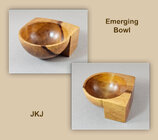
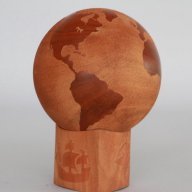
1766231039159.jpeg

JKJ
 
When I’m working with timber that I want to use all of (usually burl or exotics), I’ll use a glue block. I always turn the block away when I’m completing the bottom, though, so haven’t had the need for the paper method.

Regarding types of glue, I only use wood glue these days. Most of my pieces have a very narrow bottom. As I turn the block away, the area of the glued section likewise gets reduced and I’ve found that, with that little surface area, CA and epoxy lack the shearing strength to reliably stay in place when I apply my finish on the lathe. After the having a few pieces come free, I decided to only use wood glue (Titebond II or III) and haven’t had a block come undone since.

Here’s a pic where I used some scrap maple as a block for a small masur birch hollow form. Not much surface area being shared, so wood glue is the only adhesive I trust in these situations.
IMG_2709.jpeg
 
I've used paper joints like he's demonstrating in the video and I think it's a great way to turn platters. I wish he would have shown a little of the actual turning of the platter to demonstrate that he (hopefully) leaves the tailstock in place until the very end and removes it just to finish of the nub it leaves. Without the tailstock a catch can have the same result as tapping the joint with the chisel.
 
Back
Top