Hi
I am trying to make a few French rolling pins on my PM 3520 lathe. The maple blanks are 20” long, and once I get them round, I keep having issues where vibration patterns keep appearing in the work piece. I can feel them as they are being made and this is while I am trying to get the piece down to diameter. The piece is approximately 2” in diameter (but shrinking!). The picture below show the issue.
All my tools are quite sharp and I have tried regrinding them multiple times. I get this issue whether using my spindle roughing gouge, either of my skews, or a spindle gouge. I have tried to tighten the blank between centers as I have a drive spur on the headstock and a bearing type spindle on the tailstock. I have made sure that the headstock is solidly tightened, and the tailstock as well. I’ve tried tightening the piece between centers and also loosening it a bit, thinking it was too tight. I’ve tried making lighter cuts, going slower, etc, but not found a working solution just yet.
I would really appreciate suggestions on what I may be doing wrong and what I could try.
Thanks you all
‘Mark
@Mark Ahlenius,
What you describe is typical with relatively thin spindles until you learn how to control the cut. I've made a bunch of french-style rolling pins (straight in the middle and tapered on the ends) with out problems.

As others mentioned, steadying the work while turning is often important, especially with thinner spindles. The 2" diameter shouldn't need much of that.
I usually do turn these between centers since they aren't excessively thin. BUT... one thing that might really help with vibration is don't turn between centers except to round one end and maybe cut a tenon. Then hold that end firmly in a chuck. That keeps at least the first part of the blank from flexing so much that the spirals you showed get started.
I rough the blank to round with either a large skew or a SRG. Once the spiral waves get started, they can be hard to get rid of since the bevel of the tool rides up and down the crests and troughs of the waves and can make them worse.
One thing that can remove the spiral waves is cutting a pass with the short point, the heel of the skew, something not usually done since it may not leave the smoothest surface. Start near the left/chuck end where they should be smoother, and guide the skew so just the short point cuts into the crests. This will roll up torn fibers at the point but can leave a flat cylinder behind. Cranking the speed up some helps. (I turn much thinner spindles with the lathe wide open but slower for thick spindles like your rolling pin.
Once the cylinder is flat, try going over it again with the skew. Move the skew very slowly. Note that if the angle of the cutting edge is too steep (closer to vertical than horizontal), the skew is cutting a narrower shaving and a less even cut is more likely, especially if less experienced with the skew. If the angle is "flatter", more towards horizontal than vertical, the edge is cutting a wider shaving and can smooth out irregularities down the cylinder. However, this may be a bit harder to control. Tradeoffs.
I do prefer the skew over the spindle roughing gouge for these cuts. If using a SRG one that is larger diameter, or especially a shallower continental shape (I understand historically shaped by forging) may be easier for a smooth surface.
If using a skew, it may help to use a larger edge grind - one ground at 30-degs on each bevel (60-deg included angle) is easier to control than one with 30-deg bevels. When I start beginners on the skew I give them one with a 60-deg included angle and a slightly curved edge.
Another thing that may help is to use a parting tool and calipers to make sizing cuts all the way down the cylinder, the more the better. I set the calipers to just a bit over the desired final size. This is especially helpful for a a rolling pin since the pie baker really wants a straight cylinder rather than one with slight curves. On the last rolling pie I made (a couple of weeks ago), I made sizing cuts all the way down about 2" apart. Cut down close the the sizing cuts with either the SRG or the skew.
Regardless, with a spindle that long and longer the "left hand steady rest" has always worked for me. This is a common technique. I think it was Raffan who wrote that the steadying hand must exactly counter the force of the tool, and if the hand gets too hot there is too much pressure from the tool. Try for the lightest possible pressure. A sharp-sharp-shaving-sharp edge helps. (I like to test the edge by shaving a bit of hair from my left arm. It grows back.)
I posted this recently in the a thread on handles - I don't remember the length but the PM3520b had an 18" extension and I still had to position the headstock and tailstock so they were hanging off the ends and just barely clamped. Since it was so long, and much thinner than a rolling pin, turning it was a challenge but the "left hand steady rest" did the trick.

All that said, a fairly coarse grit sanding sticks/blocks can help refine the shape of the final surface. I don't use them on the thin spindle mentioned below, but I have used them as the final step on rolling pins to insure a perfectly flat surface. (Then smooth with finer paper not glued to the wood.)
I make these by gluing cloth-backed (Klingspor Gold) sandpaper to flat plywood with spray-on contact cement. (But any glue should work.) I use these mostly off the lathe to round ends of things but held against the
slowly spinning wood and moving them back and forth on the cylinder can help. Some well used blocks, 2" wide - I glue another grit on the other side of each.
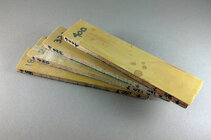
Most of my thin spindles are very thin, down to 1/4 or less in places and I use the same technique on all of them - support one end firmly, use high speed, use a sharp skew, and control flexing with the left hand. Notice I always use my thumb to further support the skew. (The is no danger of getting cut. Maybe don't have a huge catch.)
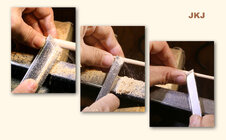
I posted a document on the sub-forum "Tutorials and tips". It describes how to turn a thinner spindle, a "magic" wand as an example but the same techniques apply. Maybe it will be useful.
This document shows the tools and methods I use to hold, shape, and successfully finish a thin spindle. I wrote this update for a recent club demo.
As spindles get long and thin, there are challenges to turn them successfully. My demos use “magic” wands to show the techniques but they apply to many types of thin spindles. I always take some long examples, a couple of tapered shafts that go from about 1/2” diameter down to 1/16” diameter in more than 24” - one I turned from a piece of shelving pine board from Home Depot.
Some things covered here are about the wood itself and how to...
JKJ