• The forum upgrades have been completed. These were moderate security fixes from our software vendor and it looks like everything is working well. If you see any problems please post in the Forum Technical Support forum or email us at forum_moderator (at) aawforum.org. Thank you
  • It's time to cast your vote in the March 2026 Turning Challenge. (click here for details)
  • Congratulations to Chris Lawrence for "Dragon's Grip" being selected as Turning of the Week for March 30, 2026 (click here for details)
  • Welcome new registering member. Your username must be your real First and Last name (for example: John Doe). "Screen names" and "handles" are not allowed and your registration will be deleted if you don't use your real name. Also, do not use all caps nor all lower case.

What is the best RPM for sanding a bowl?

You should note that it is more than RPM since the surface speed is greatest at the largest diameter and will decrease as you work closer to the center.


OK, that's a fair statement, Don.....

I avoid turning bowls less than 6" diameter, and I seldom have the opportunity to turn bowls over 12", or so. Outside of that perimeter, I would adjust the RPM to suit.

Generally speaking.......about 250 rpm is best for me.

=o=
 
For my warped bowls, I do power sand, and since they are warped, I sand at about 10 to 15 rpm. Can't keep the abrasives on the wood at higher speeds. This speed is slow enough that I can see my wood as it turns rather than being blurry. I do find it interesting that Tomislav sands at about the same speed he turns, and so does Richard Raffen. For a long time, it has been considered slow speeds were better. I think this was more because the abrasives, is spun too fast, would not be able to really dig in and cut. I do keep my finger about half way down on the trigger of my angle drill. This does have the added benefit of the bearings lasting several times longer than if I am running at full speed. Most lathes won't go down to less than 50 rpm. My Vicmark 240 does, and I had my Beauty reprogrammed so it would go down that low. My Beauty is so old, it has 3 speed pulley ranges. I use it mostly for sanding now days since I can keep the hood on all the time, and the hood can't be left on if I am turning.

robo hippy
 
Depends. Power sanding, course through fine grit, I'll start slow usually under 50. As grit gets finer, speed goes up, usually finishing around 2-250 rpm.

Hand sanding, course usually the same slow speed, the finer the grit, the faster I go up to around 300. On both, always by hand with the white 3m pads, I'll run up to 1-1,200 rpm if I'm going for a final touch/polish.
 
RPM of the lathe or the sander?

I almost never use power sanding on the exterior of my bowls, so the "sander" would be me....and that would be zero rpm! :)

I do use power sanding on the interiors of my bowls, and 250rpm works there the best, too.....also at about 250rpm.

=o=
 
RPM of the lathe or the sander?
Much depends on 'how' you sand. I use both power and inertia, along with hand. So I use zero, slow speed as Odie mentioned and the actual speed here varies due the hardwood I use. Too much speed here develops heat and with some hardwoods a glazing effect. Then we have inertia which predominates in the final stages, as in my humble opinion produces the finest surface.
 
It all depends on what I'm sanding. A once turned bowl that is dry and warped lathe speed is about 50. I use a Milwaukee 12 volt drill and a small random orbit sander. I run the drill or random orbit about 1/2 speed. I use the drill for 150 and 180 and random orbit on grits above that. If a twice turned bowl that's round lathe speed is about 150 for either sander. If I'm hand sanding lathe speed is about 250. That's what works for me and I lighten up or slow the lathe down if I start feeling heat through the paper. I've never tried an inertia sander.
 
When sanding harder more solid woods like rosewoods, the speed can make a huge difference. The factor that can ruin the project is heat.
When I first started out, I learned this from experience. The completed project would develop microcracks all around the surface.
If a rosewood or other wood is sanded at high-speed, heat can be a problem compounded by the oils in the wood that tend to clog sandpaper.
Applying too much pressure while sanding can prevent the sanding dust from moving away from the project and clog the paper.
Of course the heat becomes trapped there and then the friction of the material there makes it even worse.
I like to explain sanding as trying to glide over the surface. Not being heavy handed to get it over with as soon as you can...
You do totally love the sanding portion of your projects... don't you? ;)

There are a couple things to prevent this.
- slowing the lathe speed
- reducing pressure on the sanding material so it can work correctly
- removing the sandpaper from the project often and knocking the dust off the grit
- using your sandpaper sheet in a single layer between your fingers and project. If it's hot, you're stressing the wood surface
- move the sandpaper around and don't concentrate on one spot for a long time

The woods I usually deal with are all kiln dry or at equilibrium to the environment. Sanding on a wet wood can develop
heat on the surface where it dries the wood too fast compared to the rest can cause stress fractures. That's a whole big
can of worms too.

 
Last edited:
I power sand warped wood with the lathe at 50rpm and round wood a bit faster but usually still less than 120 rpm. The random orbit sander has a speed setting from 1 -5. Not sure what the rpm is but I run it around 3 most of the time. Have been concentrating a lot lately on having a light touch while sanding and that seems to make things work out better.
 
I use a lot of card scrapers, various thickness and several custom shapes, to reduce/eliminate sanding < 180 gr, many times sanding with 320 to start.

In general, the slowest speed that accomplishes the sanding needed, by hand or drill. Heat is the enemy of the wood and the paper. I use a (cheap HF) router speed control with the drill so rpm is held constant with trigger pulled all the way. Just guessing, 50-100 rpm (I need to measure with a tach). Do 98% of my sanding with the piece mounted on the lathe, whether turned on or rotated by hand.

I do a lot of 1 turn, which warp of course, and power and/or hand sand, depends how out of round. Much of this sanding is with the lathe off and rotated slowly by hand.
 
For me, it really depends on the wood, the size/diameter, and what grit. As you get to finer grits, the speeds need to be reduced because more heat builds up than with coarser grits. A slower speed also keeps the dust closer to my dust collector inlet. Higher speeds whips it around the piece and some escapes the suction.
 
Well, Dale Larson was our demonstrator at our last meeting. He is a fan of oiling the wood and then sanding. He did use a card scraper on the bowl first, again oiled. He then started sanding at 80 grit, or 100, I can't remember. He did use a shear scrape on the outside, and I think a NRS on the inside. He was turning madrone, which is cheating since it cuts so nicely with just about any tool you use. I never use a card scraper. I use a spear point shear scraper on the outside of the bowls, and a round nose for the inside. I do use a NRS across the bottom of the bowl since the fibers are fairly straight so there is little tear out. I do not use the NRS on the walls, other than for madrone which cuts like butter. With bay laurel, I start at 100 grit. With madrone, I start at 120. When I first started, I looked at the inertial sanders and said nope. Mostly because they work on many bowls, but if you have a spot with tear out, then you have to change tools to work on the tear out spots. An extra production step. I did try the rechargable battery drills once, and it wouldn't make it through one bowl without needing to be recharged. The corded tool proved to be more efficient. The random orbit sanders worked fine with the finer grits, but not for the coarser grits, they just were not as fast.

I have seen some claim to have "no tear out". When you are cutting side grain bowls, there is always tear out since you are cutting through unsupported grain fibers. With really clean cuts, you can greatly reduce tear out, but it is always there. You may not be able to see it clearly, but your fingers can always feel it.

robo hippy
 
I use a spear point shear scraper on the outside of the bowls

robo hippy
I’ve watched several videos where the spear point is used for shear scraping and have thought about trying one.
Do you feel it does a better job than sheer scraping with a bowl gouge and easier to use? From what I’ve seen it appears to do a great job but never tried one and I turn a lot of bowls.
What brand do you use or recommend?
Thanks!
 
I’ve watched several videos where the spear point is used for shear scraping and have thought about trying one.
Do you feel it does a better job than sheer scraping with a bowl gouge and easier to use? From what I’ve seen it appears to do a great job but never tried one and I turn a lot of bowls.
What brand do you use or recommend?
Thanks!
I use one a lot. Easier to use vs BG? It is around the bottom of a bowl, where the BG cant be held at a hi enough angle, for the rest of the bowl its maybe a tie, but…I use a lot of pull shearing cuts with the BG, so the wing may be dull and I grab the scraper.

I grind my own from the cheapest scraper shape for whatever scraper mfr you like. I use Benjamin’s Best from PSI, they are cheap M2 steel that hold an edge, the price allows one to have many of them of various sizes and shapes.
 
If vendors of sanding products are reading this thread, I wonder why they don't join this discussion.

Why would they have any insight into sanding that you wouldn't?

=o=
 
I almost never use power sanding on the exterior of my bowls, so the "sander" would be me....and that would be zero rpm! :)

I do use power sanding on the interiors of my bowls, and 250rpm works there the best, too.....also at about 250rpm.

=o=
Lately most days i feel like im operating at zero RPM
 
Hi Odie. I just assumed (you know how that works out) that those who sell products also are knowledgeable in how to best use their products. Naivete has popped up again.

Howdy back Larry.....:)

I think that's true to some degree.....however, it is my feeling that the great majority of these people want to convince you of the usefullness of their products, and you are most likely to get a biased opinion. I'd tend to trust what your thoughts are..... over theirs!

Too many people these days acting the part, but not walking the walk....if you know what I mean! :)

=o=
 
Last edited:
Too many people these days acting the part, but not walking the walk....if you know what I mean! :)

=o=
Hi again, Odie. When I made my latest assumption, I was specifically thinking of Brent English's occasional input. I ALWAYS find his input to be valuable. Also, whenever I have an issue with Trent Bosch's hollowing tools, his help is a phone call away.
 
Well, here is a video I did a while back on shear scraping.

View: https://www.youtube.com/watch?v=xeOhPqOsORs


I do prefer the spear point for the outside of a bowl, and like mine more pointed than some. Mostly that is about being able to drop the handle for a higher cutting angle. There are long diagonal cut shear scrapers where you need a right and left handed one, but I just use the spear point so I can do both with one tool, and I never have to worry about going over the center point so there is no risk of catches like with the skew chisel. I did use a burnisher, but now days, I can turn the burr down and then back up once, after that, it never seems to cut as well as fresh off the grinder. On the inside I use a half round or ) shape nose, and 70 degrees on my robo rest, which is actually 65. Since I don't use a swept back gouge any more, I don't have one to try it with. I switched, mostly due to "specialized" tools do seem to out perform the all purpose tools.

robo hippy
 
As a vendor of sanding products, Robo is correct, but it is my 25 years of woodturning that helps.
Sand slow, but you don't have to sand at 250rpms, lets just say, under 1000 RPM. If power sanding, lets go with about the same. The main reasons are heat check on the wood and melting the fingers of the velcro. Heat is the enemy. But if you are hand sanding I would go with Robo's guidance or at least the 500ish RPM of most lathes so that you don't hurt your hands.

As far as vendors, I may be the most frequent vendor visitor here, but I have history here also...
 
My personal policy is to turn fast and sand slow.

I tried power sanding long ago, starting with coarse grits, and hated the clouds of dust and what it did to the wood at times. I do have a close quarters drill but use it for drilling. I prefer to sand by hand.

If I sand with hand-held paper against spinning wood I always follow it with hand sanding with the lathe off, across the scratches just made. If those scratches can't be taken out with that paper, they sure won't come out easily with the next finer grit.

This is easier with small things and spindles.

But for larger things most of the time I don't sand at all at this stage, especially on face grain work - bowls and platters- and with vessels and some boxes. Instead, I cut with as much control as I can manage, remove tool marks with NRS, remove NRS marks with hand scrapers, then hand sand with fine grits. I can usually start with 400 or 600 grit, perhaps a bit coarser in areas where NRS and hand scrapers won't easily fit.

I do sometimes finish up with a pneumatic ROS such as the Grex but only with 600 or finer paper. I keep a shallow dished piece divided into quadrants to let people see and feel the differences made in each step.

To me, these methods work wonders with the wood and finish and give me a result I like.

JKJ
 
heat check on the wood
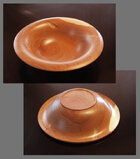
It was heat check that caused me to develop hand scraping methods. I was making this bowh from cedar years ago, one of my earliest bowls.

1775004347039.jpeg

The sanding advice I got from an instructor was to back up sandpaper with a piece of scotchbrite or something to keep from burning the fingers while spinning and sanding. What this actually did was make terrible heat checks around the inside walls. Nothing I tried helped.

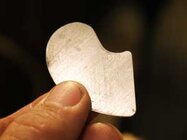
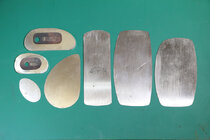
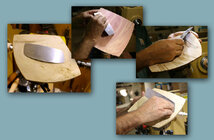
Then I noticed a curved hand scraper, cut the tip off with a Dremel tool, sharpened it like a cabinet scraper, and quickly removed all the heat checks. I was a convert and have been making, using, and evangelizing about curved hand scrapers since! Used off the lathe, with rare exceptions.

1775004639634.jpeg 1775004666789.jpeg
1775004848498.jpeg

JKJ
 
Back
Top