• Congratulations to Bernie Hyrtzak, People's Choice in the January 2026 Turning Challenge (click here for details)
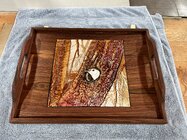
  • Congratulations to David Croxton for "Geri's Basket Illusion" being selected as Turning of the Week for February 2, 2026 (click here for details)
  • AAW Symposium demonstrators announced - If the 2026 AAW International Woodturning Symposium is not on your calendar, now is the time to register. And there are discounts available if you sign up early, by Feb. 28. Early Bird pricing gives you the best rate for our 40th Anniversary Symposium in Raleigh, North Carolina, June 4–7, 2026. (There are discounts for AAW chapter members too) For more information vist the discussion thread here or the AAW registration page
  • Welcome new registering member. Your username must be your real First and Last name (for example: John Doe). "Screen names" and "handles" are not allowed and your registration will be deleted if you don't use your real name. Also, do not use all caps nor all lower case.

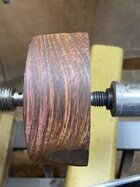
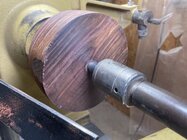
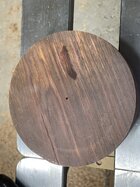
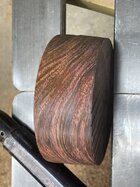
What is this wood species?

Joined
Nov 22, 2023
Messages
824
Likes
5,793
Location
Morganton, NC
First time I have ever had to ask this question. I purchased several exotic blanks from someone several years ago. This is the only one left and was thinking of using it for the top on a lidded piece.
I am allergic to Morado which is a Bolivian Rosewood and this looks like it could be in the rosewood family. I turned just enough to get the wax off of it and expose the grain. It is dense, heavy for its size, and fairly hard. Size is 5-11/16” x 2-1/8” and weighs 2.2 pounds.
The oil in rosewood sends me to the doctor to get shots so I’m not turning anymore rosewood. This is the only wood I seem to have a reaction too and I’ve turned several exotic woods.
I’m a little hesitant to turn this so there’s a chance someone is going to get a free piece of wood😁

1770499399561.jpeg

1770499346013.jpeg
 
Could be Etimoe? Which is also known as African Rosewood. The blanks I have gotten have less black and more tans in them but it sure looks similar.

I am far from an expert.

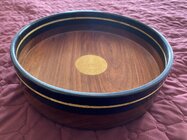
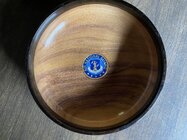
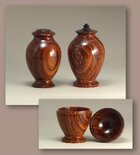
These are a few bowls I have done using Etimoe Blanks.

Bob

IMG_1137.jpeg

IMG_1439.jpeg
 
Looks like Cocobolo to me.

It would have a pretty distinctive sweet smell (sweet to me anyway).

I’d be happy to pay shipping if you want to send it my way! Send me a PM if you want to get rid of it!
 
Looks like Cocobolo to me.

It would have a pretty distinctive sweet smell (sweet to me anyway).

I’d be happy to pay shipping if you want to send it my way! Send me a PM if you want to get rid of it!
Now it could be cocobolo, it did have the sweet smell. It’s been a couple years since I turned cocobolo but it didn’t have the streaks and was mostly black.
If it is coco I’ll have to rethink what I want to use it for!
 
FWIW, African Blackwood is in the rosewood family, as well. Back in the day when regular people could afford to buy these woods, the word on rosewoods was, "It's not whether you'll become allergic to rosewoods, it's when." If you're allergic to one, you probably should assume you're allergic to all of the genus Dalbergia. Some of us can be OK if we use maximum respiratory protection, but not everyone. Really a pity, given how wonderful they family is to work and how attractive.
 
Interestingly Morado is not in the Rosewood family, although anyone can be sensitive to “just about any” wood species. There’s plenty of folks sensitized to Walnut among other species. Yes, the Rosewoods , and many other exotics, can be more problematic than the domestic varieties we use more regularly like Cherry, Maple, etc.

I do know an inordinate amount of folks who mention Cocobolo as a “super-sensitive”species in the Rosewood family. There’s people that can’t be in the same room where the dust is without sneezing and getting itchy.
 
It looks much like Cocobolo to me too, at least looks much like some I have. HOWEVER, the end grain pores look large to me and too open. I usually turn it in spindle orientation (boxes, etc) so I don't have much experience with cutting across the end grain. Under the microscope many pores are often packed with a transparent resin that often looks orange. Maybe read the Identifiction section on this page:

But as with many species, there is much variation (and lots of look-alikes).

One thing very distinctive to me is the smell of Cocobolo when sanding a patch, bandsawing, or turning. Once smelled, it's hard to forget!
Maybe take it to a club meeting and ask others.

Another good website for seeing the color, grain, and figure of different species is Hobbithouseinc.

Note that a US citizen can send a sample of wood to a US laboratory for professional identification. I did this once to verify a species when learning to ID.

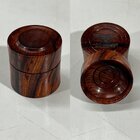
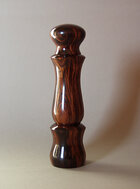
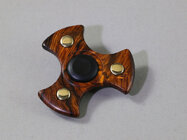
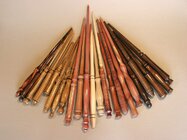
Some things I've turned from Cocobolo (I LOVE the way it turns).
1770516986687.jpeg
1770517034804.jpeg
1770517058073.jpeg
One of these (from 2008) is Cocobolo - the one on the left.
1770518624978.jpeg

Some people are highly allergic to Cocobolo (and other rosewoods). One guy refused to turn on any lathe that had ever had Cocobolo on it. A friend got so sensitive to it and some other species he gave up woodturning.

I've have a fairly large stash acquired almost by accident and have turned a bunch over almost two decades. (The seller had it labeled as Claro Walnut from California and I didn't know any better at the time. I bought it all since it looked nice, felt dense, and was inexpensive!) Although I have lots of respiratories sensitivities and can get asthma almost from looking at some things (hay, pollen, grasses, animal dander, etc) I've not yet been affected by Cocobolo.

One non-respiratory test for wood sensitivity: put a little dust on the skin (the inside of your forearm, for example) and cover with a bandaid. If sensitive, after a while it will start to itch or show a mild rash. I found out I was mildly affected by eastern red cedar by getting some fine dust under a wrist watch.

JKJ
 
Back
Top