

• The forum upgrades have been completed. These were moderate security fixes from our software vendor and it looks like everything is working well. If you see any problems please post in the Forum Technical Support forum or email us at forum_moderator (at) aawforum.org. Thank you
  • February 2026 Turning Challenge: Cookie Jar! (click here for details)
  • Congratulations to Dean Center for "After Life" being selected as Turning of the Week for February 16, 2026 (click here for details)
  • AAW Symposium demonstrators announced - If the 2026 AAW International Woodturning Symposium is not on your calendar, now is the time to register. And there are discounts available if you sign up early, by Feb. 28. Early Bird pricing gives you the best rate for our 40th Anniversary Symposium in Raleigh, North Carolina, June 4–7, 2026. (There are discounts for AAW chapter members too) For more information vist the discussion thread here or the AAW registration page
  • Welcome new registering member. Your username must be your real First and Last name (for example: John Doe). "Screen names" and "handles" are not allowed and your registration will be deleted if you don't use your real name. Also, do not use all caps nor all lower case.

What Lind of wood is this?

Joined
Feb 25, 2025
Messages
634
Likes
792
Location
Jackson, MS
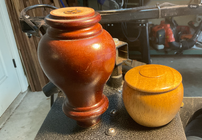
I kept the legs from an old ottoman that was thrown away and decided to turn one today. It was extremely dry but was a pleasure to turn. A bit dusty, about the hardness of cherry and little tear out. I’m pretty sure it was not made in the US and I don’t have a clue what the wood is.
 

Attachments

  • IMG_2890.png
    IMG_2890.png
    4.8 MB · Views: 24
I'm under an impression that luan/lauan, a tropical hardwood from SE Asia, is often used for furniture components like this. It is a common material for thin plywood as well. I may be wrong but that is my best guess. Also known as Phillipine mahogany, and other names.

I've done the same thing, scavenging legs off furniture heading to the dump.
 
I'm under an impression that luan/lauan, a tropical hardwood from SE Asia, is often used for furniture components like this. It is a common material for thin plywood as well. I may be wrong but that is my best guess. Also known as Phillipine mahogany, and other names.

I've done the same thing, scavenging legs off furniture heading to the dump.
I understood that there is no longer any true Luan. It was basically all used up for plywood and now they are using other species. If that is imported, my guesses are Acacia or Rubberwood (Parawood). Most likely Rubberwood.
Google says;
Key Details on Lauan Wood:
  • Availability: Due to excessive, unsustainable harvesting, authentic lauan is difficult to find.
  • Replacement: It is often replaced by inferior timber from Central and South America.
 
I don’t have a clue what the wood is.
The first step is to look at the end grain of a small scrap sample. The article on the Wood Database tells how to get started. I found the book Identifying Wood by R. Bruce Hoadley invaluable. All that's needed is a single edged razor blade and a magnifying glass.. I use a low power stereo microscope but any magnifying glass about 10x will do.

A look at the shaved sample of end grain can tell much, perhaps most importantly eliminate a huge number of species it can't be. Ring porous? diffuse porous? ray characteristics, tyloses in pores, etc. Wood density can help narrow things down. Also, any US citizen can also send off a small sample for free professional ID.
 
Back
Top